


October 23, 2026
8 min read
Without linked records and clear handoffs, finance and customer success must piece together facts that sales already holds.
Delays can start before a customer signs.
HubSpot reports that 36% of reps take more than a full day to deliver a finalized quote.
The cause may lie between product choice and price approval, not just in drafting the final document.
The quote to cash process runs from product and price through quote, approval, contract, invoice, and payment. Renewal and expansion extend that relationship beyond the first sale. Teams need clear records, owners, and rules before they add automation.
What the Quote to Cash Process Looks Like Inside HubSpot
HubSpot should make those links easy to follow while ERP and billing systems keep their agreed roles.
Each stage needs proof that work can move forward. Without an exit rule, the next owner must guess whether the record is ready.
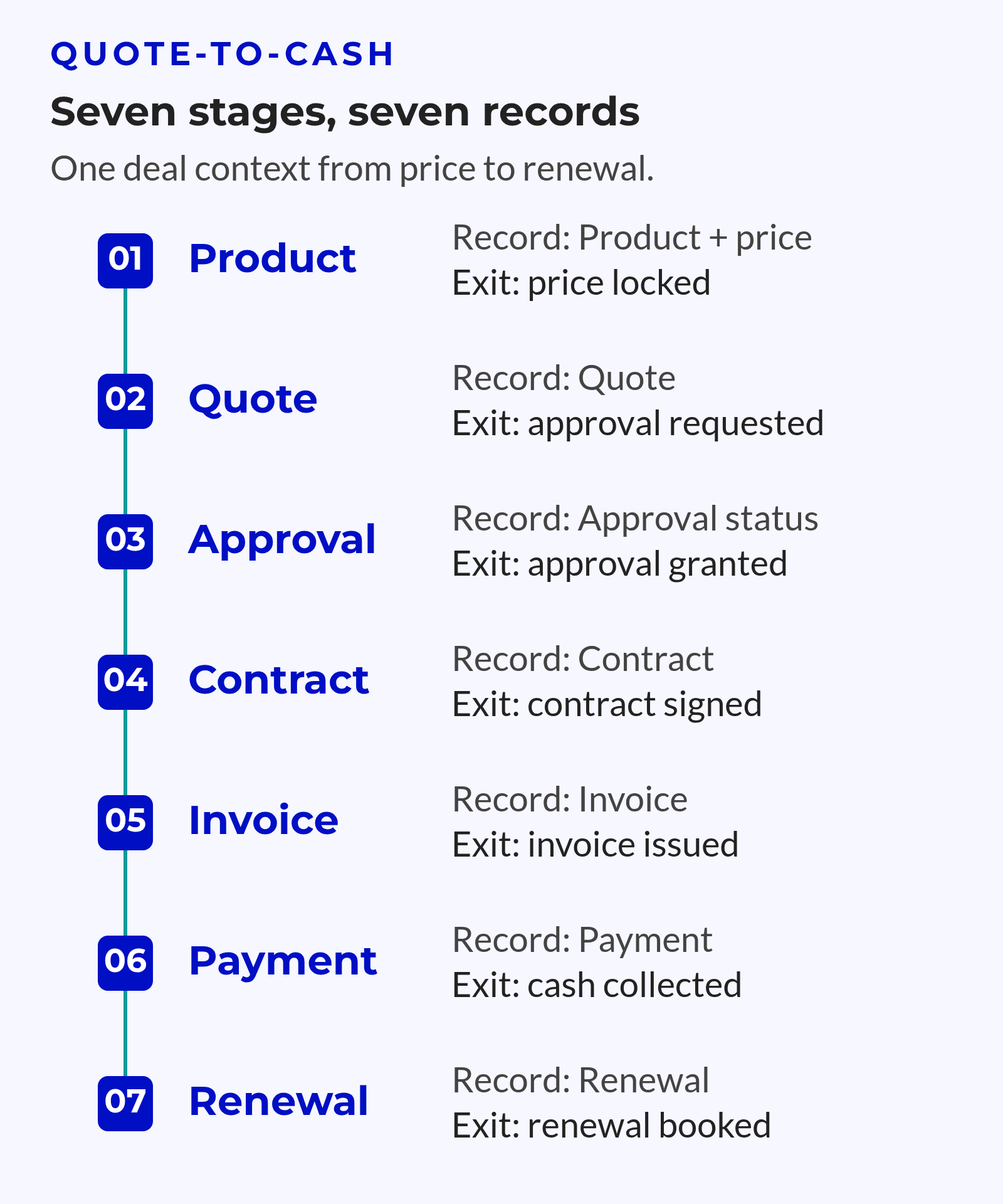
The Seven Stages From Product to Renewal
These are process stages, not default HubSpot pipeline stages.
Stage Exit Rules
- Product and price configuration: Set the package and price inputs. Move forward when scope, quantity, currency, and price basis agree.
- Quote creation: Build the proposed offer. Submit it when line items and terms pass the agreed checks.
- Approval: Keep the decision with the quote version under review. Proceed when all required reviewers record their decisions.
- Contract: Keep the final terms and signed document reference. Pass the record to billing when dates, value, and billing terms agree.
- Invoice: Create the billing record in the agreed system. Complete the handoff when its reference and schedule match the contract.
- Payment: Record the receipt and match it to the invoice. Close the step after finance resolves any mismatch.
- Renewal and expansion: Record the next decision about the agreement. Include its outcome, effective date, and any scope change.
CPQ means configure, price, quote. A sound cpq process supports the early stages, but contracts, billing, payments, and renewals need their own checks.
What HubSpot Owns and What Stays in ERP and Billing
Decide which system owns each record and field, rather than treating one platform as the source for everything.
System Boundaries
- Keep sales and contract context in HubSpot:
- Product choices, agreed prices, and quote history.
- Contract terms, renewal dates, and account owners.
- Keep financial authority where agreed:
- Invoice issuance and payment matching in finance systems.
- Ledger entries and accounting checks in ERP.
When those boundaries are unclear, teams can report different totals. HubSpot reports that only 32% of Finance and Sales teams close the month from the same numbers. Shared references matter more than copying every financial field.
Check the portal’s hubs, tier, permissions, and connected tools before choosing the build. An integration should align record IDs and status without creating competing ledgers.
The Objects and Records That Carry Commercial Context
A deal amount, a signed commitment, and collected cash answer different questions. Keep their records distinct so teams do not mistake one for another.
Standard Objects: Products, Quotes, Deals, Subscriptions, Invoices
Start with these record roles, then check which objects and features the portal supports.
Record Roles
- Product: Holds the catalogue offering, not the customer’s final agreement. A missing product reference makes package reporting harder.
- Line item: Holds the quantity and price for a sale. Without billing frequency, finance can need to ask how recurring charges work.
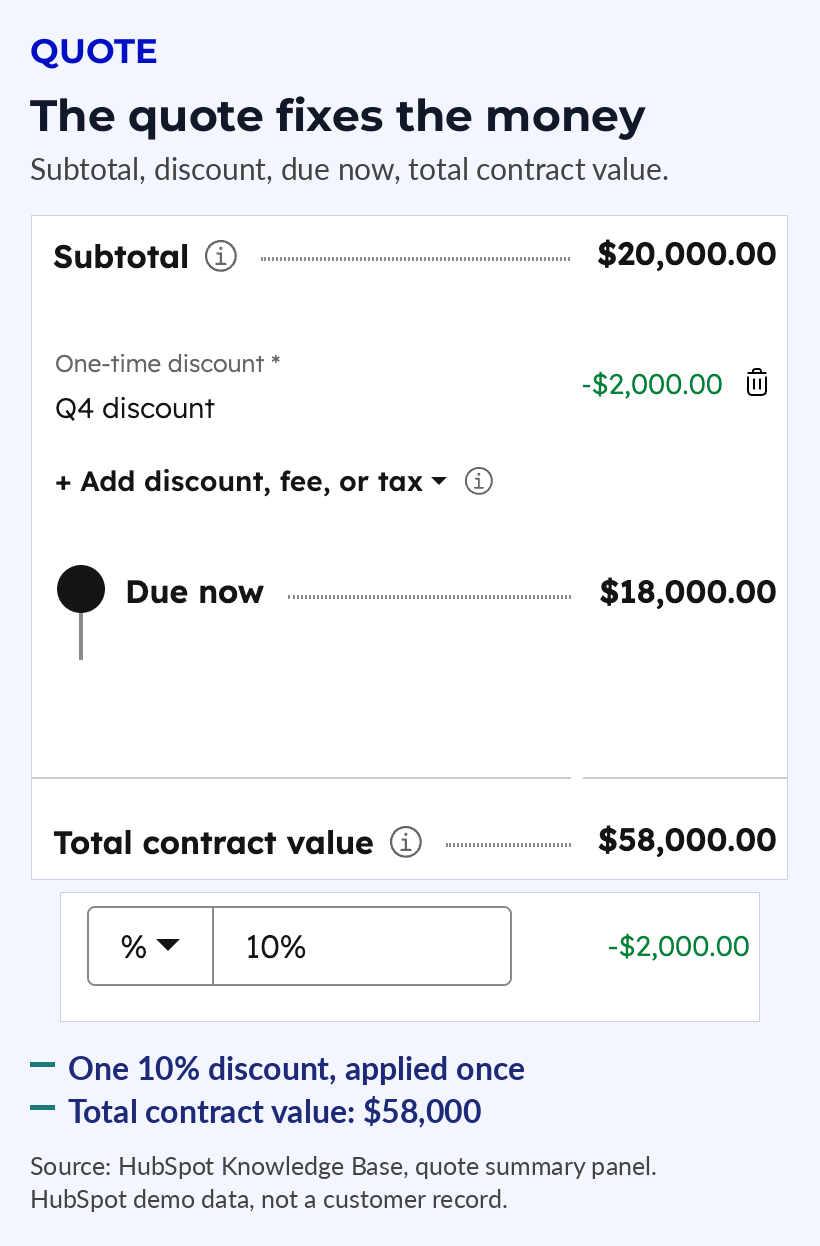
- Quote: Holds the proposed offer, not proof of payment. Without approval evidence, the team cannot explain why a reviewer allowed a deviation.
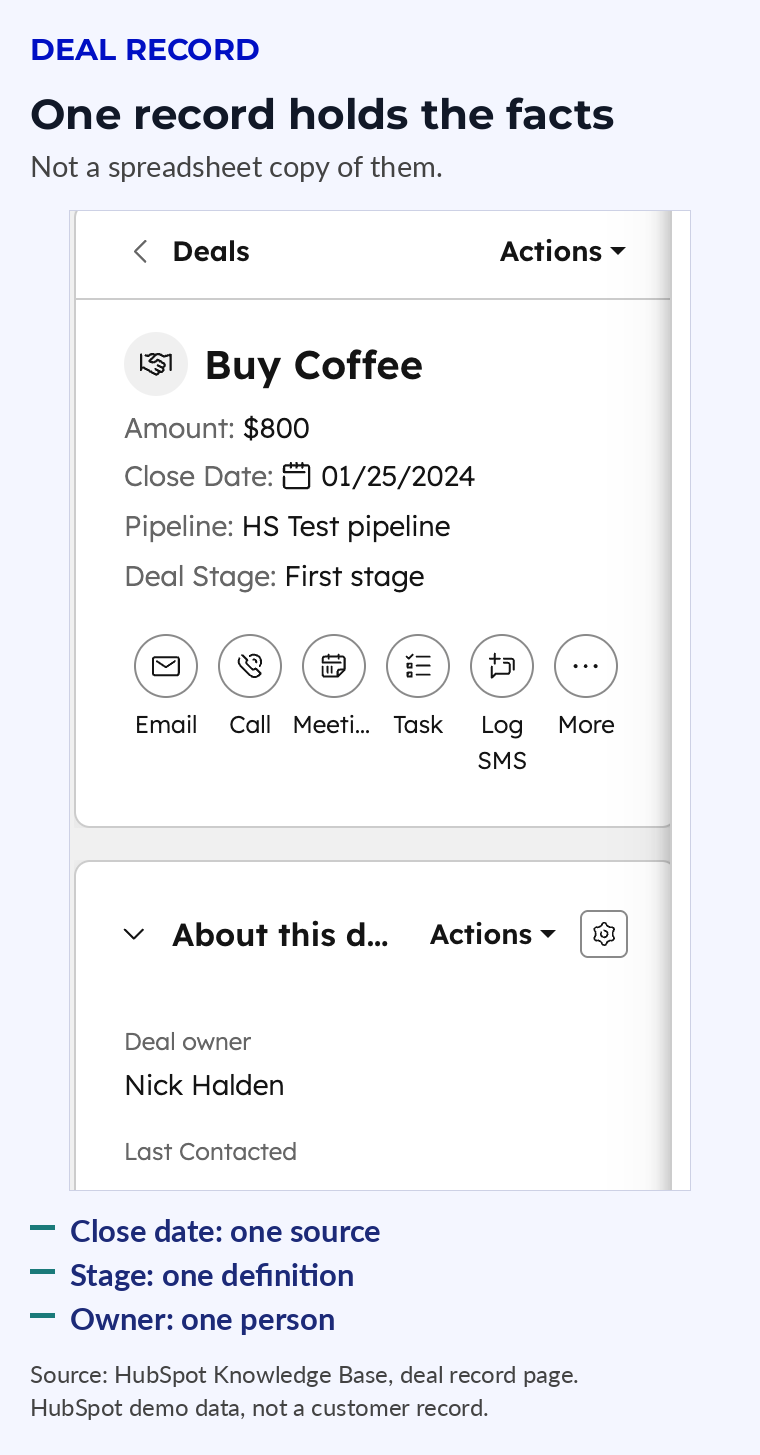
- Deal: Tracks the sales opportunity, not the full contract history. A missing contract link breaks the path from sale to signed commitment.
- Subscription: Holds recurring billing context where used. Term and billing links show what each recurring charge covers.
- Invoice: Holds the billed amount and payment terms. A missing external ID makes it harder to match records across systems.
Keep approval history with the quote so teams can trace a decision without searching email.
📊 Fact
“72% of revenue leaders say their AI tools lack complete, accurate revenue data.” AI needs linked, complete records to work with the full sales and contract picture.
Custom Objects and Properties You Actually Need
Use a contract record with clear ownership and rules when the current model cannot hold the agreement cleanly. Do not assume that “Contract” is a standard object in every portal.
Minimum Contract Context
- Keep the agreement details:
- Start date, end date, term length, and notice period.
- Committed value, billing frequency, and document reference.
- Keep the handoff details:
- Billing reference and assigned renewal owner.
- Amendment status and approved exception details.
The contract should preserve revenue context: what was sold, for how long, and who acts next. Add custom objects only when a distinct record needs its own history or owner.
Do Not Build
- A custom object for every document format.
- A parallel pipeline that copies contract status without a clear purpose.
- A second invoice ledger inside HubSpot.
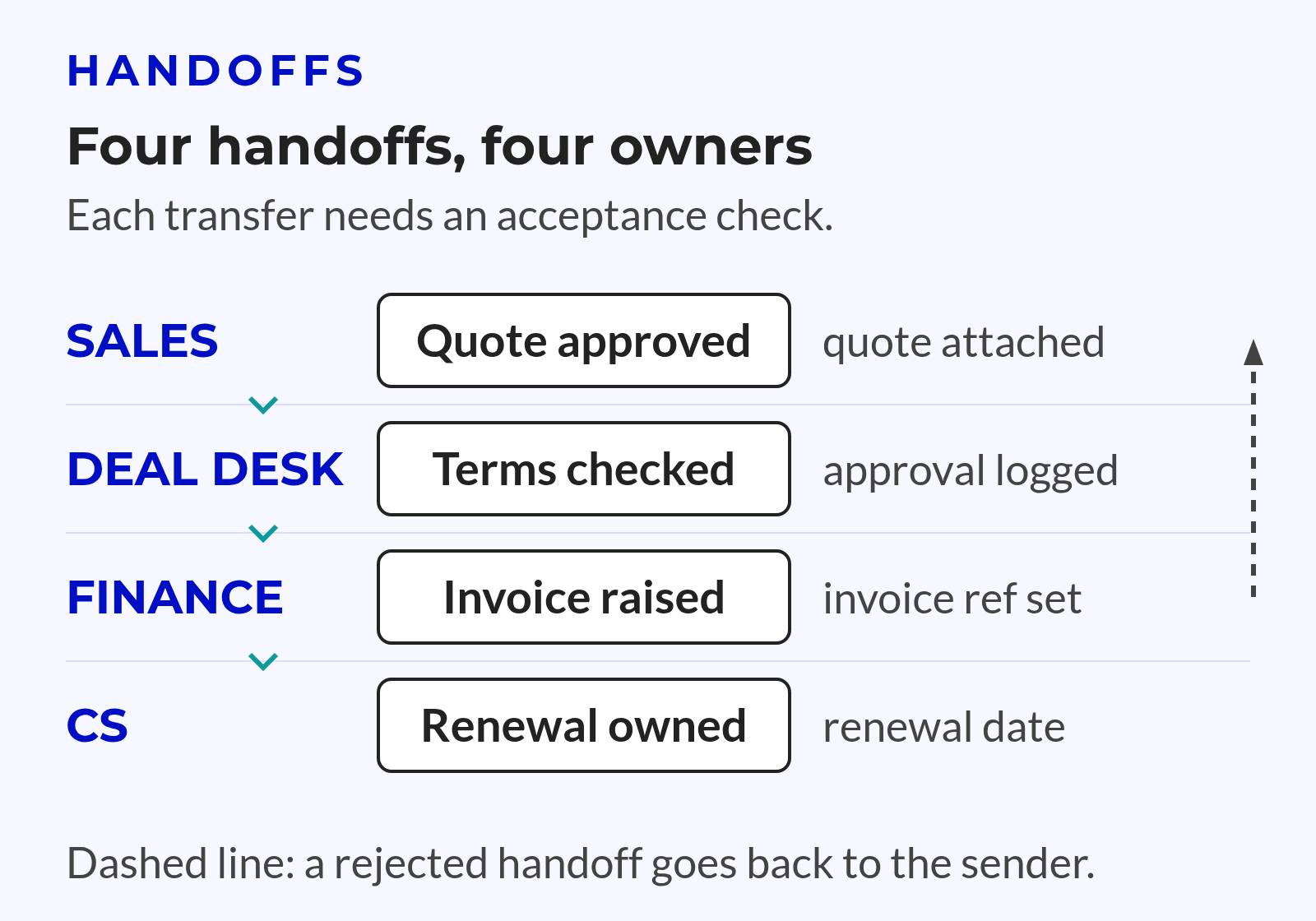
Owners, Entry Rules, and Exit Rules for Each Handoff
A handoff ends when the receiving owner accepts a complete record. A message or deal-stage change does not prove that acceptance.
Handoff One: Sales to Approval
The deal owner stays responsible until the reviewer records a decision. To enter approval, the quote must be complete, with products, prices, dates, and terms that agree.
Approval Evidence
- Record the request:
- Quote version and requested decision.
- Required approver role and submission time.
- Record the outcome:
- Decision, approver, and timestamp.
- Reason and any attached conditions.
These are proposed fields, not default HubSpot property names. Agree on names and storage locations before setting up workflows.
A revised quote must not inherit approval because an earlier version passed. Apply the agreed review rule when price, scope, term, or payment terms change.
💡 Insight
Approval belongs to a version of the offer, not to the deal that holds it.
CPQ quote governance needs role-based rules for discounts, term length, and non-standard payment terms. Keep the rules in a controlled location so each team follows the same policy. Sales Operations should document how deal desk operations route exceptions to the right approver.
Exception Controls
- Assign the decision:
- Name the approver role and backup route.
- Set an escalation rule for overdue requests.
- Keep the deviation history:
- Store the reason code, reviewer, and expiry date.
- Link the exception to the affected quote version.
An override needs both permission and a review schedule.
Without review, teams can keep using a temporary exception after its purpose has passed.
Handoff Two: Contract to Billing and Finance
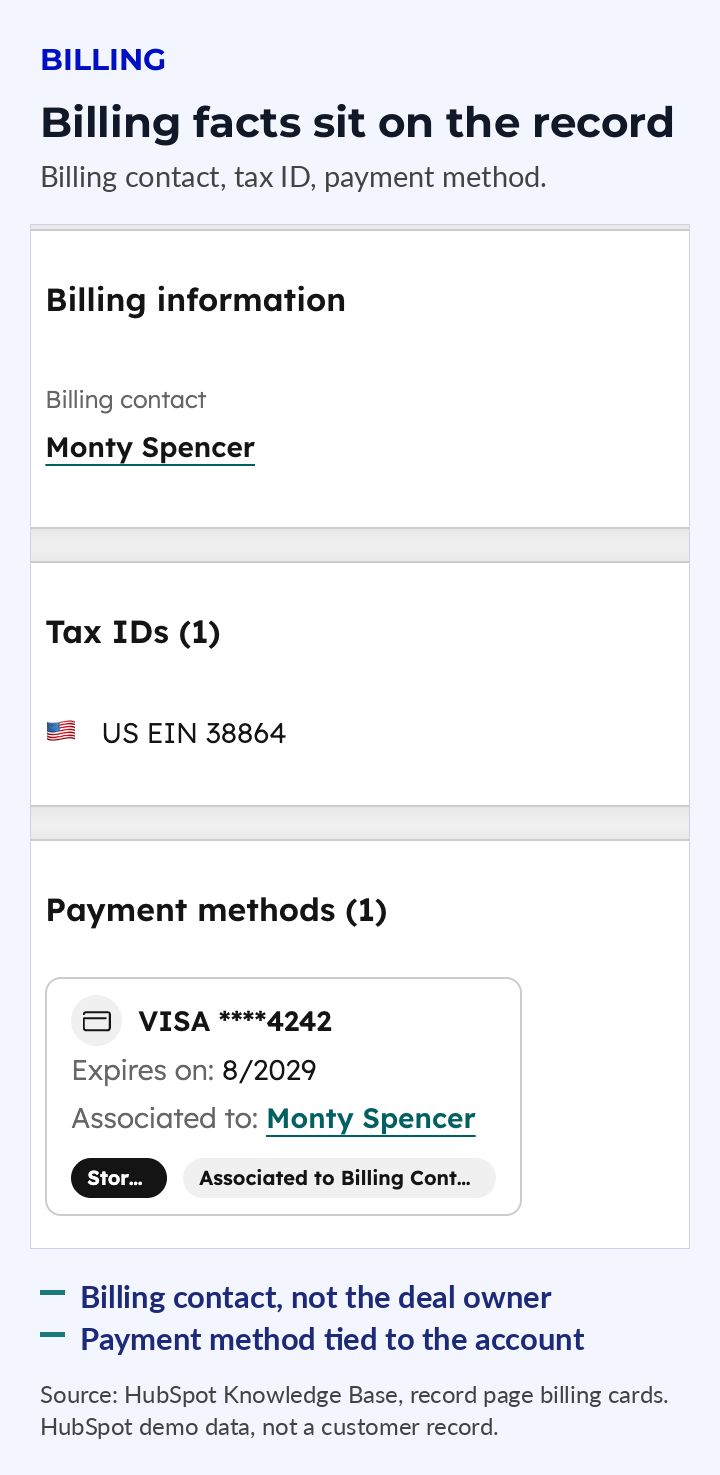
Finance owns invoicing, while RevOps owns the agreed record checks. The handoff starts with final approved terms and a signed document reference on the contract.
It ends when the billing schedule and reference IDs match the invoice.
A “closed-won” label cannot replace those checks.
Billing Acceptance
- Confirm the agreed terms:
- Check committed value, billing frequency, and payment terms.
- Check start dates and approved billing exceptions.
- Confirm the system links:
- Keep the customer and contract IDs that billing uses.
- Return the invoice reference and agreed status to HubSpot.
Payment matching needs a named owner too. In BillingPlatform’s survey, 60% report difficulty reconciling payments. That figure describes a payment challenge, not a HubSpot failure rate.
Finance should own payment matching and disputes, with HubSpot showing the agreed status.
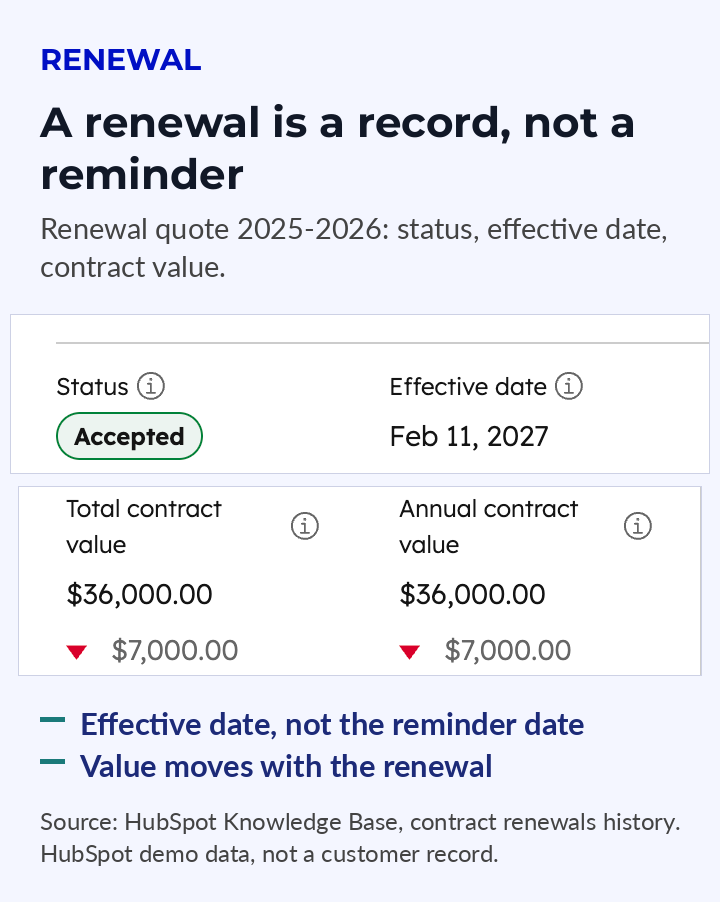
Delivery to Renewal
- Customer success accepts ownership when the customer is live and the contract record is complete.
- The contract holds dates, committed value, notice period, and renewal owner.
- The renewal decision records the outcome, decision date, and any scope change.
Keep amendments and their effective dates in the record’s history. Overwriting the original terms can leave finance and customer success working from different versions.
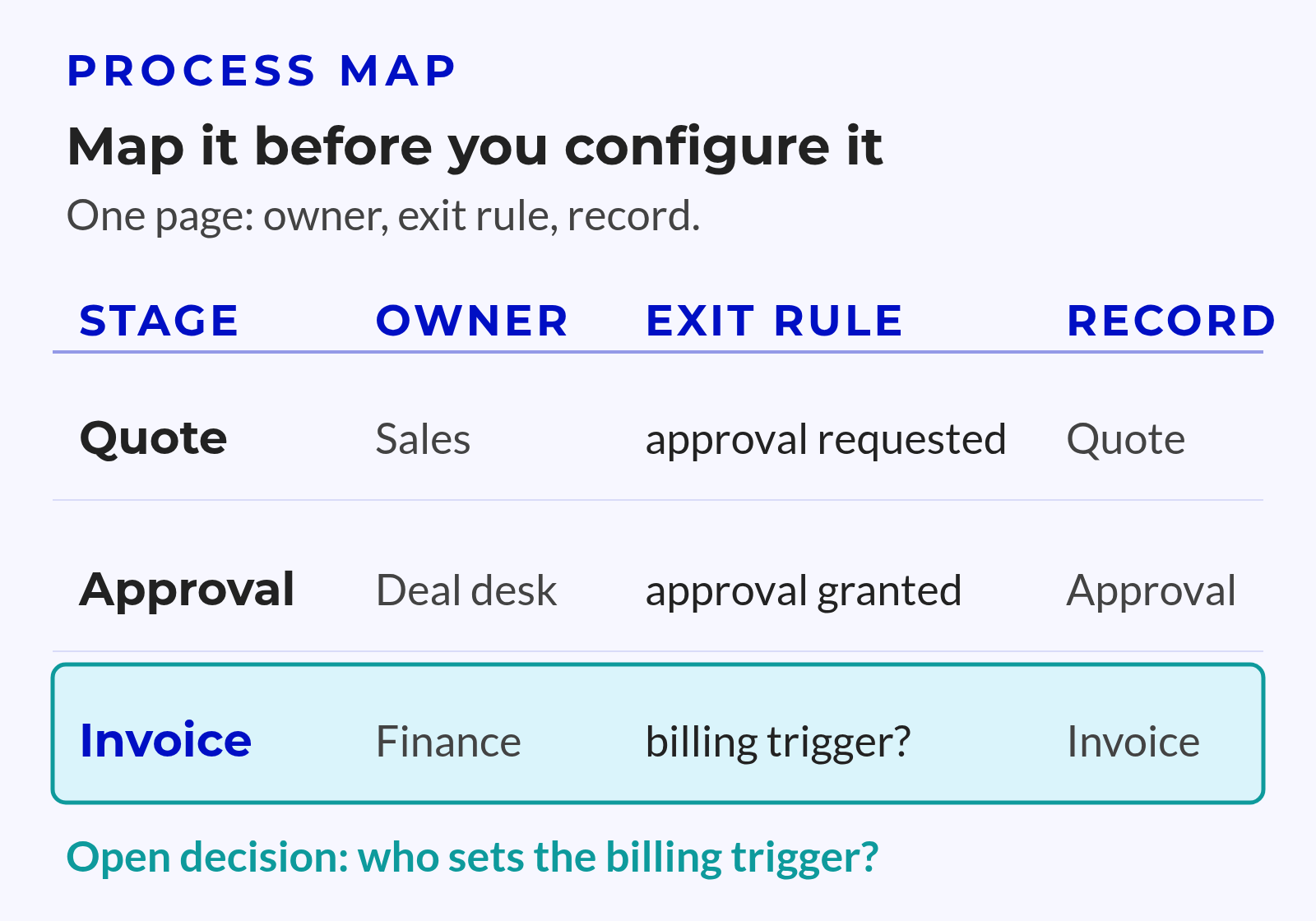
MAP the Process Before You Configure HubSpot
A process map exposes open decisions before they become workflow branches. Sales, finance, legal, and customer success should be able to read it without technical training.
A One-Page Process MAP That Teams Will Use
Build the map with the people who create, check, and receive each record. Use the same columns at every stage so gaps remain easy to spot.
| Stage | Owner | Entry Rule | Exit Rule | Record | System of Authority |
|---|---|---|---|---|---|
| Quote | Deal owner | Scope and pricing ready | Complete offer submitted | Quote | Agreed quoting system |
| Approval | Assigned approver | Complete quote version | Decision retained | Approval evidence | Agreed approval record |
| Contract | Contract owner | Terms approved | Signed agreement complete | Contract record | Agreed contract source |
| Billing | Finance owner | Contract accepted | Schedule and reference matched | Invoice reference | Billing platform or ERP |
| Renewal | Assigned success owner | Live customer and complete terms | Decision retained | Contract and renewal outcome | Agreed commercial record |
These are suggested roles, not universal job titles. Assign each row to a specific role holder and name a backup.
Keep unresolved rows visible.
A blank exit rule shows where the process still needs a decision. Writing “team to confirm” does not resolve who accepts the record or what they check.
Questions That Expose Missing Rules
A useful answer names a field, record, or written rule. “Finance handles that”. Gives the next person no way to check whether the work is complete.
Diagnostic Questions
- Who approves a discount above the standard tier?
- Which field proves approval for the current quote version?
- What event triggers billing, and who accepts the record?
- What changes when a contract is amended mid-term?
- Who maintains the renewal date and notice period?
- Where does the invoice reference live?
- Who resolves a failed sync or mismatched status?
Buyers may move without a rep guiding each step. Gartner reports that 67% of B2B buyers prefer a rep-free experience. That preference does not remove approval or billing duties.
Clear rules still need to govern what happens behind the buyer-facing process.
💡 Tip
Test the map against a revised quote and a mid-term amendment, not only a clean new sale.
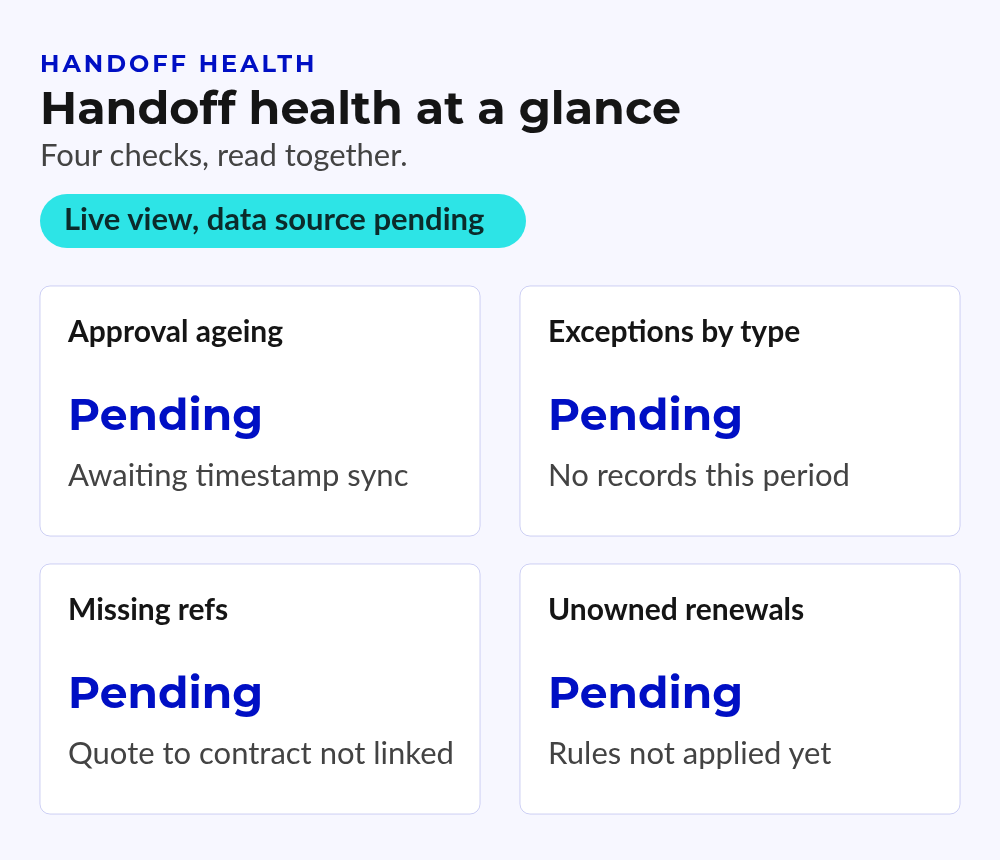
The Reporting Layer That Makes the Process Trustworthy
Use CRM reporting to check whether records and handoffs work in practice. If nobody owns the source fields, a dashboard reflects data-entry habits rather than the true state of an agreement.
Metrics That Show Handoff Health
Focus on failures that someone can fix.
Each metric needs an owner and a clear decision when it flags a problem.
| Health Check | Owner | Failure Detected | Decision |
|---|---|---|---|
| Quote-to-approval cycle time | Sales operations owner | Requests age without escalation | Resolve routing or capacity gaps |
| Approval exceptions by type | Approval policy owner | Overrides repeat or spread | Review policy and exception use |
| Contracts missing billing references | Finance owner | Signed work never reaches billing cleanly | Repair the handoff |
| Renewals without assigned owners | Customer success owner | Upcoming decisions lack accountability | Assign ownership before the notice deadline |
Define which timestamps start and stop cycle time. State how rejected, withdrawn, and revised quotes affect the measure. Otherwise, teams can read the same number in different ways.
Missing data is not a healthy zero.
A contract with an end date but no notice period can still hide renewal risk. The contract owner must fill that gap before teams can trust the renewal view.
Invoice and payment status also need clear owners. Atradius reports that overdue invoices affect 43% of credit-based B2B sales among surveyed US companies. That US finding is not a benchmark for UK or EMEA teams.
It does show why a signed contract alone cannot tell leaders whether cash has arrived.
Why Dashboards Fail Without Record Ownership
Assign an owner to each field used in reporting. State who updates it, which source takes priority, and how teams resolve conflicting values.
Build visibility first, agree on operating rules, then automate. ERP and billing keep their authority unless teams make a separate decision to change it.
Pilot Sequence
- Prove visibility:
- Select contracts that include amendments and exceptions.
- Link product, quote, approval, contract, and billing references.
- Enforce the model:
- Turn accepted entry and exit rules into supported checks.
- Test rejection, reapproval, failed syncs, and owner changes.
- Automate agreed actions:
- Route complete records and flag failed handoffs.
- Add AI only where inputs, permissions, and review routes support it.
Train each receiving owner to accept or reject a handoff from the record itself. Keep training current as rules and roles change after launch.
Release depends on a readable record and a tested transfer, not just a finished dashboard.
Frequently Asked Questions
The right HubSpot setup depends on which records teams need, who owns them, and where finance keeps authority.
Can HubSpot Manage Quote-To-Cash Without Replacing ERP?
HubSpot can give teams a working view of sales and contract context while ERP and billing systems keep financial authority. The design should link quotes, approved terms, contract dates, invoice references, and renewal owners. Check portal access and connected tools before choosing native records, custom records, or integrations.
What Should We Fix Before Automating Quote-To-Cash?
Fix missing owners, unclear approval rules, and broken links between quotes, contracts, and billing first. Test the model with agreements that include revisions and exceptions. Automation can then enforce accepted rules, with a clear route for incomplete records and failed handoffs.
Conclusion
A dependable quote to cash process lets teams trace an offer through approval, signed terms, billing, and payment. Named owners and tested exit rules make those handoffs clear without forcing finance to replace its systems.
Revenue leaders gain a view that distinguishes proposed value, signed commitments, and payment status.
Key Takeaways
- Each record has a defined role and source of authority.
- Each handoff has an accountable owner and an acceptance rule.
- Approval versions, contract terms, billing references, and renewal owners stay linked.
- Handoff measures expose gaps before automation repeats them.