
September 6, 2026
7 min read
Native capability sets a firm boundary for the content covered here.
Governance design must begin with commercial policy, not a list of software features.
A useful rule reflects how the company sells under normal conditions. A weak rule treats normal deals as exceptions and sends them to leaders for routine approval. The goal is a system that protects value, handles genuine risk, and lets sound deals move quickly.
What Quote Governance Actually Controls
Quote governance defines which commercial decisions sellers can make independently. It also determines when a decision requires review, who reviews it, and what evidence they need. This section separates meaningful control from approval theatre.
Governance Covers Decisions, Not Documents
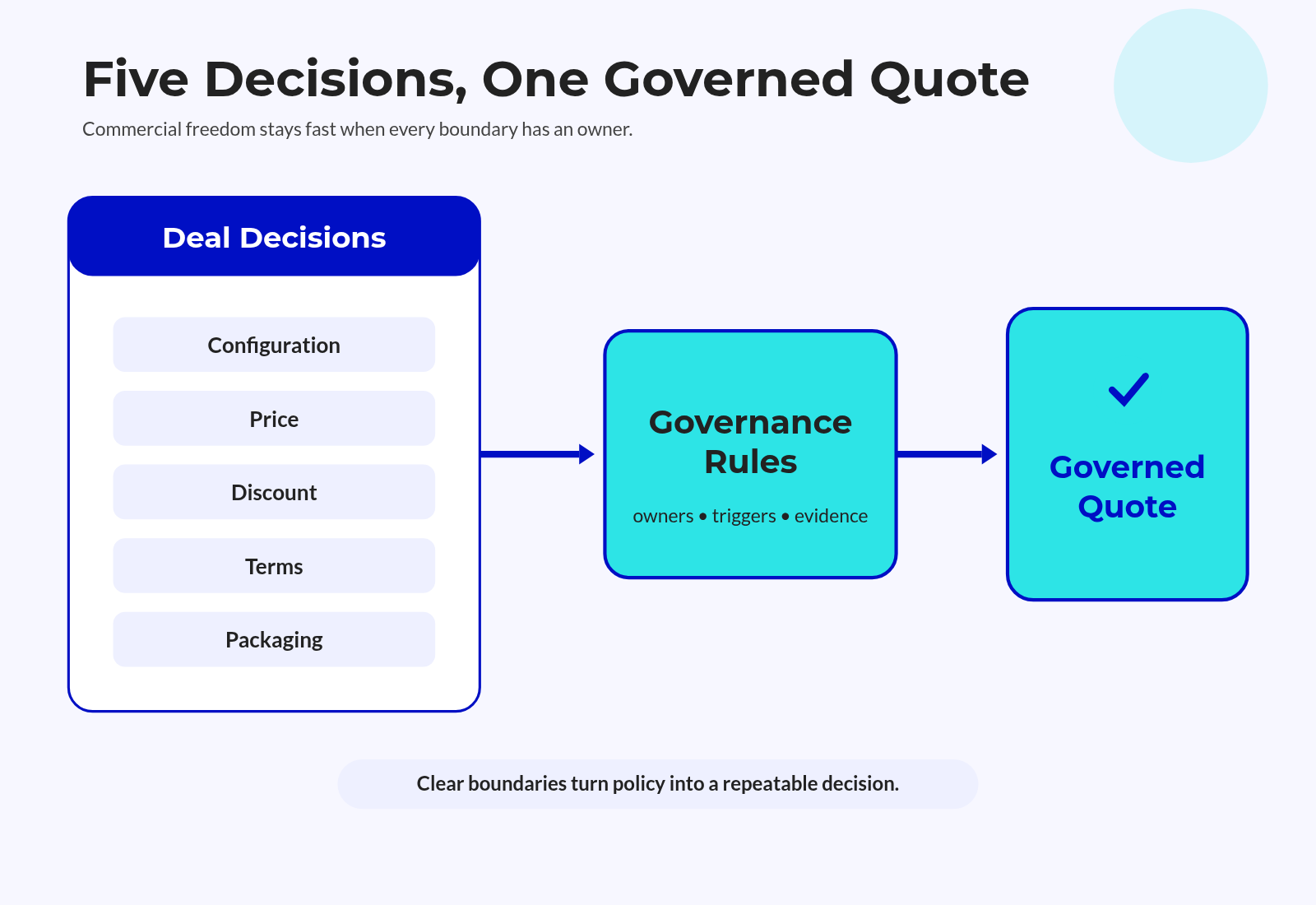
A quote is the output of several connected decisions. These decisions shape the offer, price, terms, margin, approval path, and customer commitment.
Readers who need the category background can review what CPQ means without repeating the definition here. Governance begins after that foundation, when the business decides which choices require control.
Five decisions need clear ownership:
- Configuration: Which products, services, and quantities can appear together?
- Pricing: Which price list, currency, and commercial model apply?
- Discounting: How much authority does each role receive?
- Terms: Which payment, renewal, delivery, and liability terms are allowed?
- Exceptions: Which unusual requests need finance, legal, product, or executive review?
Each decision needs an owner and a measurable trigger. “Manager approval required” is not enough because the trigger remains open to debate.
A strong trigger names the condition and required response. It also records why the decision departs from the standard offer.
Controls Must Match Commercial Reality
A discount threshold becomes useless when sellers routinely cross it during ordinary deals. Instead of protecting value, the threshold creates a queue.
💡 Insight
Approval volume is often a policy signal, not a seller discipline problem. When routine deals require exceptions, the standard rule no longer reflects the market.
Governance should answer four practical questions:
- What can a seller approve?
- What must a manager review?
- What requires specialist input?
- What must the company refuse?
The answers should reflect actual deal patterns. Review recent quotes, approved exceptions, lost deals, and margin outcomes before setting a new policy.
The Four Types of Quote Rule
A single approval workflow cannot govern every type of commercial risk. Quote rules fall into four categories, each requiring different logic. Mixing them creates duplicate reviews and unclear ownership.
Separate Product and Commercial Logic
Configuration rules protect the integrity of the offer. They apply compatibility and incompatibility rules to prevent sellers from building combinations that cannot be delivered, supported, billed, or renewed.
Commercial rules protect economic and contractual value. They govern price, discount, margin, payment terms, and other commitments.
| Rule Type | Main Question | Typical Owner | Best System Response |
|---|---|---|---|
| Configuration | Can these items work together? | Product or solutions team | Block or guide the choice |
| Pricing | Is this the correct base price? | Commercial operations | Calculate automatically |
| Approval | Who can accept this risk? | Sales, finance, or legal | Route only when triggered |
| Exception | Should policy change for this case? | Named policy owner | Record, review, and learn |
This distinction matters because commercial approval cannot repair an invalid product setup. Likewise, a valid product bundle can still produce an unacceptable margin.
Platforms in the CPQ category support product, pricing, and proposal workflows, as shown in Infor’s CPQ overview. The company must still define its authority model and commercial boundaries.
Use the Right Response for Each Rule
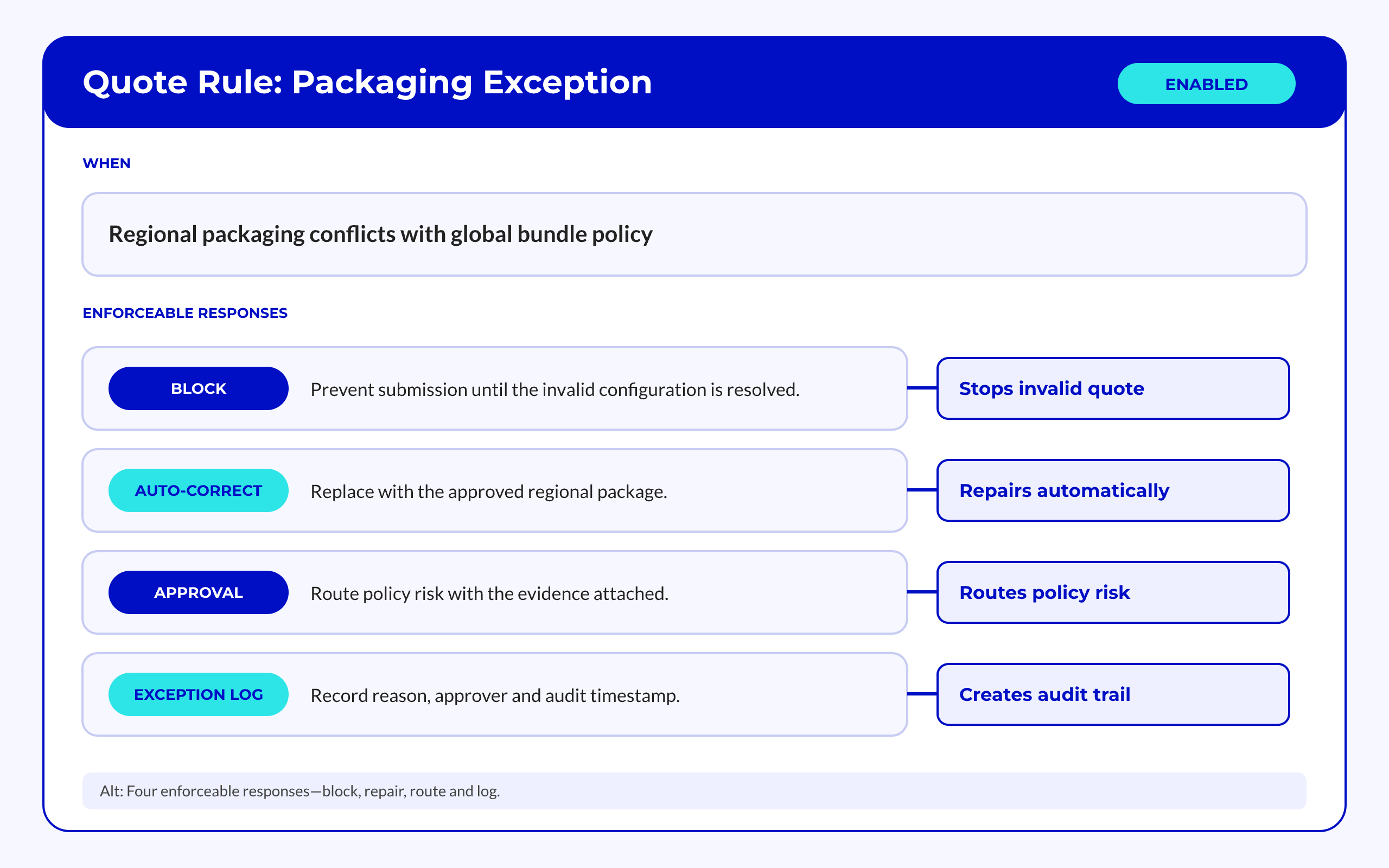
Not every rule should trigger an approval. Some choices require a hard block; others call for a warning or guided correction.
Choose the response based on risk:
- Block the quote when delivery is impossible.
- An item requires a missing dependency.
- Two options cannot operate together.
- Correct automatically when the answer is deterministic.
- The wrong price list was selected.
- A required fee was omitted.
- Request approval when a leader can accept the trade-off.
- Discount exceeds role authority.
- Payment terms create cash risk.
- Log the exception when the pattern requires policy review.
- A common bundle lacks formal approval.
- A regional need conflicts with global packaging.
📊 Fact
A warning that sellers can ignore is not a control. Reserve warnings for guidance, not conditions that make a quote invalid.

Designing an Approval Matrix People Do Not Route Around
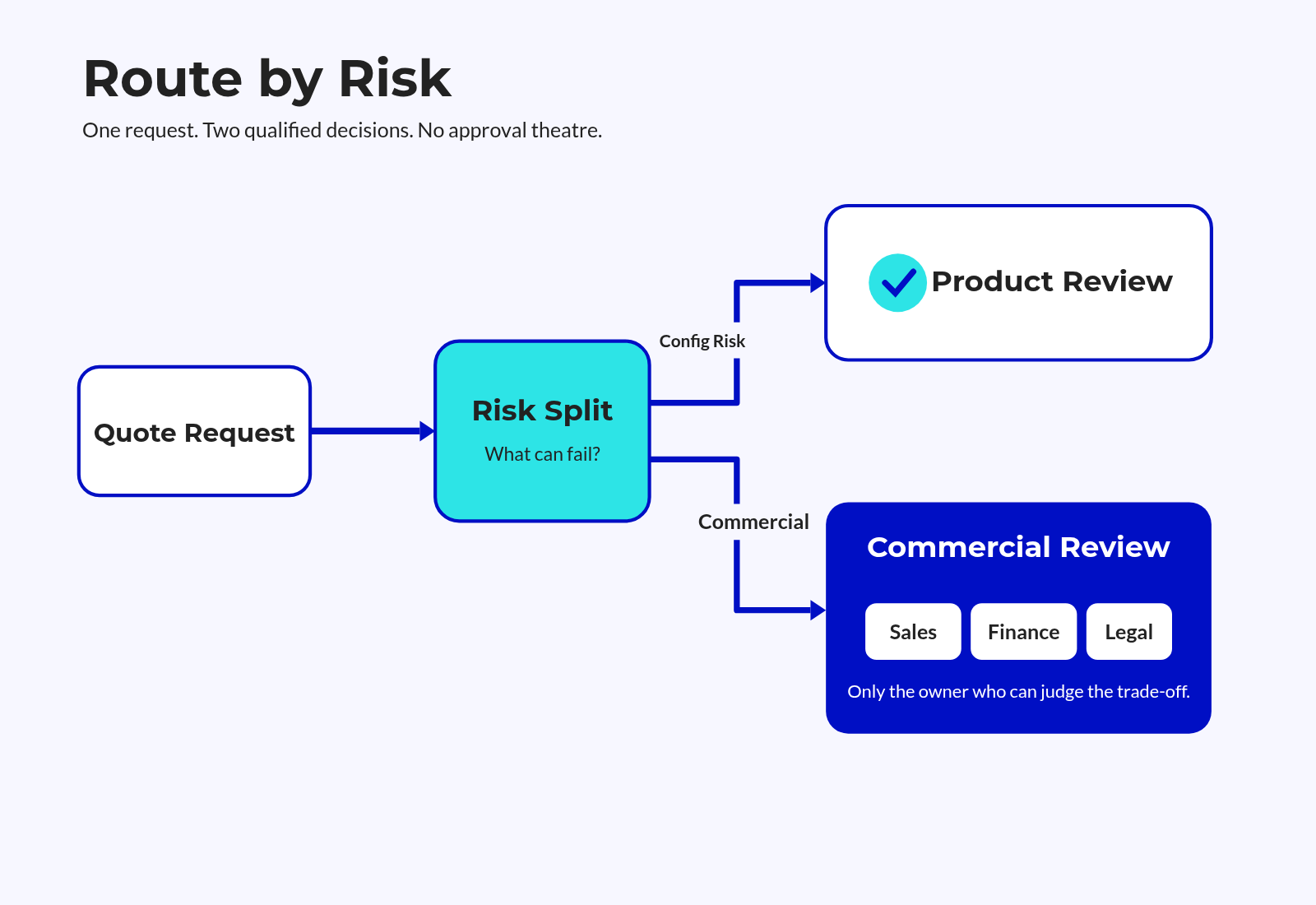
An approval matrix should send each risk to the person qualified to judge it. It should not force every unusual deal through the entire leadership chain. Effective routing depends on risk, value, role, and evidence.
Route by Risk, Not Title Alone
Simple title-based approval creates bottlenecks. A sales director can understand the account strategy but lack authority over legal terms or delivery risk.
Route each issue to its actual owner. Gartner’s CPQ application market reviews show that buyers assess several products for complex quoting needs. Tool selection alone does not resolve the company’s internal policy.
A practical approval matrix includes:
- Trigger
- Discount band
- Margin result
- Contract term change
- Packaging exception
- Required reviewer
- Sales manager
- Finance
- Legal
- Product or delivery owner
- Evidence
- Commercial reason
- Competitor context
- Expected expansion
- Delivery impact
- Deadline
- Expected response window
- Escalation owner
- Delegate during absence
The reviewer should immediately see which condition fired and which values it affected. They should not need to rebuild the quote to understand the request.
Keep Configuration and Commercial Reviews Separate
Product rules determine whether the offer works. Commercial rules determine whether the company should accept its price, terms, and risk.
Compatibility and incompatibility rules belong at this boundary. They should guide or block product choices before the quote reaches a commercial approver.
Reduce routing friction with these checks:
- Does one approval cover one clear risk?
- Can the reviewer approve without requesting missing facts?
- Does the route skip people who add no decision?
- Can a delegate act when the owner is absent?
- Does rejection explain the next valid option?
💡 Tip
Measure how many requests return because information is missing. A high return rate usually means the approval form lacks the context reviewers need.
Margin Floors and Discount Authority
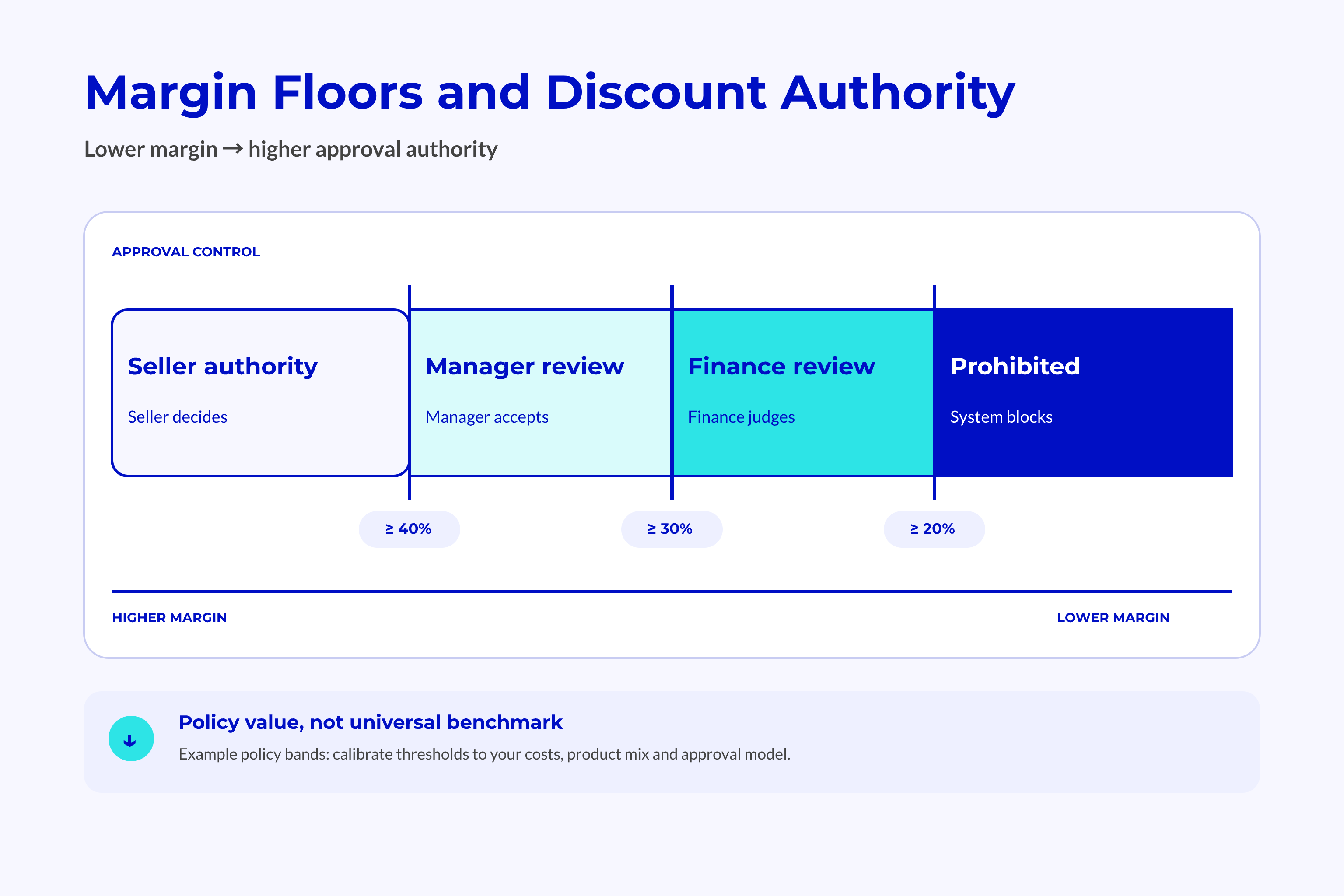
Discount and margin are related, but they are not interchangeable controls. The same discount can produce different margins across products, regions, and service mixes. Enterprise CPQ governance must evaluate both.
Set Authority Around Economic Impact
Discount authority defines how far a seller can move from the approved price. Margin floors define the lowest economic result the company will accept.
A seller can stay within the discount limit and still create a weak margin. This often happens when delivery costs, partner fees, support work, or bundled services vary.
Use several inputs when setting authority:
- Role and experience
- Product or service category
- Deal value and term
- Delivery cost
- Region and currency
- New sale, renewal, or expansion
- Strategic account status
- Payment timing
The policy should also specify whether authority applies per line, package, or full quote. Without that distinction, sellers can shift discounts between lines while leaving the visible total unchanged.
DealHub’s enterprise CPQ guide highlights the complexity created by large product sets and approval requirements. That complexity makes clear ownership of calculations essential.
Create Floors That Support a Decision
A margin floor should do more than turn a field red. It should tell the seller what needs to change and show the approver why the result can still be acceptable.
A useful floor response offers valid paths:
- Reduce the discount.
- Change the product mix.
- Remove a costly service.
- Shorten or extend the term where policy allows.
- Change payment timing.
- Submit a documented exception.
The approval record should preserve the original margin, final margin, reason, and reviewer. This history allows RevOps to compare approved trade-offs with later outcomes.
📝 Note
Margin data is reliable only when cost inputs have clear owners and refresh rules. A precise formula based on stale costs creates false confidence.
The Exception That Keeps Getting Approved
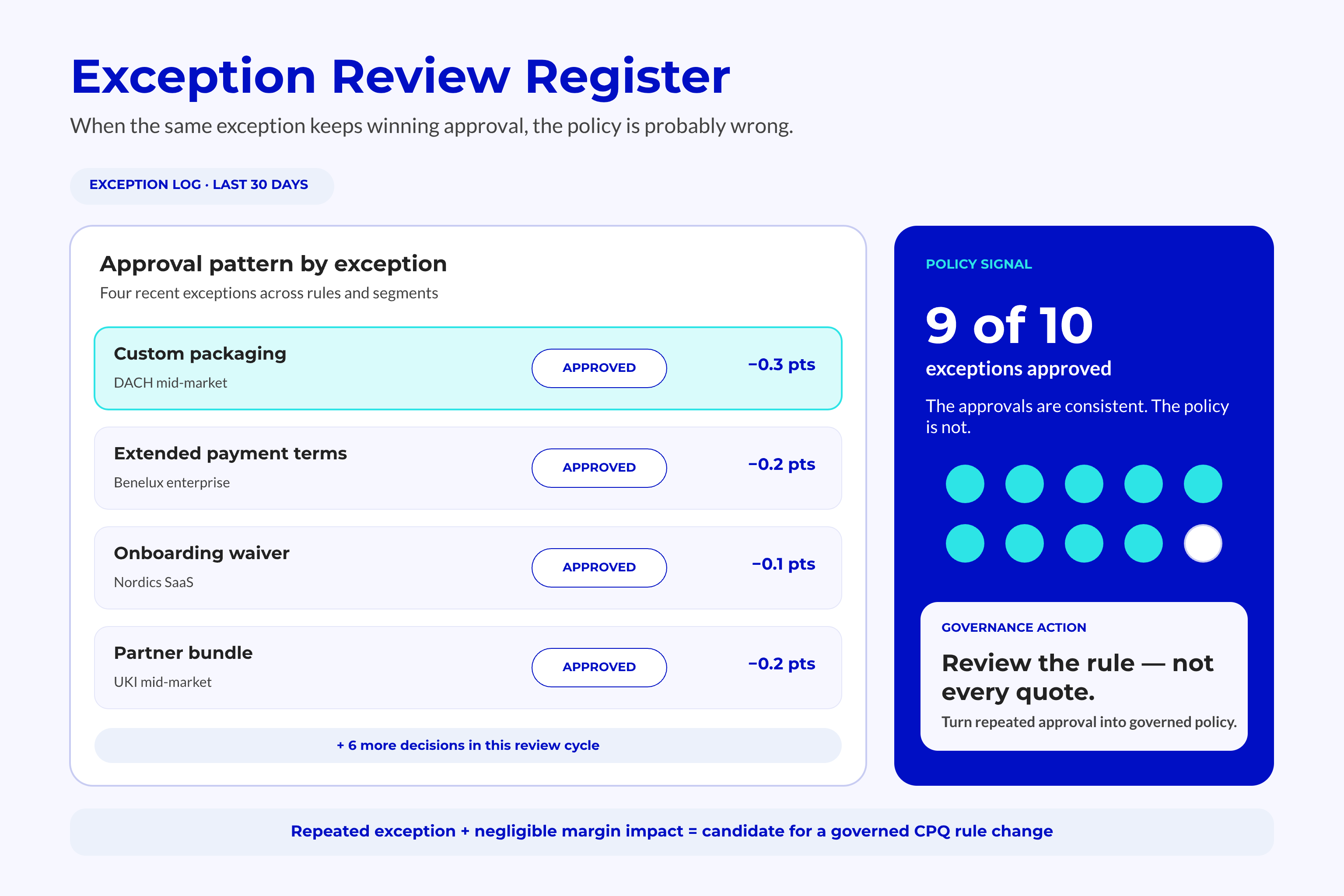
A repeated exception provides evidence about the policy. It can reveal that packaging, pricing, authority, or market assumptions have changed. Treating every request as an isolated case hides that signal.
Distinguish Valid Exceptions From Policy Debt
Some exceptions should remain rare. A new market entry, unusual procurement requirement, or strategic contract can justify special review.
Other exceptions recur because the approved offer no longer matches buyer needs. The company then pays an approval cost on every affected deal.
Review repeat exceptions by pattern:
- Same product combination
- Same buyer segment
- Same region
- Same payment request
- Same service adjustment
- Same approver
- Same reason for approval
When a pattern repeatedly receives approval, leaders must make a policy decision. They can formalize it, narrow it, price it correctly, or stop approving it.
An enterprise CPQ system can enforce commercial policy through rules and approval workflows, but accountable business leaders must define and approve that policy. Governance requires a named owner who reviews exception data and updates the standard offer.
Turn Exception History Into Policy Change
Create an exception register with a focused set of required fields. The register should connect each request to the quote outcome.
Capture these details:
- Rule that was broken
- Reason for the request
- Buyer or segment context
- Margin and revenue impact
- Approver and decision
- Conditions attached to approval
- Final deal outcome
Review the register on a fixed cadence. Look for volume, approval rate, response time, margin impact, and recurring reasons.
💡 Insight
An exception approved almost every time is usually an undocumented offer. Keeping it outside the catalogue adds work without reducing risk.
What Changes at Enterprise Scale
Scale adds markets, currencies, business units, channels, products, and specialist reviewers. It also makes local workarounds harder to detect. Enterprise CPQ needs stronger policy ownership without forcing every unit through one rigid route.
Use a Global Core with Local Boundaries
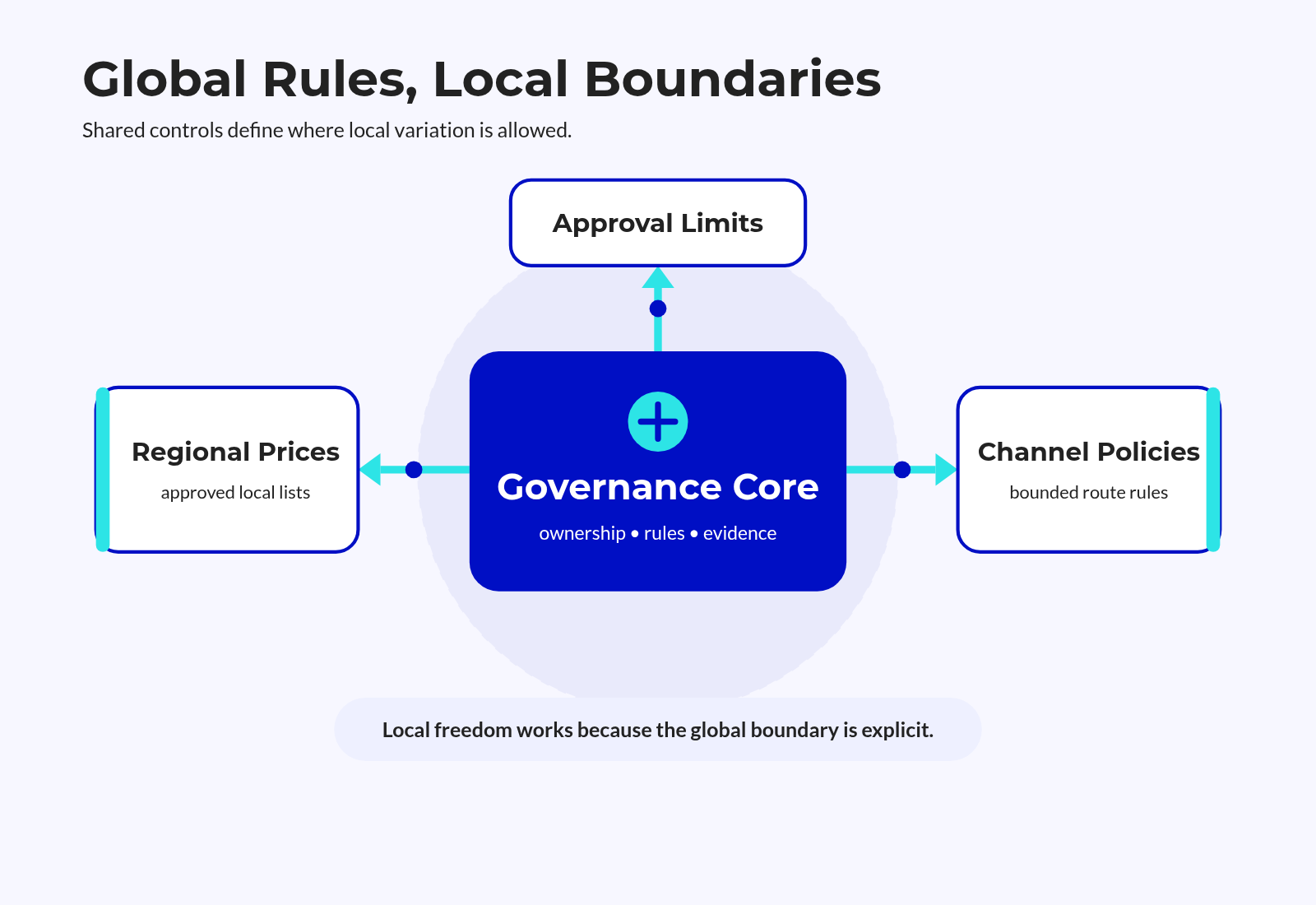
Global governance should define the non-negotiable controls. Local teams can manage approved variations within those boundaries.
The global core often covers:
- Margin calculation method
- Required quote data
- Legal red lines
- Approval evidence
- Audit history
- Exception categories
Local policy can cover:
- Currency and price lists
- Regional discount bands
- Tax and payment practices
- Channel rules
- Approved packages
- Named local reviewers
This model gives leaders a shared control layer while accommodating real market differences. It also makes deviations visible rather than hiding them in spreadsheets.
Build Governance Before More Automation
Large systems can automate poor policy at high speed. The result is more approvals, more alerts, and more work across a larger company.
Configure One’s enterprise CPQ overview reflects the role of guided selling and complex configuration at scale. These capabilities work best when ownership and exception paths are already clear.
Before expanding automation, confirm that:
- Every rule has an owner.
- Every approval has a clear trigger.
- Every reviewer receives enough evidence.
- Every exception enters a shared record.
- Every policy has a review cadence.
- Every local variation has an approved boundary.
Track approval time, exception volume, margin movement, and override rates by unit. These measures reveal whether governance supports selling or creates hidden delays.
Frequently Asked Questions
This section answers practical questions revenue leaders raise when redesigning quote controls. The answers focus on policy, ownership, and operating choices rather than product features.
What is Quote Governance in CPQ?
Quote governance is the set of rules, owners, approvals, and records that control commercial decisions during quoting. It covers product fit, pricing, discount authority, margin floors, contract terms, and exceptions. Its purpose is to protect value while allowing standard deals to proceed without needless review.
How Do We Know Our Approval Thresholds Are Wrong?
The clearest sign is that ordinary deals routinely trigger approval. Other signals include frequent overrides, repeated reasons, slow response times, and sellers restructuring quotes to avoid review. If most requests receive approval without conditions, the threshold reflects an ideal process rather than current selling practice.
Should Margin Floors Replace Discount Limits?
No. Discount limits control movement from an approved price, while margin floors protect the economic result. Both controls matter because costs vary across products, services, regions, and delivery models. Use discount authority to define seller freedom and margin floors to protect the business.
How Often Should Quote Rules Be Reviewed?
Review critical rules when pricing, packaging, costs, market strategy, or legal policy changes. Use exception trends to trigger additional reviews between planned cycles. A rising approval rate or recurring package request can indicate that a rule no longer matches commercial reality.
The broader system context explains where governance sits in the quote-to-cash lifecycle.
Conclusion
Strong quote governance turns approvals from routine theatre into focused decisions about genuine risk. It helps revenue leaders move sound deals faster, protect margin, and maintain a clear record of commercial trade-offs.
The right model turns repeated exceptions into better policy and gives sellers greater freedom within clear boundaries. It also creates shared accountability across sales, finance, legal, product, and delivery. A governed quote-to-cash implementation in HubSpot supports consistent execution across that operating model.
Key Takeaways
- Quote governance should control commercial decisions rather than add review steps to every document.
- Product, pricing, approval, and exception rules need different owners and system responses.
- Discount authority and margin floors work together because the same discount can create different economic results.
- Repeated approvals reveal policy debt and should lead to a clear packaging, pricing, or authority decision.
- A common enterprise governance pattern uses a global control core with explicitly governed local variations.