

September 6, 2026
8 min read
Yet keeping contacts and deals in one place does not mean the board can trust the forecast.
New tools still depend on sound records.
Salesforce’s 2026 research reports that 46% of sales professionals with agents say data-quality issues hurt their sales.
The finding covers sellers who use agents, not all sellers.
The first task is to agree what the headline numbers mean, trace their sources, and name their owners. A shared revenue view can then link pipeline forecasts with signed terms and finance records.
Why a New CRO Cannot Trust the Revenue Number Yet
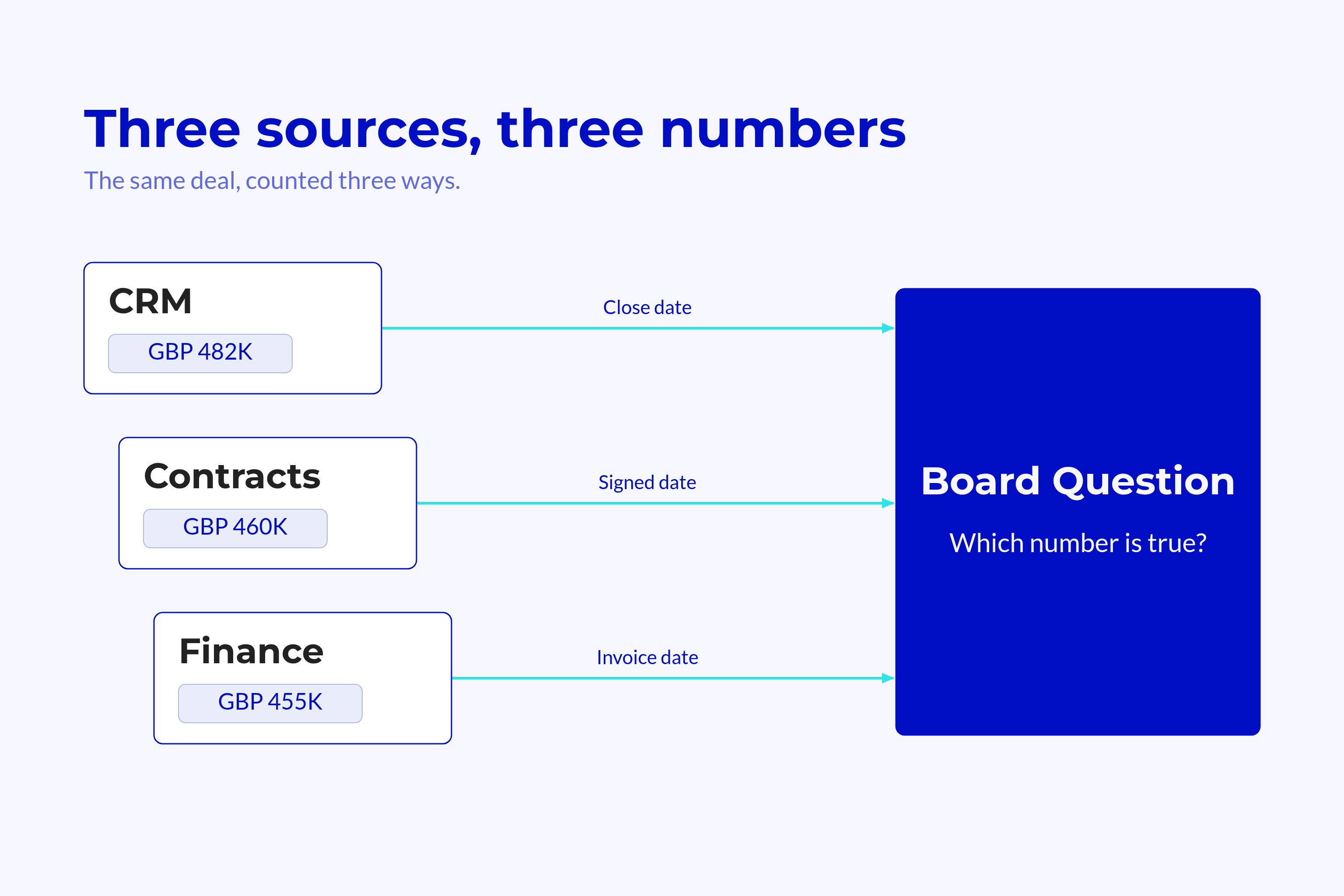
Picture the CEO asking for the revenue number in week two. Sales checks HubSpot, finance opens its ledger, and customer success searches contract files. Their answers differ because each team counts a different event.
📊 Fact
In Clari’s North American enterprise survey, 87% missed their revenue targets in 2025. This finding covers enterprise firms, not scaleups.
What the Board Actually Asks in Week One
The board needs to know whether the forecast holds, which revenue is secure, and where value can slip.
Board Questions
- Can we hit the quarter?
- Sales holds the opportunity forecast.
- Contract evidence tests the promised value.
- What revenue is secure?
- Signed terms establish the commitment.
- Finance confirms billing and collection.
- Where can we lose value?
- Customer success holds account concerns.
- Contract dates expose renewal deadlines.
CRM reporting turns customer and deal records into business answers through agreed rules. Those rules define each metric, its source, its stage checks, and its owner. Dashboards show the results, while finance keeps control of invoices, payments, and the ledger.
Metric Definitions Before Dashboards
“Revenue” can mean signed contract value to sales and recognised revenue to finance. Both can be right, but they answer different questions.
“Qualified pipeline” and “renewal at risk” need the same care.
Teams can use the same label while counting deals under different rules or time windows. Until they agree those rules, a shared dashboard will still show disputed numbers.
Definition Checks
- What event makes value count?
- Which date places it in a reporting period?
- Which source owns the amount?
- Who resolves a disputed record?
A dashboard shows the record; it cannot decide what should count.
Where CRM Reporting Breaks: CRM, Contracts, Finance, and Spreadsheets
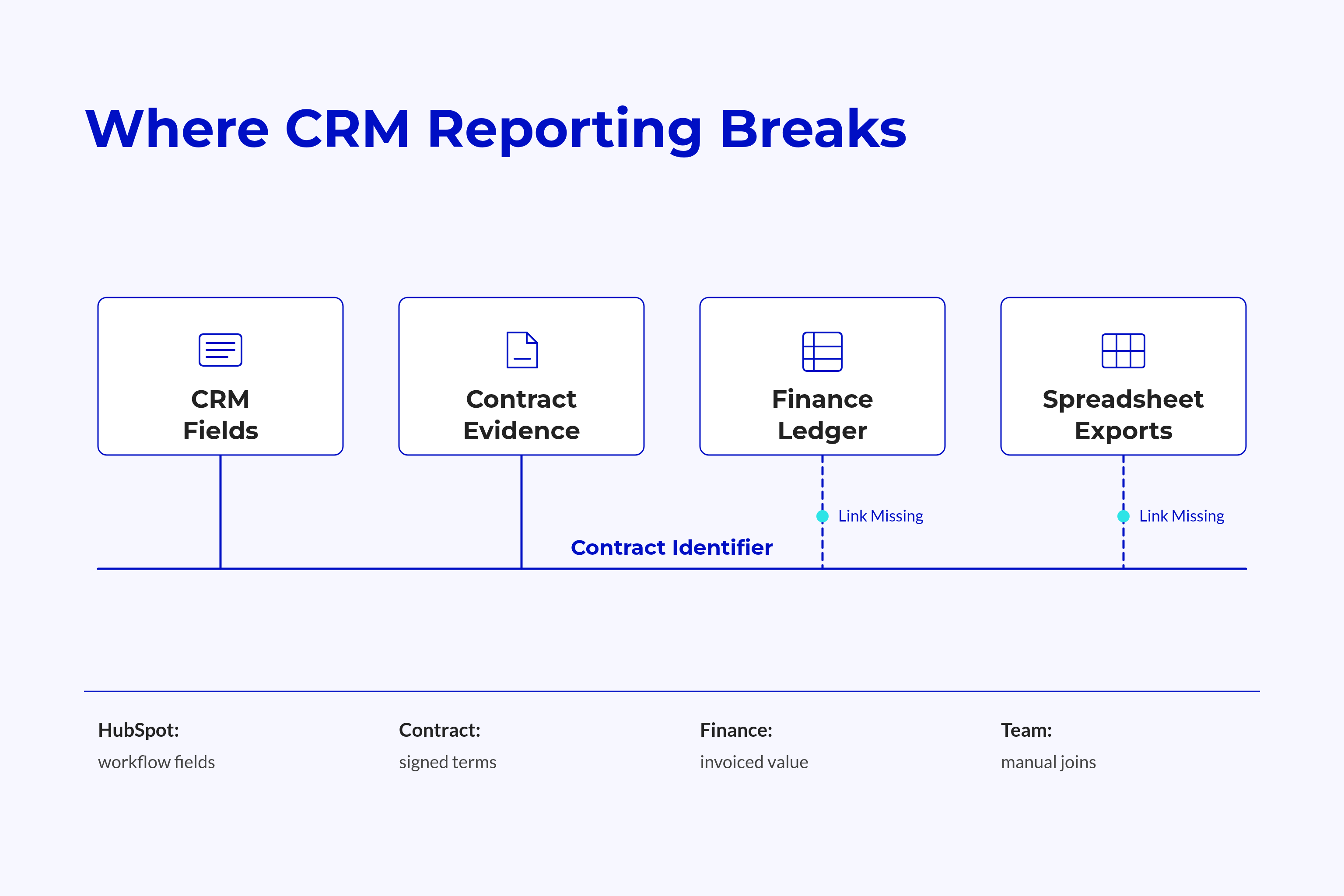
Reporting breaks when the facts behind a deal sit apart from the records leaders review. Dashboard training cannot fix a missing contract link. The reporting model needs to connect those facts.
Where the Commercial Record Splits
The CRM holds deal progress, owners, and expected close dates. Those fields track the sale but can not reflect the signed terms.
The contract file holds the agreed scope, price, term, and renewal rules. A dashboard can use those facts only when they reach linked records.
The finance system holds invoices, payments, and the accounting basis. Finance remains the source for those facts.
The spreadsheet often holds the changes and exceptions that make the board number work. Without a recorded reason, nobody can tell whether an adjustment still belongs.
Revenue needs commercial context that links these facts while keeping each source’s role clear.
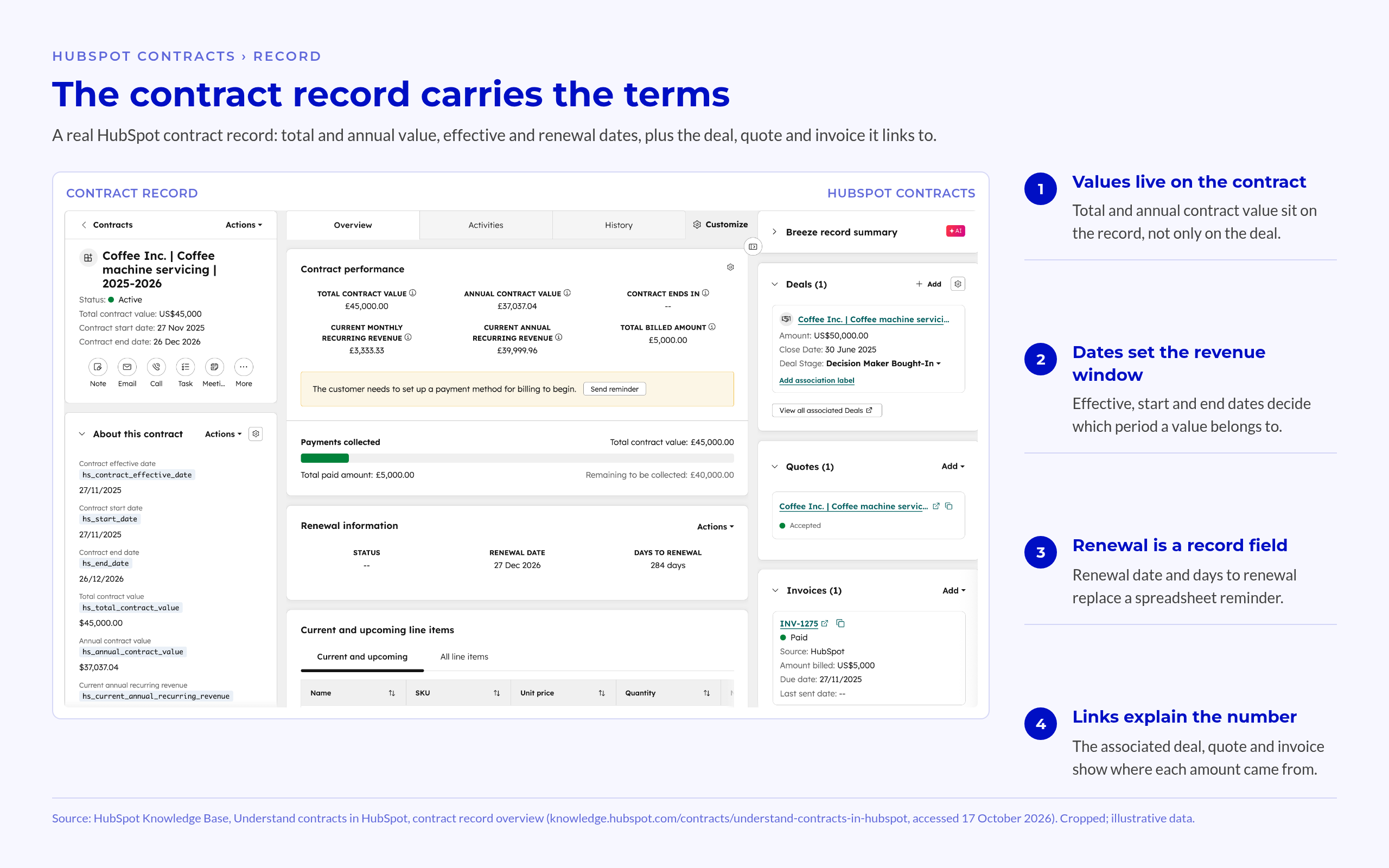
A contract record links what the customer bought with recurring value, dates, and ownership. It gives the revenue view a way to connect sales promises with signed terms.
Record Links
- Connect the account and deal to the relevant contract.
- Connect contract value to its effective dates.
- Connect finance references to the correct commercial record.
- Preserve the reason and owner for each exception.
Why More Dashboards Do Not Close the Gap
A new dashboard still reads the same stale dates and missing terms. No report fixes a Sales Operations process that was never defined.
Trace each headline figure back to named records. Keep differences visible until an owner explains them, rather than hiding them in a spreadsheet formula. That makes the gap something the team can resolve.
Source Boundaries
- HubSpot owns agreed sales and commercial workflow fields.
- Contract evidence supports signed terms.
- Finance owns invoiced, collected, and recognised value.
The 12 Revenue Questions HubSpot Must Answer
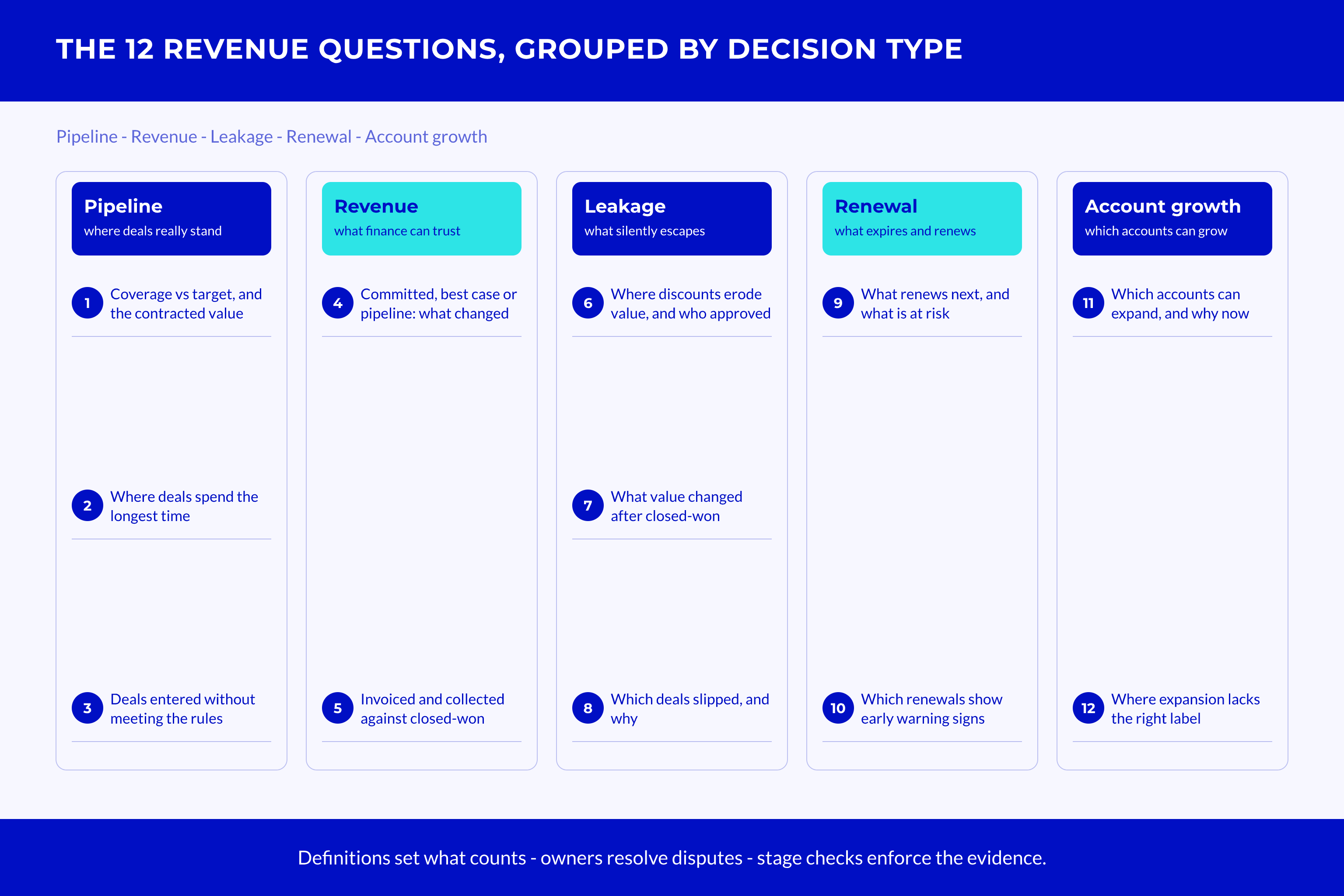
A demand shortfall needs a different response from stalled deals, lost value, or faulty reporting. Each answer therefore needs a source record and a clear rule for what counts.
Pipeline and Coverage Questions
Coverage compares eligible pipeline with a target on the same value basis and time period.
Coverage Rules
- Define eligible pipeline.
- Include deals that meet agreed entry criteria.
- Flag missing buyer evidence and stale next steps.
- Define comparable value.
- Separate expected deal amounts from signed commitments.
- Match the target’s period and value basis.
Open pipeline is not contracted revenue. Counting deals by stage alone can overstate coverage when those deals lack the buyer evidence needed to qualify.
| Group | Revenue Question | Record Dependency | Definition Needed |
|---|---|---|---|
| Pipeline | 1. What coverage supports the target, and which value is contracted? | Deals and linked contract records | Eligible pipeline and coverage basis |
| Pipeline | 2. Where do deals spend the longest time? | Deal stage history | Stage entry, exit, and ageing |
| Pipeline | 3. Which deals entered without meeting the rules? | Deals and required fields | Entry evidence |
| Revenue | 4. What is committed, best case, or pipeline, and what changed? | Deal amounts and forecast history | Category rules |
| Revenue | 5. What was invoiced and collected against closed-won value? | Deals, contracts, and finance references | Booked, recognised, invoiced, collected |
| Leakage | 6. Where do discounts erode value, and who approved them? | Deal pricing and approval records | Discount basis and authority |
| Leakage | 7. What value changed after closed-won? | Contracts and subscription context | Scope and value changes |
| Leakage | 8. Which deals slipped from the quarter, and why? | Close-date and forecast history | Slippage reasons |
| Renewal | 9. What renews in the next two quarters, and what is at risk? | Contract renewal fields | Renewal window and risk |
| Renewal | 10. Which renewals show early warning signs? | Contracts and customer health signals | Risk thresholds |
| Account growth | 11. Which accounts can expand, and why now? | Contracts and product usage context | Expansion evidence |
| Account growth | 12. Where is expansion happening without the right label? | Deal type, contracts, and line items | Expansion versus new business |
Stage ageing shows where deals slow down. Entry checks show whether those deals should have counted in the first place. Both checks belong ahead of a request for more demand from marketing.
Revenue and Leakage Questions
The choice of revenue metric shapes the answer: 42% of teams prioritise ARR as their top success metric. HubSpot’s 2025 survey included B2B and B2C sales professionals, so this is not a B2B-only benchmark.
Annual recurring revenue and total contract value measure different things.
A longer contract term does not, on its own, raise the annual recurring amount. Mixing those measures can make a deal look larger without showing more revenue per year.
Question five tests whether a gap reflects timing or lost value. Check the contract, billing schedule, invoice status, and payment record before calling it leakage.
Question seven follows value after the sale. Reduced scope, part-delivery, delayed starts, and amendments need dated changes, not silent overwrites.
Renewal And Growth Checks
- Identify the next renewal date and current recurring value.
- Attach early risk signals to a named account owner.
- Require evidence behind each expansion candidate.
- Separate expansion from new business in deal classification.
An expiry date alone cannot answer question nine. Notice deadlines, renewal terms, and account health determine when the owner needs to act.
Govern the Answer: Definitions, Ownership, Stage Rules, and Finance Context
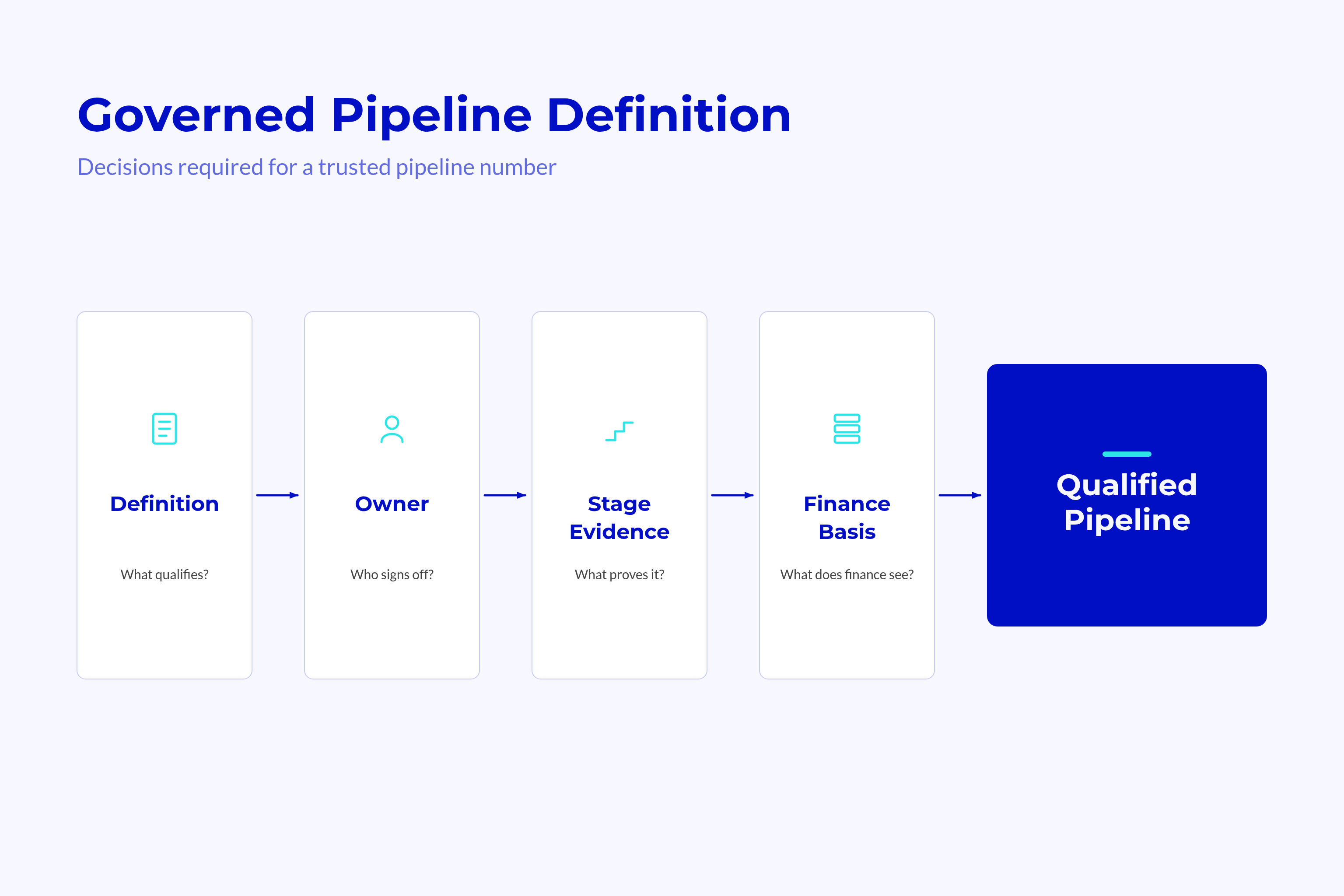
Each metric needs rules that teams can follow and HubSpot can support. Definitions set what counts, owners resolve disputes, and stage checks enforce the agreed evidence. Finance supplies the basis for billing, payments, and recognised revenue.
Write the Definitions Down
A metric dictionary records both the calculation and the event that makes value count. Revenue and finance leaders need to agree on both before an admin builds the view.
Metric Entry
- Name: Qualified pipeline.
- Scope: The agreed segment, pipeline, and reporting period.
- Value: The chosen deal amount basis.
- Evidence: Required buyer facts and next steps.
- Owner: The role accountable for disputes.
- Exceptions: Missing data and exclusions that remain visible.
Stage rules need evidence that a deal owner can provide and a manager can check.
Stage Decisions
- Advance a deal when the required buyer evidence exists.
- Record the basis for a close-date change.
- Require signed-term evidence for a contractual commitment.
- Preserve finance’s recognition rules outside sales-stage logic.
💡 Tip
Test each definition against a disputed deal before signing it off. If readers still reach different answers, clarify the rule.
One Owner Per Number
Several teams can supply a number, but one role needs to answer for it.
Accountable Roles
- Sales leadership owns pipeline eligibility and seller forecast discipline.
- Customer success leadership owns renewal risk and account action.
- Finance owns billing, collection, and recognised revenue definitions.
- RevOps owns field logic, record links, and reporting controls.
The CRO resolves trade-offs across these owners. The admin turns their decisions into HubSpot settings rather than making sales or finance policy.
This makes revenue alignment practical: agreed rules shape daily record updates and decisions in HubSpot. Owners also handle exceptions after launch, not just approve the build.
AI time savings need an owner and a use: 72% of sales organisations report low reinvestment of AI time savings into high-value selling. Time saved alone does not show a gain in revenue.
Building the CRO View in HubSpot Dashboards, Revenue Forecasting, and Sales Forecasting
HubSpot needs to reflect the rules leaders have agreed. The CRO sets the questions, source boundaries, and tests for approval. The admin checks which reporting features, record links, and system connections the build needs.
Dashboards That Read the Record, Not the Stage Label
Headline cards need fields that match the agreed definitions. Drill-down views need to show missing evidence or explain why a record does not count.
Headline Inputs
- Pipeline: Eligible value, stage age, owner, and next step.
- Commitment: Amount basis, close period, and supporting evidence.
- Contracts: Effective dates, recurring value, renewal date, and ownership.
- Finance: Invoice reference, status, collection context, and refresh date.
- Exceptions: Missing links, disputed amounts, and unresolved changes.
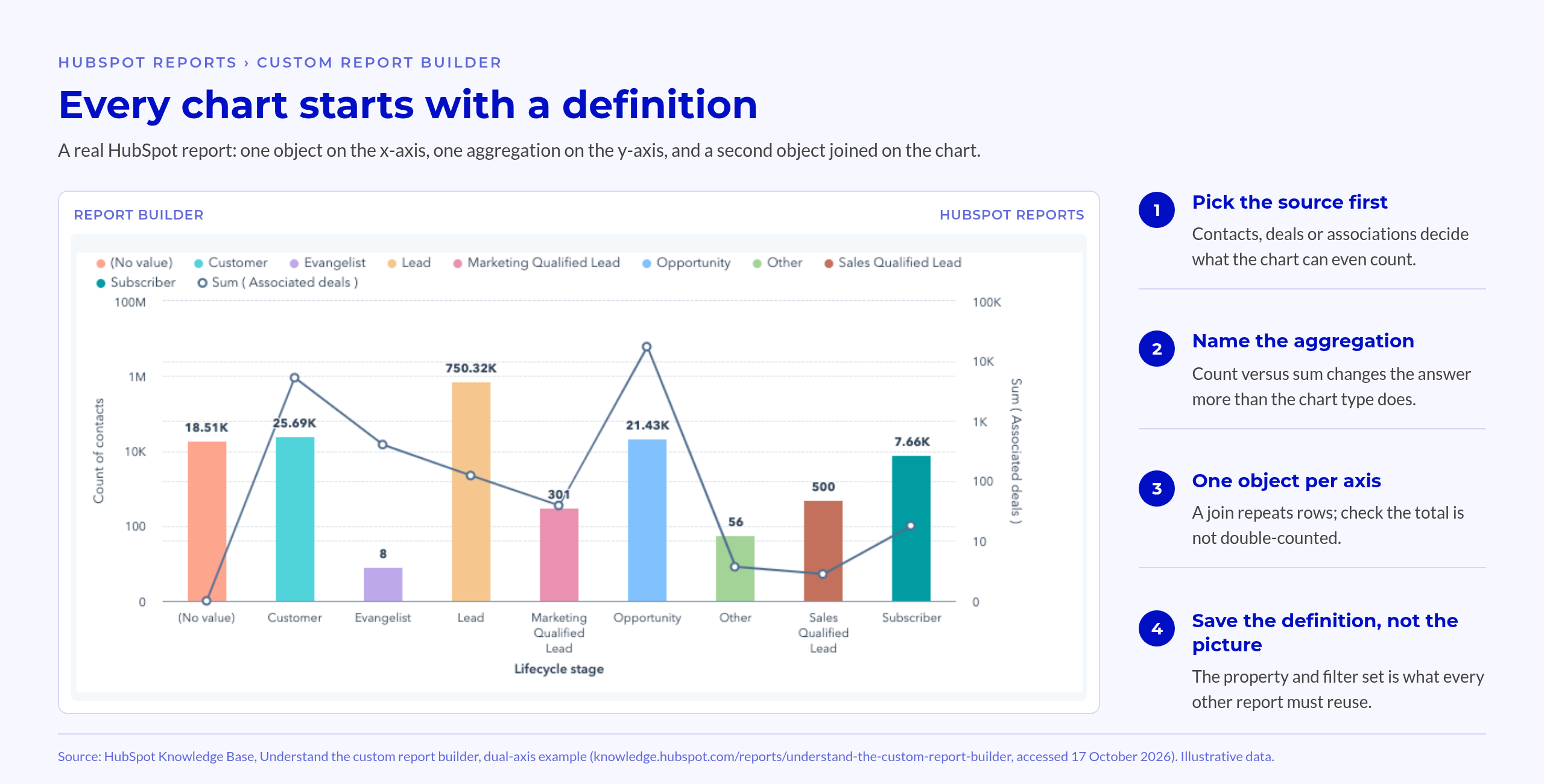
A “contract record” describes the commercial facts the model needs, not a default HubSpot object.
Linked properties, existing records, or a custom object can fit that model. The choice depends on the portal and subscription.
Record links also affect how totals add up. When a contract links to several invoices, a joined report can repeat its amount. The report needs to count the contract value once rather than once per invoice.
Revenue Forecasting and Sales Forecasting Together
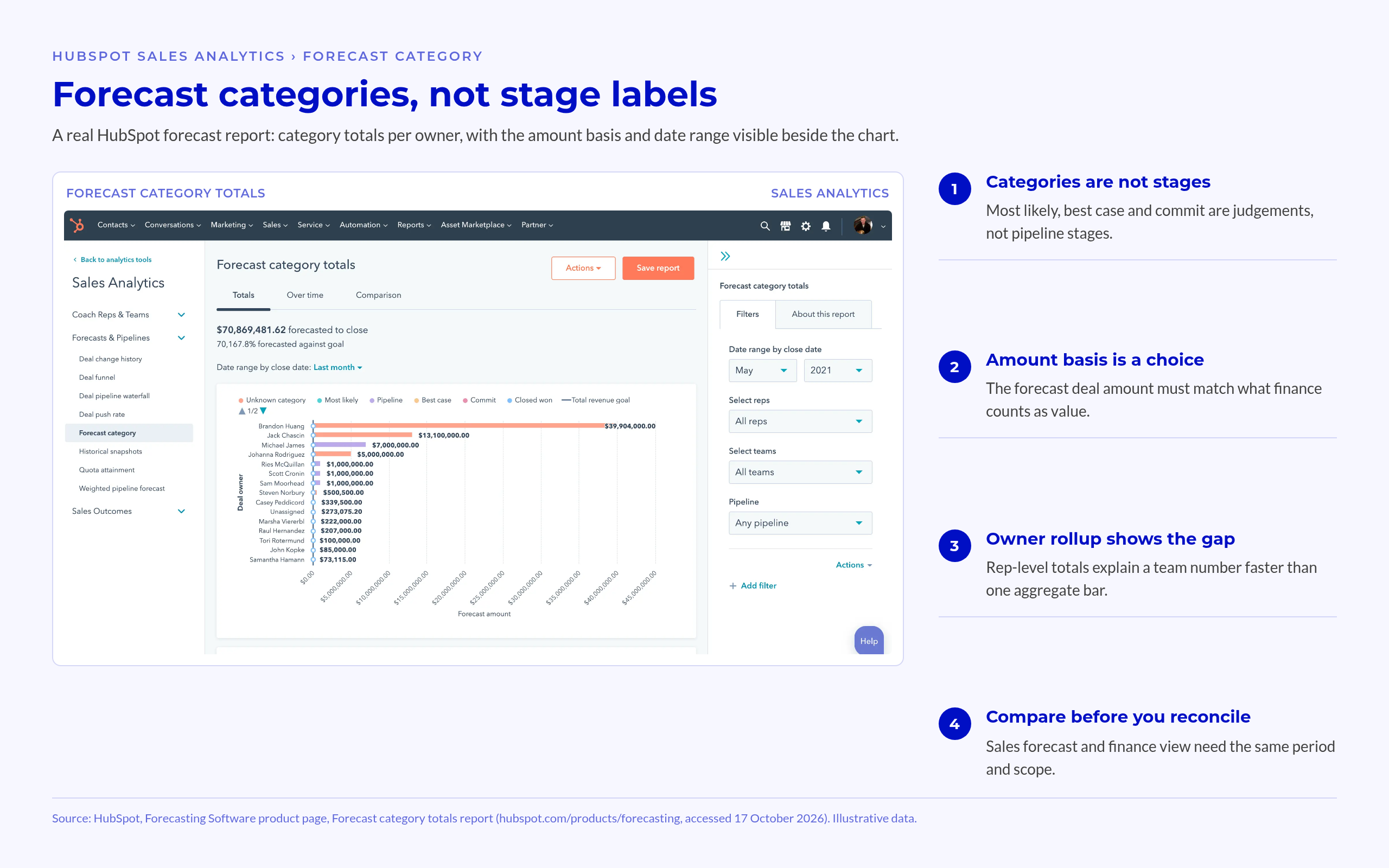
Sales forecasting combines seller and manager judgement into an expected result. Revenue forecasting adds contract timing, renewals, and known changes to the deal’s value or terms.
Both views need the same scope before leaders can compare them.
Forecast Controls
- Align the period, pipeline, owner scope, and amount basis.
- Agree whether category changes follow stage movement or explicit review.
- Preserve changes so managers can explain movement.
- Show finance reconciliation separately from seller confidence.
A deal’s stage can not reflect the seller’s current judgement. The rule for updating forecast categories needs to match the review process leaders use.
Build estimates need to cover data repair, contract mapping, access, and finance checks. Chart design accounts for only part of that work.
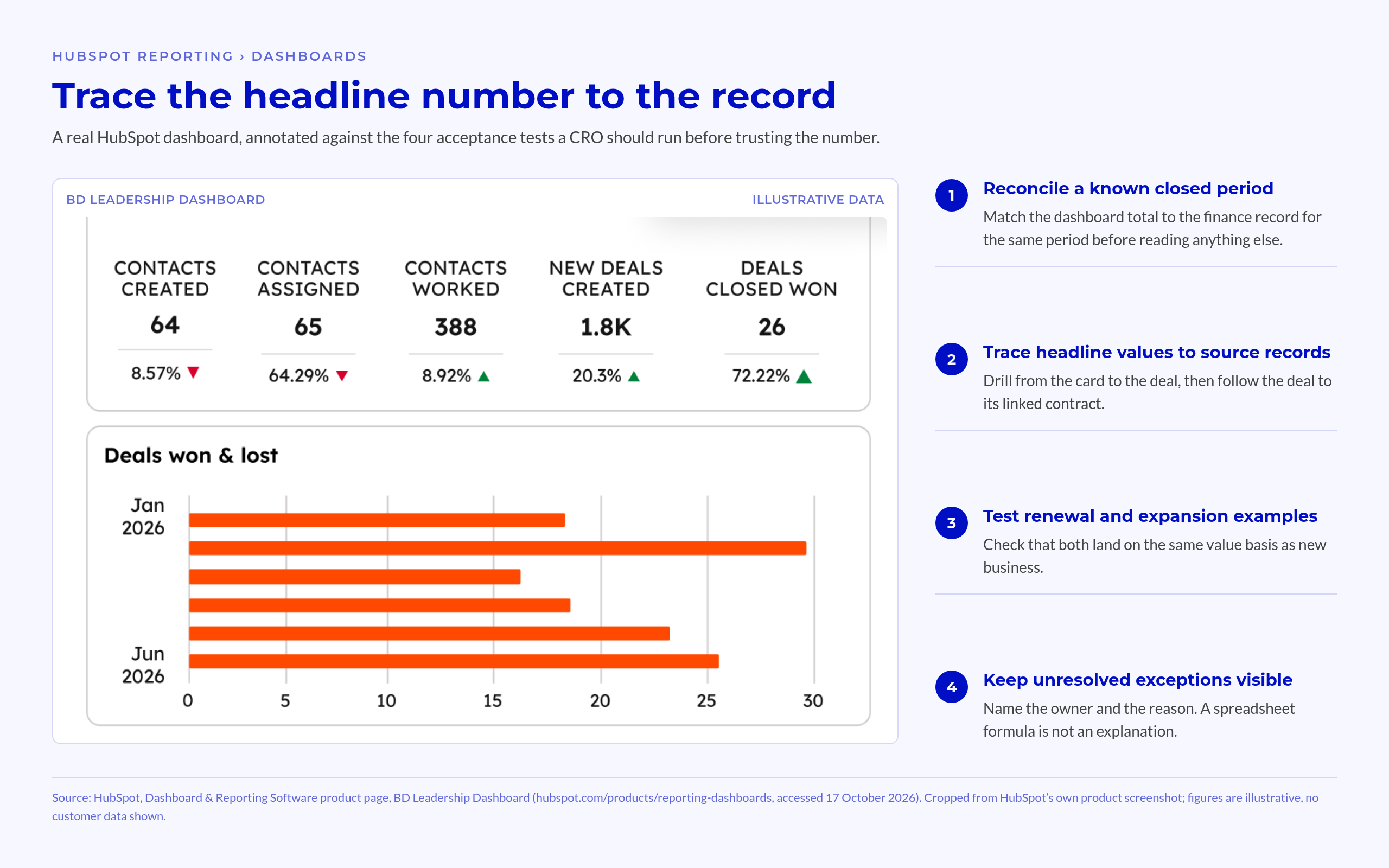
Acceptance Tests
- Reconcile a known closed period.
- Trace headline values to source records.
- Test renewal and expansion examples.
- Keep unresolved exceptions visible.
The First 90 Days: Week-By-Week Sequence for a Revenue View
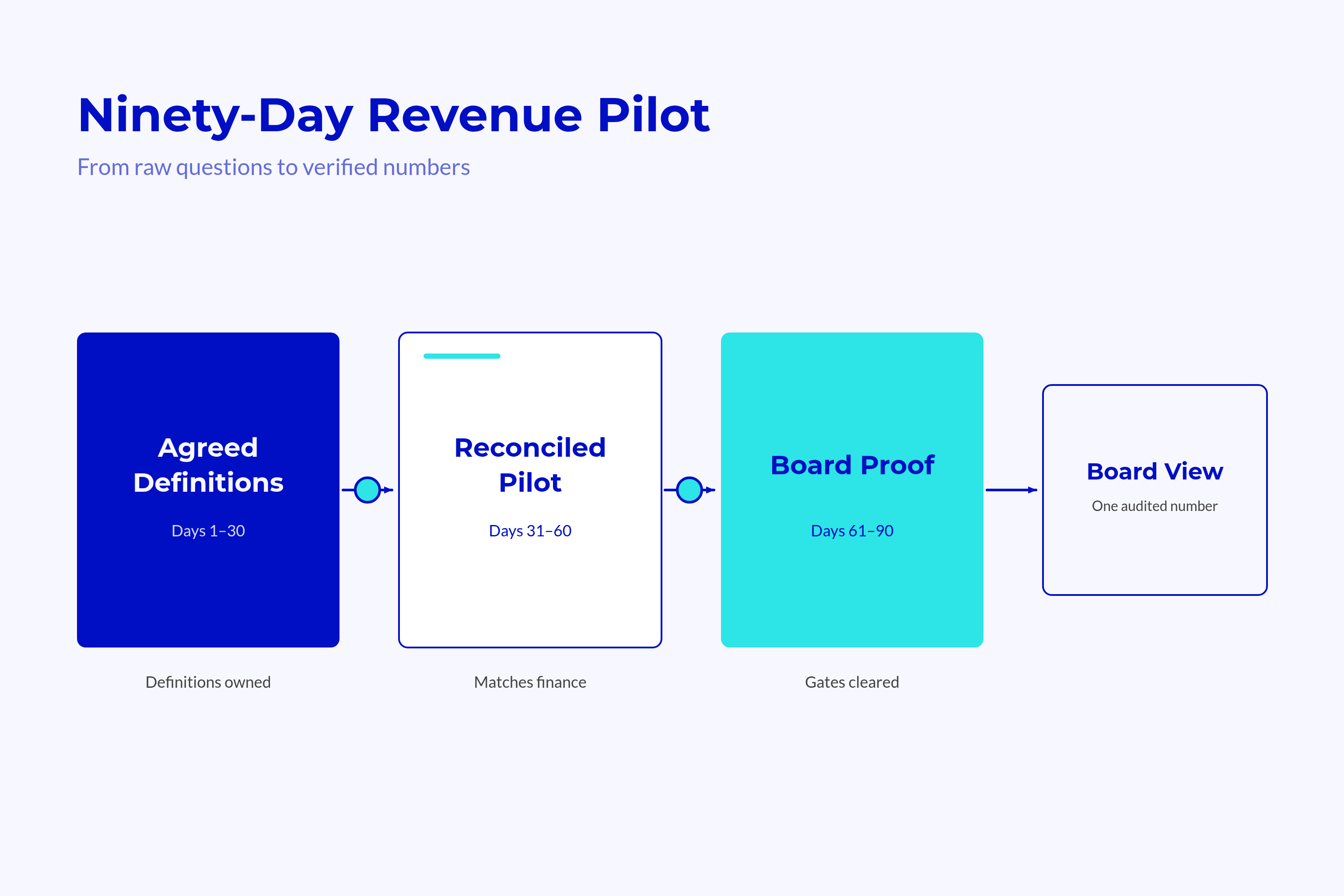
A pilot can test the revenue model before a portal-wide rebuild. It needs to include the contract types and exceptions that make reporting hard. Each phase ends with evidence and a decision on whether to widen the scope.
Days 1 to 30: Diagnose and Define
Follow customer records through CRM, contracts, finance, and manual adjustments. Compare a recent win, a renewal, and an expansion to find where their reporting paths break.
Diagnosis Work
- Ask leadership the revenue questions without suggesting report names.
- Record conflicting definitions and missing source links.
- Agree the metric dictionary and accountable roles.
- Select a segment with representative commercial complexity.
The deliverable is a set of agreed definitions. The scope decision is which segment can test the model without leaving out difficult records.
Compare leadership priorities with the CMO, agree which pipeline and handoff definitions to test together, and keep broader marketing reporting outside the CRO pilot.
Days 31 to 60: Pilot One Revenue View
Map the chosen records, build the view, and check it against a known closed period. When values differ, check the definition and source link before changing the chart.
Pilot And Proof
- Days 31 to 60:
- Deliver a reconciled pilot view.
- Decide whether the record model holds.
- Days 61 to 90:
- Deliver the board view with documented exceptions.
- Decide whether wider scope is justified.
Before accepting the pilot, ask someone other than the builder to trace the totals to source records and explain each manual adjustment.
Trust Signals And First Fixes
- Conflicting totals: align scope and value basis first.
- Duplicate value: repair record links and aggregation.
- Surprise renewals: repair dates and ownership.
- Unexplained forecast movement: preserve changes and reasons.
- Stale exceptions: assign an owner and resolution date.
A weekly review keeps unresolved records and rule changes in view after launch. Wider use depends on the pilot holding through routine updates and known exceptions.
AI spending does not settle that readiness question. In 2026, 71% of high-growth companies increased AI investment by double digits, versus 25% of laggards. That link does not prove spending caused growth or remove the need for sound records.
Conclusion
The first 90 days give a CRO a chance to replace disputed CRM totals with numbers that have clear definitions, sources, and owners. A pilot tests whether those links hold against finance records and normal deal changes.
The board view becomes more useful when it shows both the answer and its limits. Leaders can see which forecast changes need review, which renewals need attention, and which gaps still need an owner. They no longer have to treat every difference as the same problem.
Key Takeaways
- Agreed metric definitions set the basis for each report.
- Linked deals and contract terms add context while finance retains ledger ownership.
- The revenue questions expose missing evidence and unclear rules.
- A representative pilot tests the model before wider use.
- Named owners and regular exception reviews keep the view current.