


November 17, 2026
8 min read
A renewal date alone doesn’t show whether a buyer will commit to the next term.
Existing revenue deserves the same care as the next sale.
In ChurnZero’s 2025 survey, 74% of respondents said most of their company’s revenue came from existing customers.
That finding supports clear ownership of existing revenue, but it doesn’t predict whether a specific customer will renew.
Consider Northbank Software, a hypothetical customer with a reassuring account label but contracts that renew separately. An unchecked notice deadline and a renewal owner who hasn’t accepted the role leave one term exposed.
What HubSpot Renewal Management Must Show 90 Days Out
The first fix is someone who accepts the work and checks the terms, not another chart.
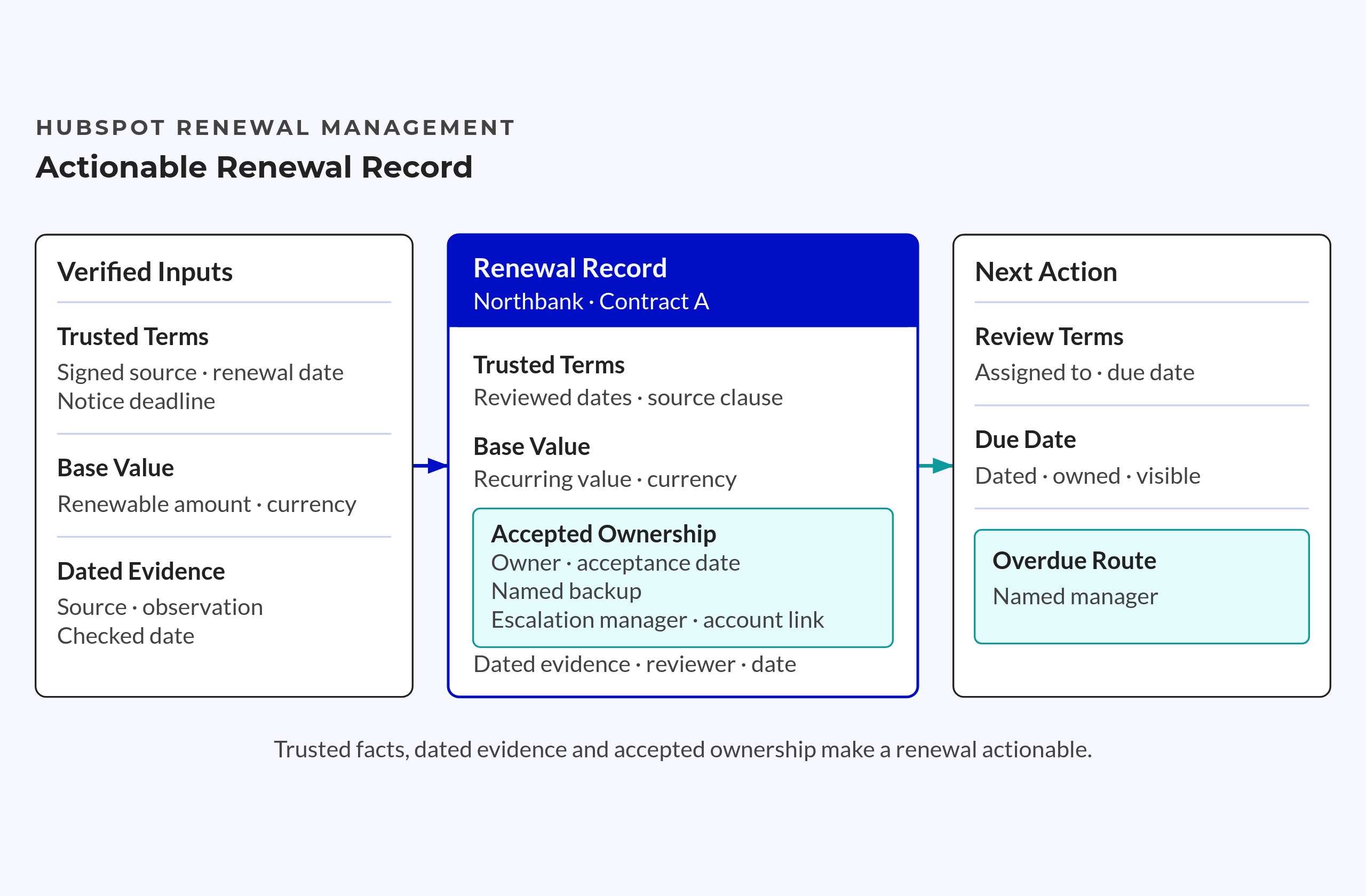
A useful renewal record shows what renews, what puts it at risk, and who acts next. The 90-day window is a planning choice, not a rule that fits every contract.
Define an Actionable Renewal Record
Minimum information
- Identity
- Customer and agreement reference.
- The specific term due for renewal.
- Timing
- Reviewed renewal date and term end.
- Notice deadline and source agreement.
- Value
- Base recurring value and currency.
- The period that value covers.
- Accountability
- Named renewal owner.
- Specific next action and due date.
- Evidence
- Current risk reason and source.
- Date of the finding and named reviewer.
These are proposed fields for your process, not HubSpot defaults. Check HubSpot’s property documentation for field options, access rights, and where fields can sit.
Mark each key value as confirmed, missing, disputed, or stale. A blank notice deadline must stay visible. A date filter must not hide a term because nobody has checked when notice is due.
Give Every Renewal an Accepted Owner
Owning the account and owning its renewal are different jobs.
The account owner manages the wider relationship. The renewal owner brings together the decision, related tasks, and issues that need a manager’s help. The same person can hold both roles if they explicitly agree to do so.
Responsibility model
| Work | Responsible Person | Support | Escalation |
|---|---|---|---|
| Coordinate renewal | Renewal owner | Sales and customer success | Revenue leader |
| Validate terms | Authorised terms reviewer | Renewal owner | Commercial or legal lead |
| Confirm customer outcomes | Customer success owner | Product or delivery team | Customer success lead |
| Confirm base value | Finance reviewer | Renewal owner | Finance lead |
| Resolve data conflicts | RevOps steward | Source-system owner | RevOps lead |
Adding a name to a field doesn’t complete a handoff. Before accepting the role, the new owner needs to review deadlines, open risks, and due tasks.
Handoff checks
- Confirm the owner accepts the renewal work.
- Confirm who completes the next action.
- Name a fallback for absence or departure.
- Route overdue work to a named manager.
For Northbank, progress starts when an owner accepts the renewal and sets a date to review its terms.
Connect the Contract, Customer, and Renewal Opportunity
The customer record holds the wider relationship; the renewable term holds the commitment under review. Keeping them separate exposes risk in one contract without losing the account context.
Preserve the Agreement and Its Sources
Northbank’s contracts need their own dates, values, and review states. One company-level renewal date cannot describe both.
A commercial contract record keeps the terms and their context together without replacing finance or billing systems. Keep the original sale intact and link future renewal work to the right term.
This is a proposed record design, not a claim that HubSpot has a native Contracts feature. Check which objects, licences, and workflow actions support it before setup.
Relationship design
- Customer
- Holds the wider account relationship.
- Links the relevant people and contracts.
- Renewable term
- Names the commitment under review.
- Holds its dates, value, and supporting facts.
- Renewal opportunity
- Tracks work to secure the next commitment.
- Links that work to the relevant term.
Shared data also needs clear fields and owners. Name the source that governs each field and the person who resolves conflicting values.
The latest sync should not settle a dispute by default. Finance can govern recurring value, while an authorised reviewer confirms contract dates. A newer value is not always the correct one.
Separate Renewal, Notice, Billing, and Close Dates
Each date answers a different question.
Date definitions
- Renewal date: when the next term takes effect.
- Term end: when the current term finishes.
- Notice deadline: when a relevant notice must arrive.
- Billing date: when an invoice or charge falls due.
- Expected close date: when the team expects to finish the commercial work.
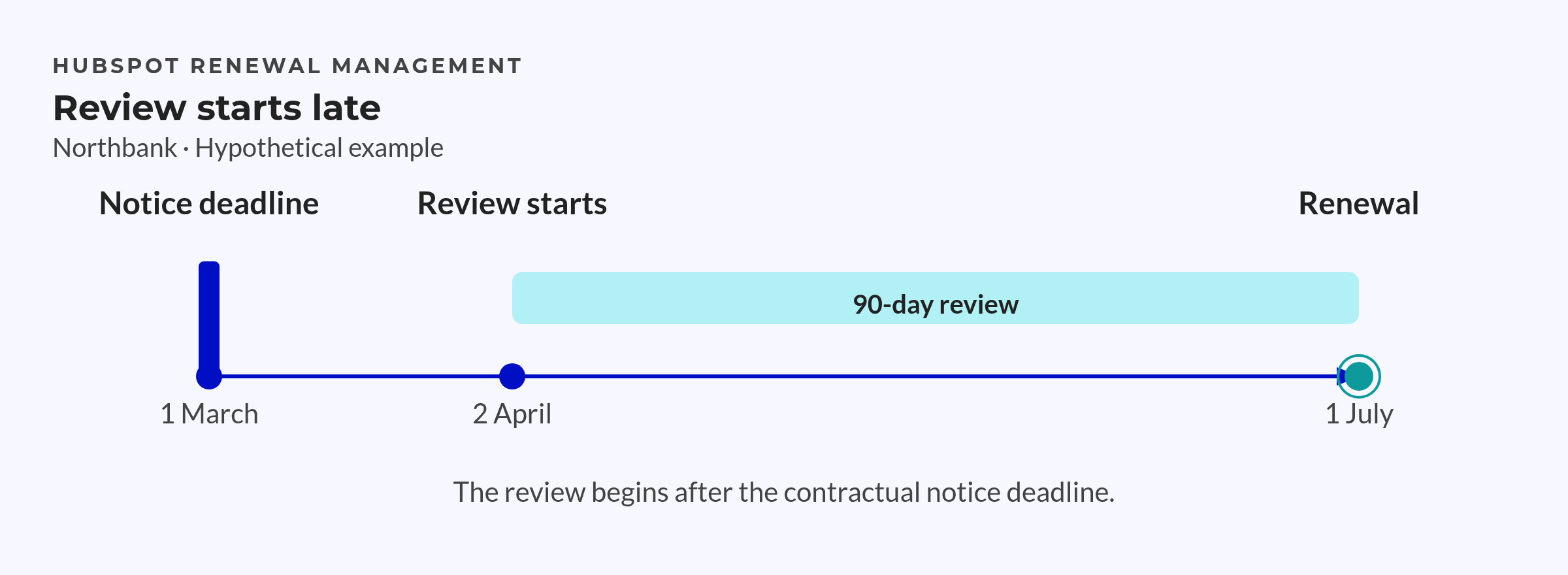
In the hypothetical Northbank example, check whether the notice deadline falls before the planned renewal review window.
Store the reviewed deadline with its source clause, reviewer, and review date. Don’t assume every notice rule allows simple calendar-day subtraction.
💡 Insight
An early renewal reminder can still arrive too late if it ignores the deadline that governs the customer’s choices.
Rolling and auto-renewing contracts need rules that match their terms. When dates are missing or disputed, assign someone to resolve the gap. Keep the record in the renewal view while that work remains open.
Turn Customer Signals Into Explainable Renewal Risk
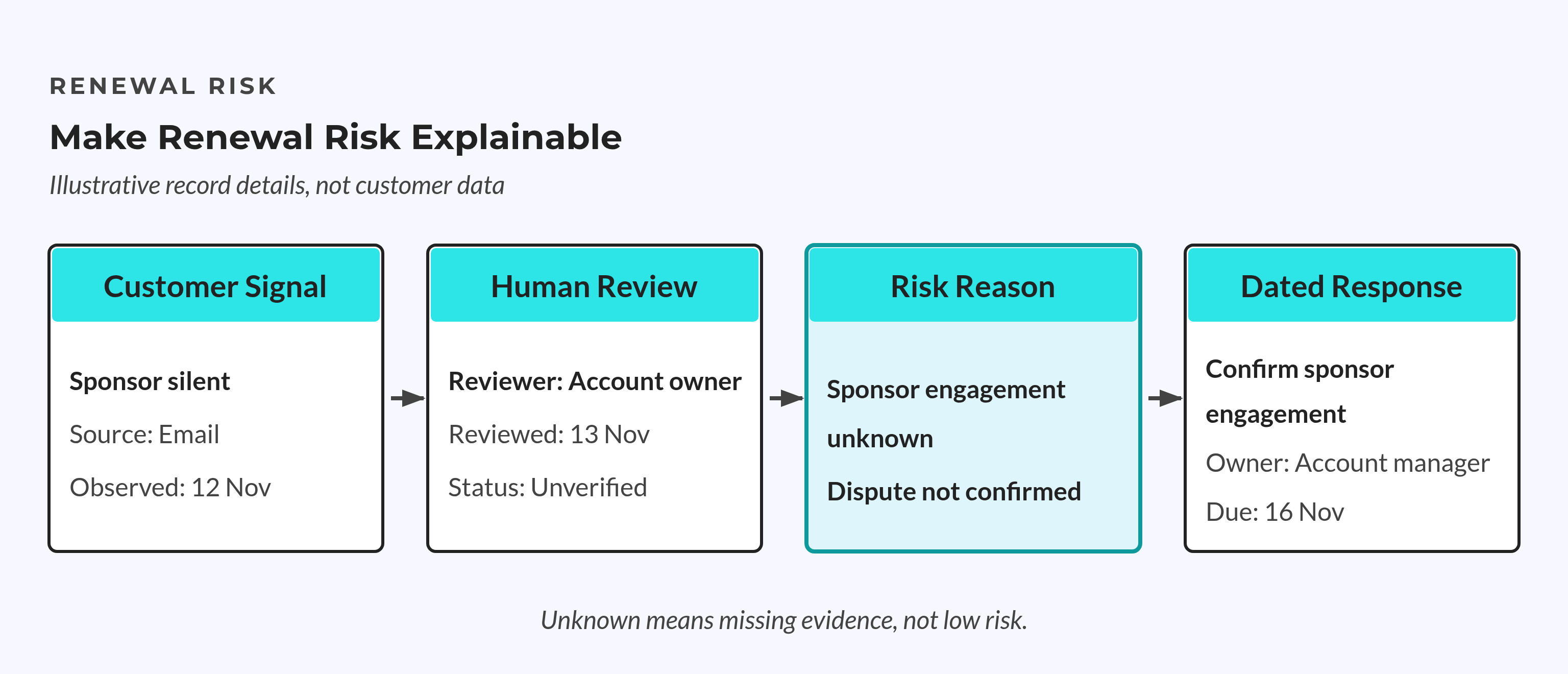
A risk label needs facts that a reviewer can trace and a response someone owns. An observed commercial concern is different from a gap in what the team knows.
Connect Each Signal to a Customer Decision
A support issue, falling usage, or a sponsor’s departure calls for review. None proves that a customer will leave.
The question is whether the customer still gets the value they bought. McKinsey’s retention analysis highlights product use and the value customers gain as relevant context.
Evidence to review
- Open service issues that block agreed outcomes.
- Reduced product use, where sound usage data exists.
- A missing sponsor or unclear decision-maker.
- Disputed pricing, scope, or payment terms.
- Customer outcomes that nobody has recently confirmed.
Product-use and payment data need sources and links that the team has set up. Don’t assume HubSpot already holds those signals.
📊 Fact
In ChurnZero’s 2025 survey, 62% picked earlier churn-risk detection among their top two relationship and retention priorities.
That finding shows what leaders want to improve, not how well their teams detect risk.
For Northbank, the owner asks whether the sponsor remains involved and whether the customer’s intended outcomes still hold. Those answers shape the next conversation.
Keep Unknown and Stale Evidence Out of Healthy
Unknown means the team lacks evidence, not that risk is low.
A recent email proves contact, but not intent to renew. A completed task proves activity, but not that someone resolved the issue. A green label cannot replace a review of the facts.
Evidence states
- Current
- Shows a dated finding and source.
- Names the reviewer and agreed response.
- Stale
- Shows when the last review took place.
- Assigns a fresh review with a due date.
- Unknown
- Names the unanswered question.
- Assigns someone to obtain the facts.
Set review intervals to match the terms, account context, and pace of change. Show when someone observed each signal and when the team reviewed it so leaders can judge its age.
Northbank’s record can show a missing sponsor response apart from a confirmed commercial dispute. The first needs an answer; the second needs a response.
Neither gap belongs under an unexplained healthy label.
Build Renewal Workflows That Assign Action Before Deadlines
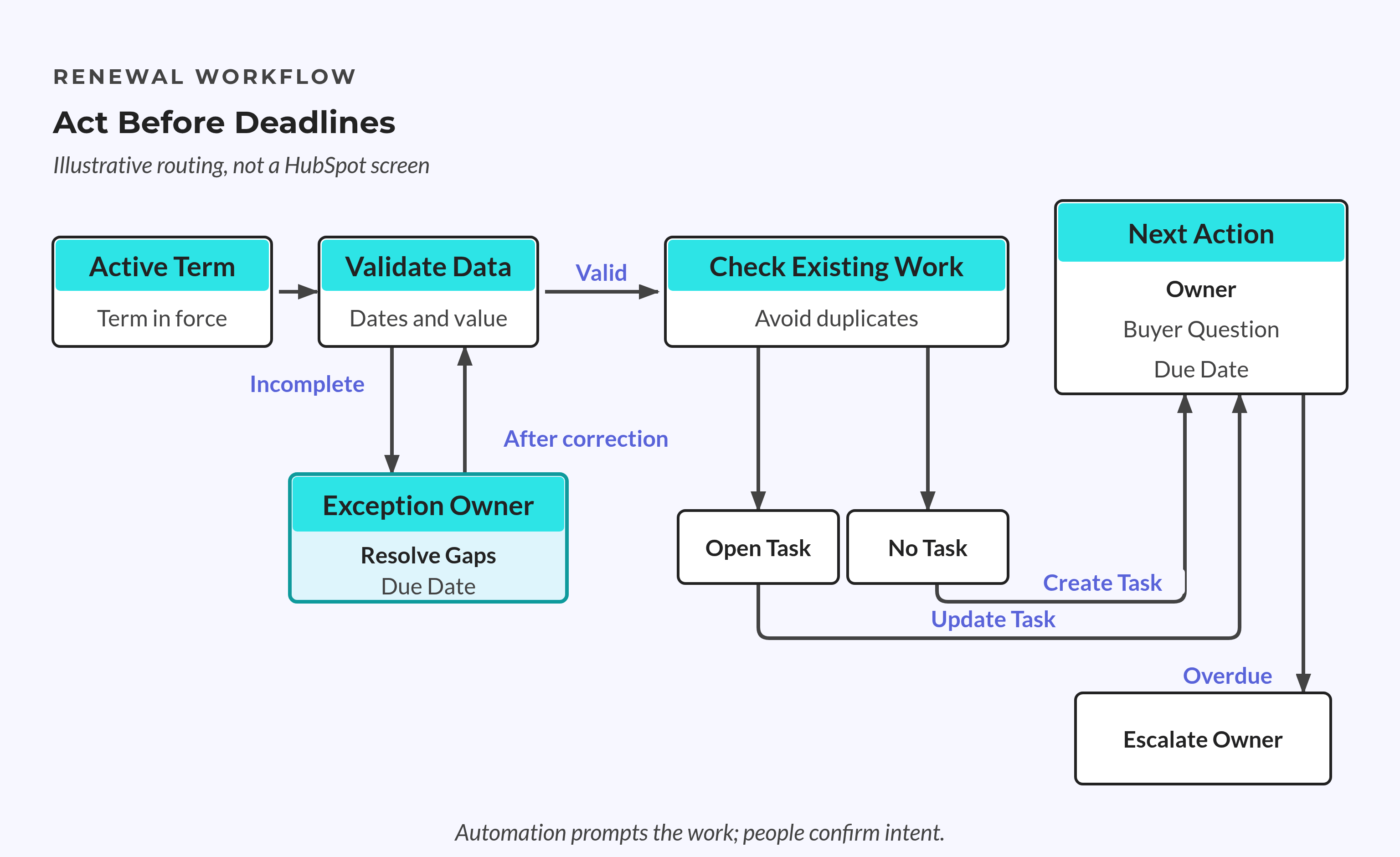
Renewal workflows need to follow contract deadlines and named roles. Define who must do what before choosing triggers or automated actions.
Start with Eligibility and Exception Paths
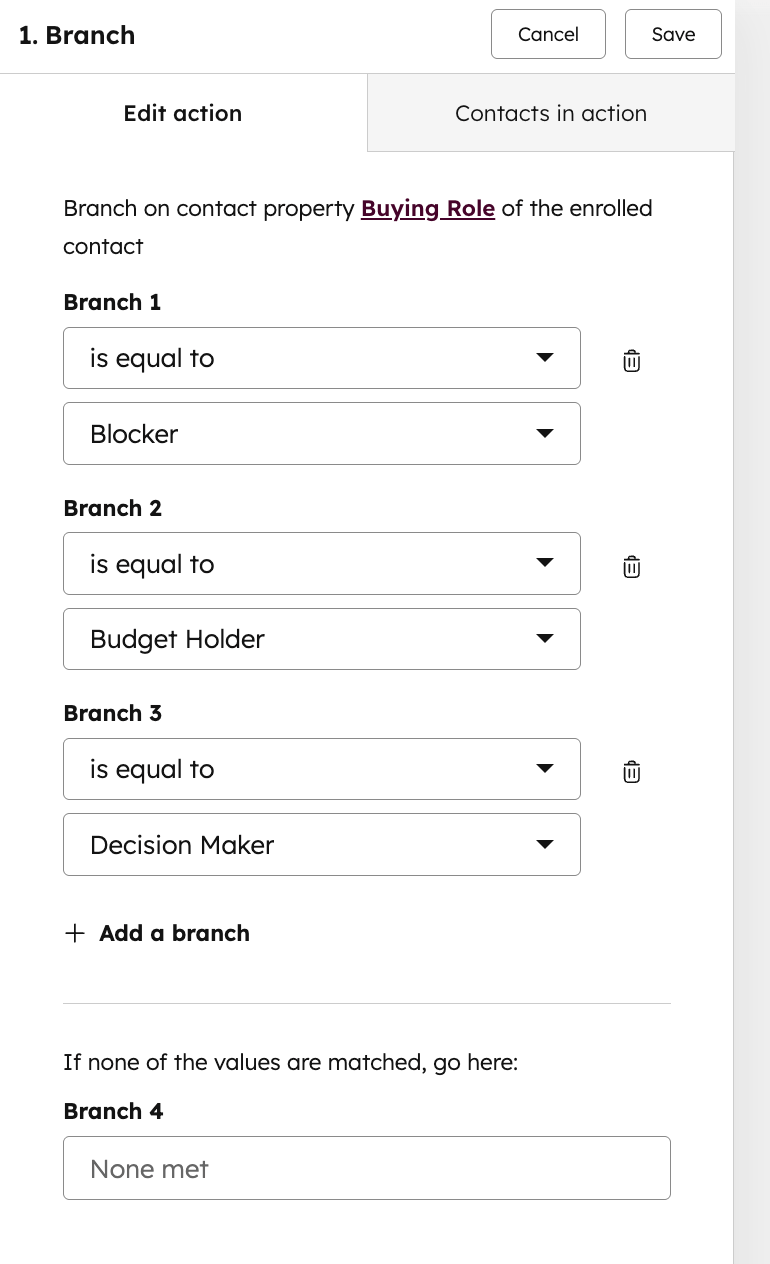
Find the renewable term and check that it is active. Reconcile its dates and base value, then confirm that the owner accepts the work. These checks determine when work must begin and which gaps need review.
Check HubSpot’s workflow documentation for the available setup options. Confirm the actions, supported objects, and plan needs before promising that workflows will create or assign records.
Operating sequence
- Identify an active renewable term.
- Check dates, value, and accepted ownership.
- Route incomplete records to an exception owner.
- Set an action date from the relevant deadline.
- Check for existing work on the same term.
- Assign the next action and define completion.
- Escalate overdue work to a named role.
Use an agreement and term identifier to find existing work. Updating an existing opportunity must not count its base value again.
Change handling
- Already inside the window: run a catch-up check.
- Changed date: review terms and replace out-of-date work.
- Changed owner: require an accepted handoff.
- Cancelled agreement: stop reminders that no longer apply and retain the outcome.
- Repeated alert: define what clears it and when it can repeat.
These are behaviours to test in the proposed setup, not assumed native controls.
Use 90-, 60-, and 30-Day Checkpoints as an Example
Each checkpoint needs a decision, not just a reminder. Move the reviews earlier when notice terms or the work involved demand it.
Example checkpoints
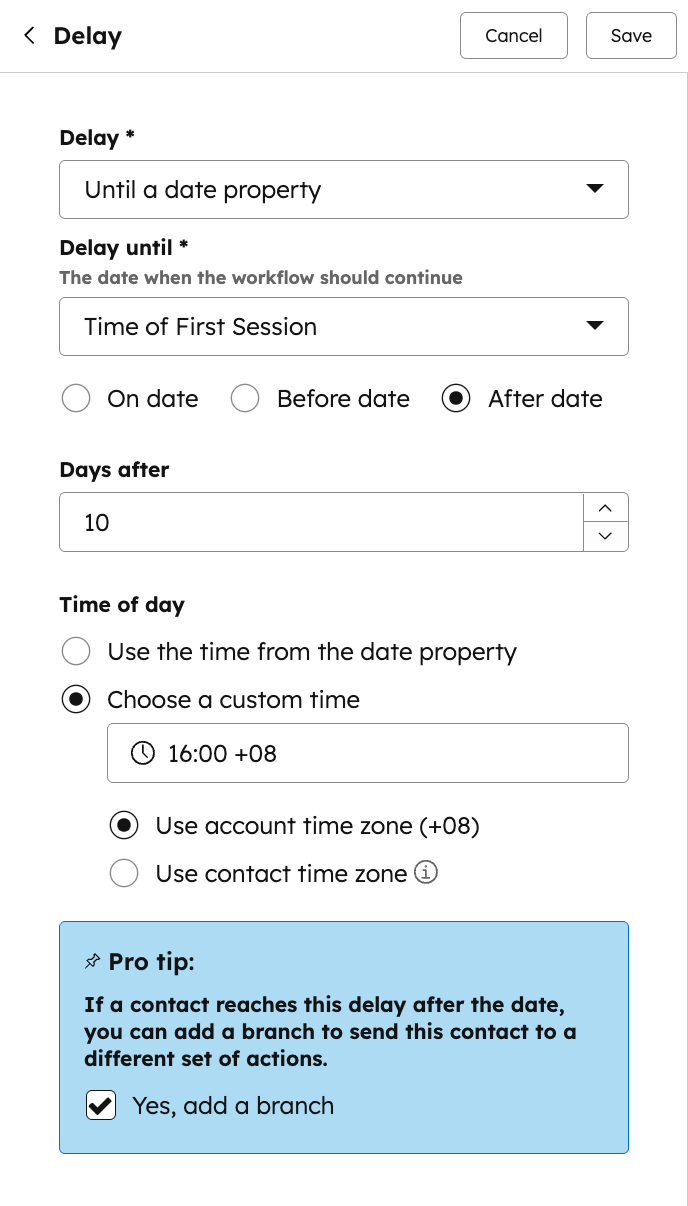
- At 90 days, check terms, ownership, and account context.
- At 60 days, confirm intent, open risks, and the path to agreement.
- At 30 days, resolve remaining decisions and confirm the agreed outcome.
This cadence is a proposed way to work, not a proven standard.
In Northbank’s hypothetical timeline, the notice deadline moves preparation ahead of the usual renewal window. The owner records which customer conversation must happen before that deadline.
💡 Tip
Define completion as evidence of the required decision, not an email sent or a reminder dismissed.
A useful action names the person, question, and due date. For example, the owner confirms the buyer’s approval path and records the response. That answer shows whether the task achieved its purpose.
Automation can prompt the work, but it cannot establish customer intent on its own.
Build a Renewal View That Exposes Exceptions and Value at Risk
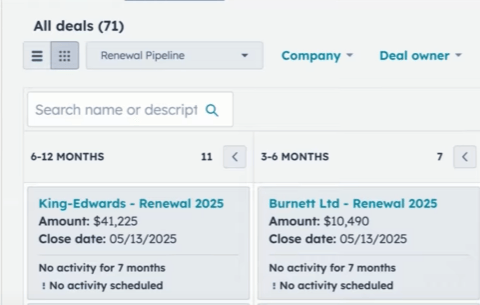
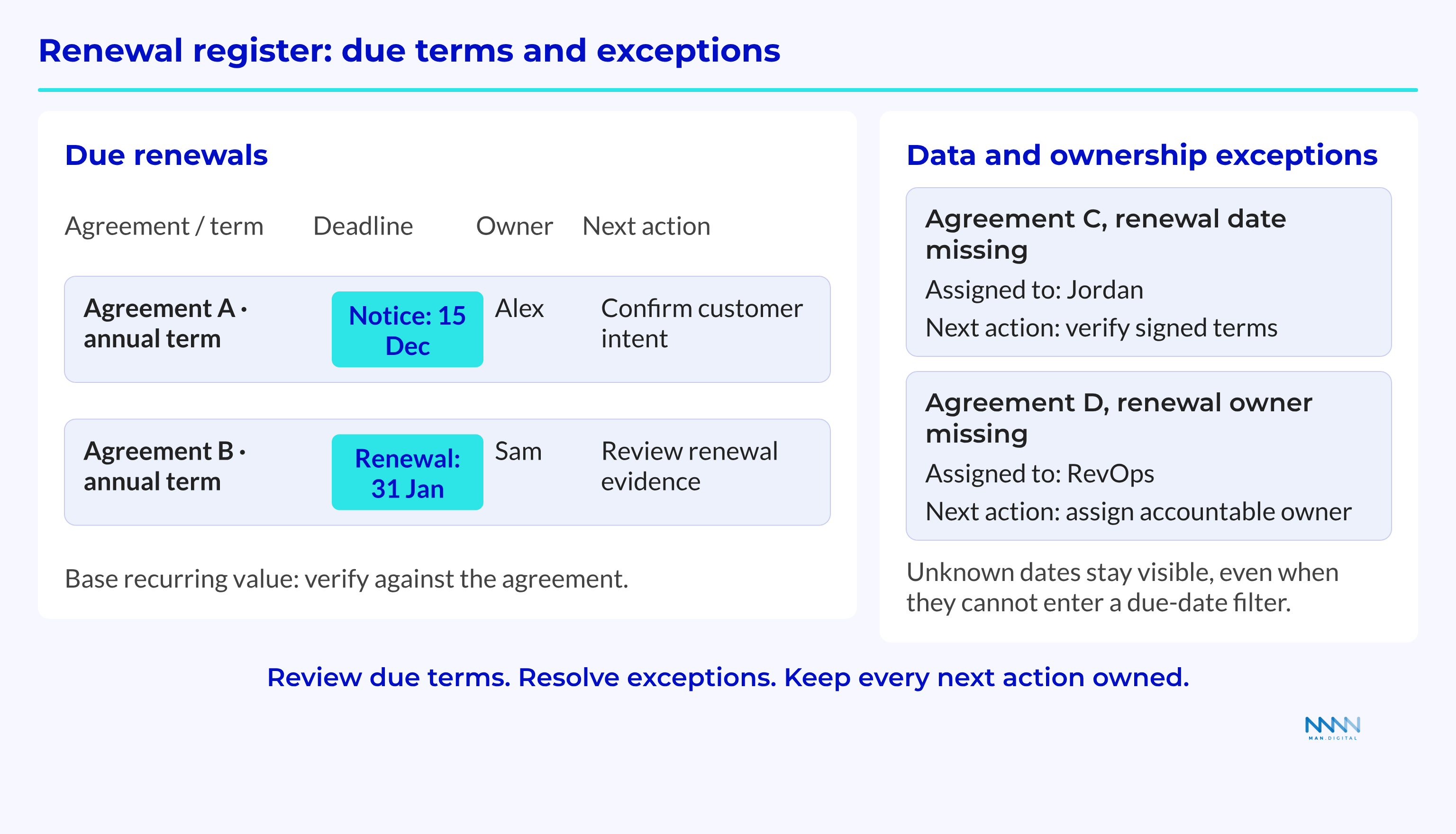
A renewal register gives the team records they can act on before a dashboard sums up the position. Each row should represent a renewable term, with separate views for deadlines and unresolved gaps.
Count Terms and Keep Base Value Separate
Register columns
- Customer, agreement, and renewable-term reference.
- Renewal date, term end, and notice deadline.
- Base recurring value, currency, and recurrence period.
- Accepted renewal owner.
- Risk reason and evidence dates.
- Data exception and resolution owner.
- Next action, action owner, and due date.
- Commercial status and separate expansion value.
Count each defined term once. Counting every linked company, deal, and task can multiply the same value.
Check HubSpot’s custom report guidance before choosing data sources and how the report totals values. Confirm which record links and plans support the proposed report.
Working views
- Terms in the rolling renewal window.
- Earlier notice or action deadlines.
- Missing dates or unaccepted owners.
- Stale evidence and unresolved questions.
- Overdue actions and observed commercial risk.
Keep base renewal value separate from potential expansion. Don’t sum currencies without a documented conversion method. Values with different billing periods also need a common basis before anyone adds them together.
“Value flagged as exposed” means the base value linked to flagged terms under your chosen rule, not an expected loss.
A forecast that weights value by the chance of renewal needs its own method. It must stay distinct from the exposed-value total.
Prove Visibility with a Representative Pilot
A pilot needs contracts that test the design, not just records with clean data.
Northbank provides a useful hypothetical test because its contracts have different deadlines and gaps in evidence. The aim is a working view the team can trust, not a claim that the pilot improves retention.
Pilot cases
- Multiple agreements under the same customer.
- An early notice deadline.
- A missing or unaccepted owner.
- A changed renewal date.
- Work already inside the action window.
- A term with existing renewal work, to test whether the proposed process creates duplicates.
Check each selected term against its contract and finance record. Confirm that gaps reach the right people and that changed dates update the right work.
For a migration, a representative pilot should prove the renewal view before the wider move. Unresolved migration issues still need owners and next steps. Launch sign-off must not hide them.
The pilot passes when people can trace the terms, trust the value, and identify the next action. Scheduled reviews help maintain that trust as contracts and roles change.
Frequently Asked Questions
Contract terms set the deadlines, while customer evidence informs the renewal decision. Named owners connect both to work the team can complete and review.
What Must Be in HubSpot for a Renewal to Be Visible?
A visible renewal needs a specific agreement or term, trusted dates, base recurring value, and an owner who accepts the work. It also needs current evidence and a dated next action. Source links let reviewers resolve conflicts without relying on memory.
Missing information needs a visible exception path with an owner and due date.
Is a Health Score Enough to Manage Renewal Risk?
A health score can sum up signals, but it cannot confirm contract deadlines, buyer intent, or ownership. Reviewers need the source, age, and named reviewer behind the label.
Product-use data needs links to the right systems, and commercial decisions still need direct confirmation. Unknown or stale evidence must stay distinct from a healthy assessment.
Conclusion
HubSpot renewal management gives revenue leaders a clearer view when each term has trusted dates, an accepted owner, and facts behind its risk label. Dated next steps show whether the team is addressing open questions before deadlines pass.
Northbank’s reassuring account label cannot resolve an unchecked notice deadline or an unaccepted handoff. Term-level records expose those gaps, while a tested process assigns the work to close them. Finance systems retain their role as the source for the values they govern.
Key Takeaways
- Each renewable term needs trusted dates, base value, and source references.
- Accepted renewal ownership connects supporting roles to a dated next action.
- Unknown and stale evidence stay separate from a healthy assessment.
- The relevant notice deadline determines when work must start.
- Exposed base value stays separate from expansion, and a representative pilot tests the workflow before wider use.