


July 3, 2026
9 min read
Each team can act correctly while its reports show different totals.
The gap creates work when nobody can explain how the agreed fees relate to the amounts billed and paid.
In Leapfin’s finance automation survey, 28% selected cross-system data reconciliation as the manual task they most wanted to eliminate.
That finding shows respondents’ priorities, not how much time they spent matching records.
A shared contract record links what the customer bought, when it applies, who owns delivery, and the related finance records. It gives teams a common reference without forcing every measure into the same total, while billing, payments, and accounting stay in their controlled systems.
Why HubSpot Reporting Breaks Between Sales, Customer Success, and Finance
Sales, customer success, and finance use different dates and values because they answer different questions. A broad report label such as revenue can hide those differences and make valid totals look wrong.
Separate the Commercial Win From Active Revenue
A deal tracks a potential sale and its outcome, not every event that follows the sale. Closing it does not prove that service has started, onboarding is ready, or payment has arrived.
HubSpot’s revenue reporting documentation lists sales amounts, bookings, effective committed revenue, billed revenue, and collected revenue as distinct measures. That distinction does not establish which measures each portal supports or how it calculates them.
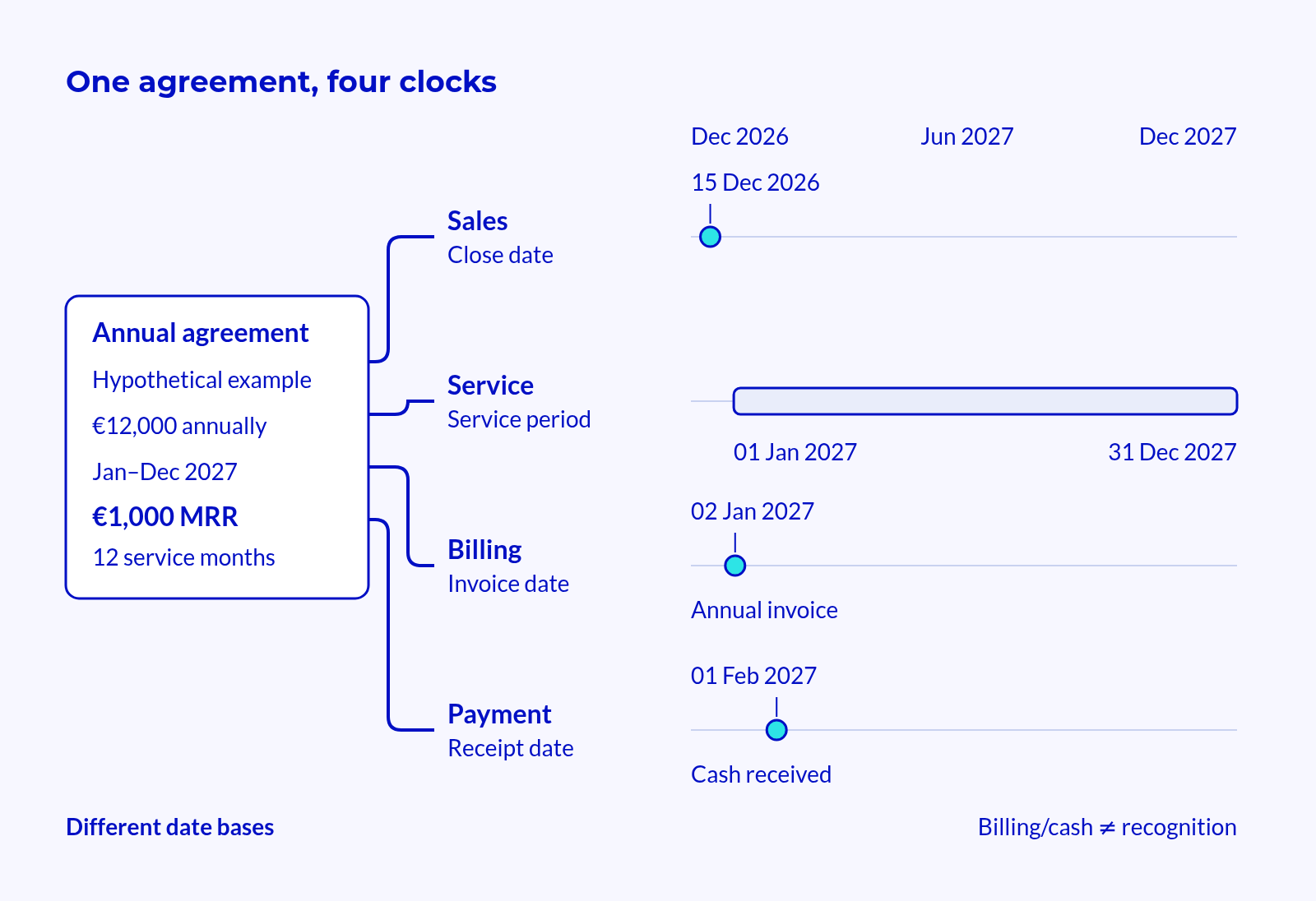
The date basis matters:
- Close date shows when sales recorded the win.
- Service start shows when the agreed service period begins.
- Invoice date shows when finance raised the bill.
- Payment date shows when the customer paid.
A contract can link these events while keeping each date and measure distinct.
For CRM reporting, shared commercial context links recurring revenue to its contract, timing, and ownership. Teams can then explain why totals differ instead of searching spreadsheets for the terms behind each amount.
Traceability checks:
- Does the amount link to approved terms?
- Can the reader find the period it covers?
- Does it have a named owner?
- Can finance find the matching external record?
A total that fails these checks needs clearer rules or better source data, not another chart.
Set Inclusion Rules and Reporting Dates
Monthly recurring revenue, or MRR, expresses ongoing commitments as a monthly amount under an agreed policy. Contracted MRR tracks those commitments; it does not replace accounting revenue or show when cash arrives.
Where it applies, IFRS 15 ties revenue recognition to meeting performance obligations. Finance must confirm which accounting rules apply and how the business should use them.
Assume a hypothetical fixed recurring fee of €12,000 over twelve service months, with no tax, usage charges, or setup fees. Under the stated policy, active contracted MRR is €1,000. The annual invoice and its payment remain separate billing and cash events.
Policy decisions:
- Define included charges.
- State how discounts affect recurring value.
- Keep one-off fees separate from ongoing service fees.
- Define timing.
- Set rules for future starts and when cancellations take effect.
- Record the reporting timezone and period cut-off.
- Define variable amounts.
- State whether committed usage belongs in contracted MRR.
- Show currency effects separately from growth in contract value.
Finance owns the metric policy, while revenue operations, or RevOps, puts the agreed rules into practice. Each exception needs an approver and a recorded reason that explains the departure from policy.
Build the Shared Contract Record and Its Associations
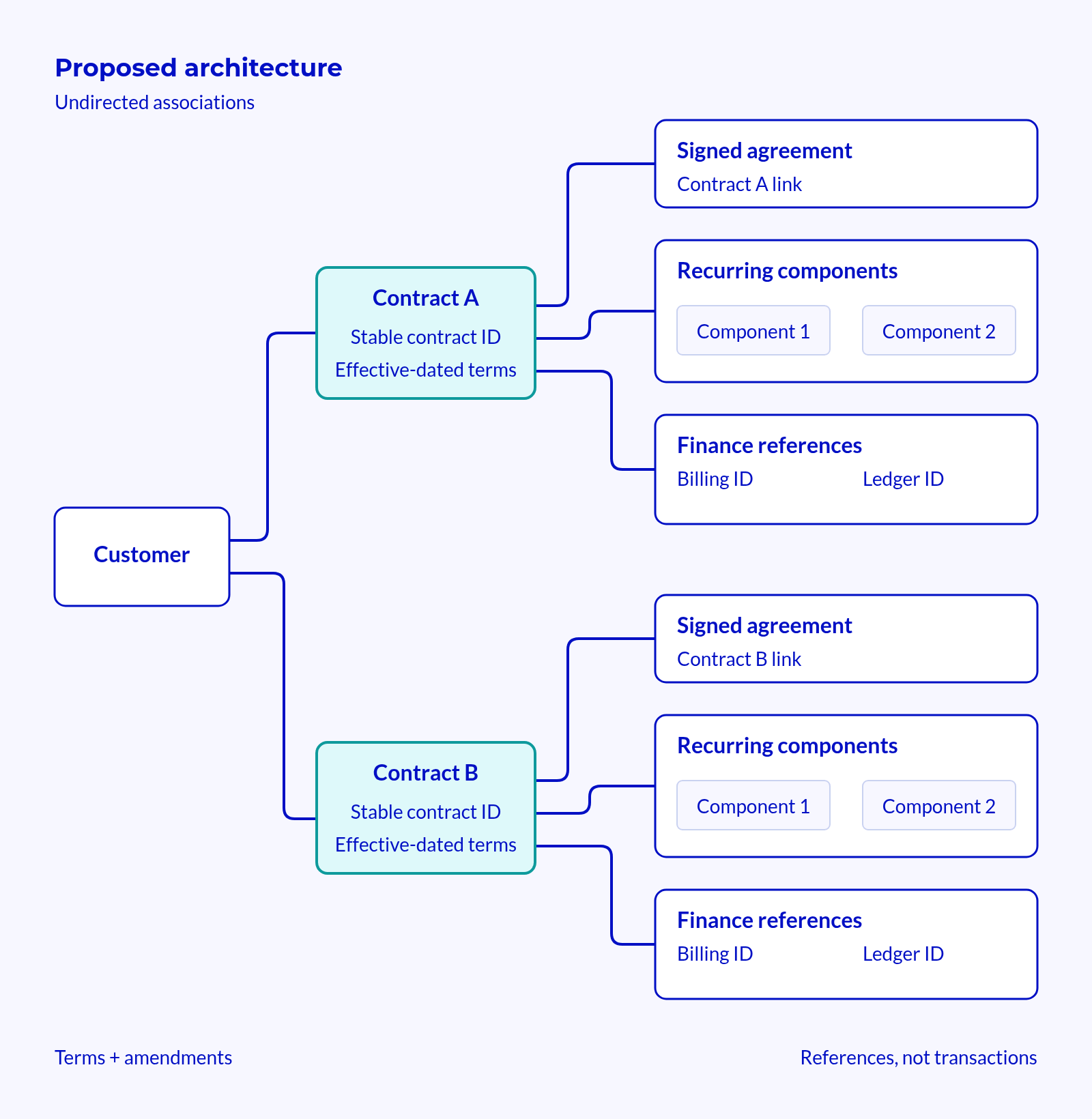
A shared record holds the terms, dates, and owners that teams need for reports and handoffs. It links to the signed agreement and finance records rather than replacing either source.
Define Field Ownership and Stable Identifiers
“One record” means a shared reference that teams can follow, not a physical row holding every transaction.
The model needs terms, stable IDs, effective dates, owners, and links to the records behind them. Each field also needs a trusted source and a clear rule for accepting changes.
Minimum commercial field map:
| Field | Business Meaning | Authoritative Source | Accountable Owner | Validation |
|---|---|---|---|---|
| Contract identifier | Stable agreement key | Managed contract register | RevOps | Unique and not blank |
| Customer identifier | Key for matching customers | Chosen customer master | RevOps and finance | Links to the correct account |
| Agreement reference | Signed terms and amendments | Agreement store | Commercial operations | Approved terms stay accessible |
| Status and currency | Contract state and amount currency | Approved terms and process | Commercial operations and finance | Uses agreed values |
| Recurring components | Separate ongoing commitments | Agreement or amendment | Commercial owner | Includes the periods when each applies |
| Service dates | Start and end of service | Approved terms | Commercial operations | Dates agree with the terms |
| Notice deadline | Due date for contract notice | Agreement | Contract owner | Includes its basis and timezone |
| Scope and obligations | Purchased services and promises | Agreement and approved scope | Commercial owner | Receiving team can act |
| Sales and customer success owners | Sending and receiving owners | Team assignment process | Team leaders | Named before acceptance |
| Finance references | External account and billing links | Finance mappings | Finance operations | Links reach the correct records |
Customer names and email domains help people search, but they make weak keys for matching records. Names change, and a customer can hold several agreements.
For contracts, the contract data model defines how fields and links connect without merging separate agreements. A customer may hold several contracts, each with recurring fees that apply during different periods.
Check what the portal supports before choosing how to build the model. Standard objects, a custom object, or a linked model are possible choices, not features every portal includes.
Architecture checks:
- Confirm record support.
- Check the relevant plan and access rights.
- Check support for record links and reports.
- Confirm history support.
- Check how teams retain approved changes.
- Check whether they can reproduce prior periods.
Preserve Amendments and Effective-Dated History
An amendment has a recorded date and an effective date, and the dates need not match. Reports must use the right date to show when revised terms apply.
Keep versions, schedules, or stored change events that show which terms applied during each reporting period.
Change evidence:
- Previous and revised recurring amounts.
- Effective start and end dates.
- Recorded date, reason, and approval reference.
- Links to the affected contract components.
Do not overwrite the only stored amount and expect today’s value to explain what happened in past months. Property history alone does not establish a reliable model for reporting past MRR.
💡 Insight
Today’s balance can be correct while past revenue reports are wrong if amendments erase the terms that applied before them.
A subscription record also needs a clear scope within the model. It represents the arrangement used in the setup, which can not cover the full signed agreement.
Build Recurring Revenue Reports Without Double-Counting
Useful totals start with a written rule for what each row in the report represents. The date basis, included states, currency, and method for adding values must agree.
Define the Report Grain Before the Dashboard
The grain defines what a row represents, such as a recurring component active at the reporting cut-off. It keeps the report from mixing contract commitments with contacts, invoices, or other linked records.
Check that the chosen sources and record links preserve this row definition before accepting the report total.
In a hypothetical example, a recurring component links to two contacts in the same customer account. Its value must not double because the report returns a separate row for each contact.
Report specification:
- Name the measure and the business question it answers.
- Define each row and its source fields.
- State the effective date and cut-off.
- List included and excluded contract states.
- Record currency rules and how to add values.
- Define the test for sample records.
Useful views:
- Current contracted MRR shows active recurring commitments.
- Monthly movements explain changes between periods.
- Future contracted value stays separate from active MRR.
- Exceptions show missing fields, broken mappings, and gaps that need an explanation.
A HubSpot reporting template cannot decide these rules on behalf of the business.
Compare the source rows with approved contract terms before accepting the total. Include customers with multiple contracts and components, since simple accounts can hide joins that count values twice.
Reconcile Opening MRR to Closing MRR
A growth report needs to show lost and reduced fees as clearly as new and increased fees. Benchmarkit’s retention report puts median gross revenue retention at 84% for calendar 2025, versus 88% for calendar 2024.
That benchmark does not show that reporting caused the decline. It adds context for tracking contraction and churn alongside expansion rather than showing gains alone.
Movement bridge:
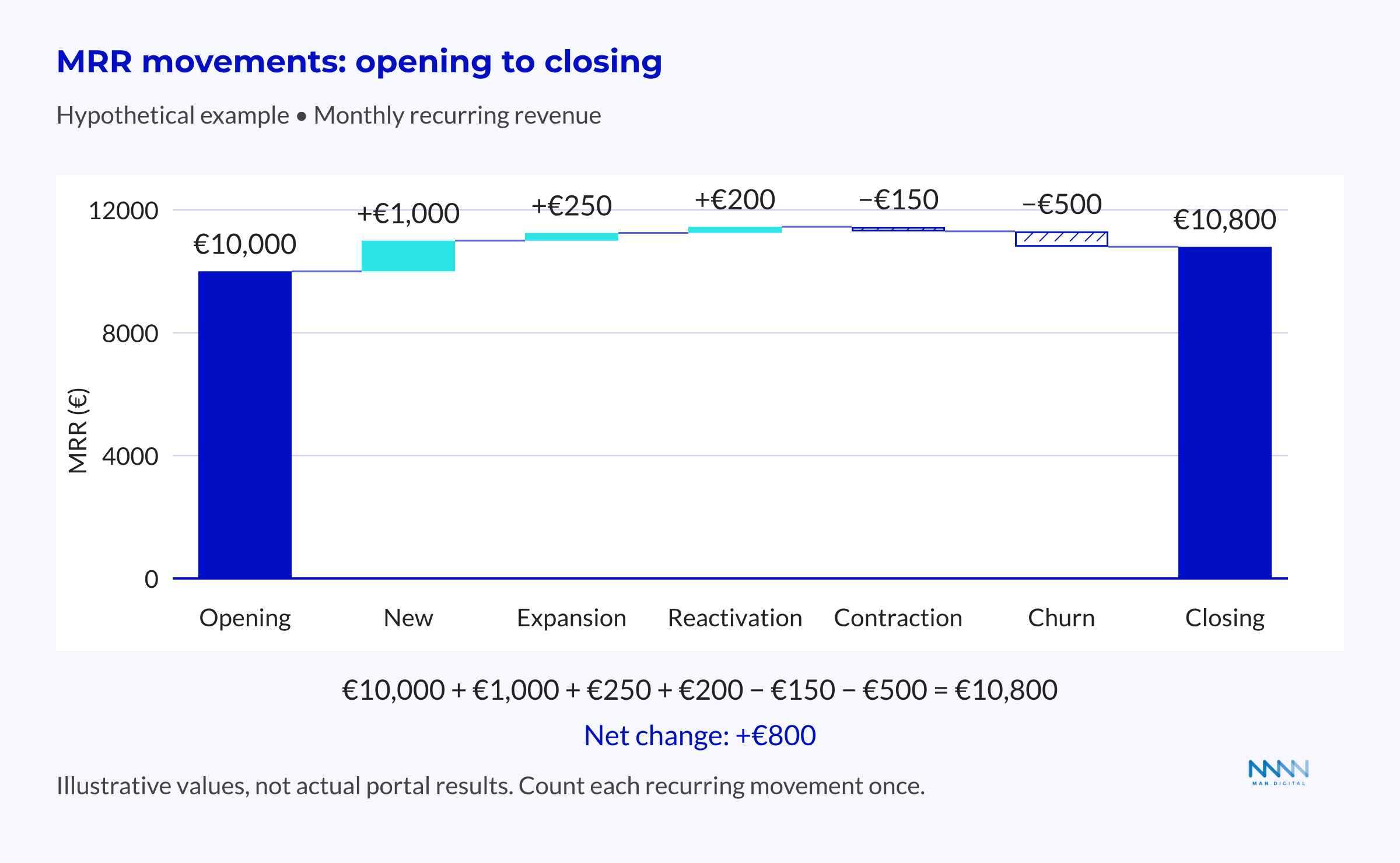
Opening MRR + new + expansion + reactivation − contraction − churn = closing MRR.
Set event rules for each component so the same change cannot enter more than one category. New means first activation, expansion means an increase, and reactivation means a return under the agreed policy.
Contraction reduces an active commitment, while churn ends its remaining recurring value. A renewal at unchanged value is not automatically new MRR, even if sales records a new deal.
Consider a hypothetical upgrade from €1,000 to €1,250 MRR, effective 1 October. Under a month-end policy, October expansion is €250. Entering the amendment in September does not create September expansion.
Hypothetical portfolio bridge:
- Opening MRR: €10,000.
- New: +€1,000.
- Expansion: +€250.
- Reactivation: +€200.
- Contraction: −€150.
- Churn: −€500.
- Closing MRR: €10,800.
The bridge needs stored events or period snapshots, not just the current balance shown on each record.
Check whether the chosen portal model supports the required calculations and retained history. Test past periods and refresh timing against the agreed report rules before approving the setup.
Make the Customer Success Handoff an Accepted Workflow
Customer success owns the work that helps customers gain value from the services they bought. A closed-won alert should start a handoff check, not serve as proof that the receiving team is ready.
Transfer Scope, Obligations, and Renewal Context
The contract record must carry the promises that affect how the team delivers the service. A signed agreement can be valid even when onboarding lacks the contact or input needed to start.
📊 Fact
ChurnZero’s 2026 study found a median existing-customer revenue share of 70% among surveyed companies (customer revenue study).
That figure shows where revenue comes from, not the rate of retention or growth. It gives handoffs a revenue context without proving that a shared record improves customer outcomes.
Handoff acceptance checklist:
- Confirm the commercial basis.
- Make signed terms and amendments easy to find.
- Record scope, purchased rights, and key promises.
- Confirm delivery readiness.
- Name the key contacts and the person leading setup.
- Record service dates, required inputs, and service duties.
- Confirm ongoing ownership.
- Assign a named customer success owner.
- Transfer renewal terms and the notice deadline.
Keep what the customer has a right to receive separate from their health score. The score can guide where teams focus their effort, but it does not change purchased scope or agreed service duties.
The contract states what the customer bought; delivery records show how the team plans and completes that work.
Define Acceptance Checks and Missing-Data Routes
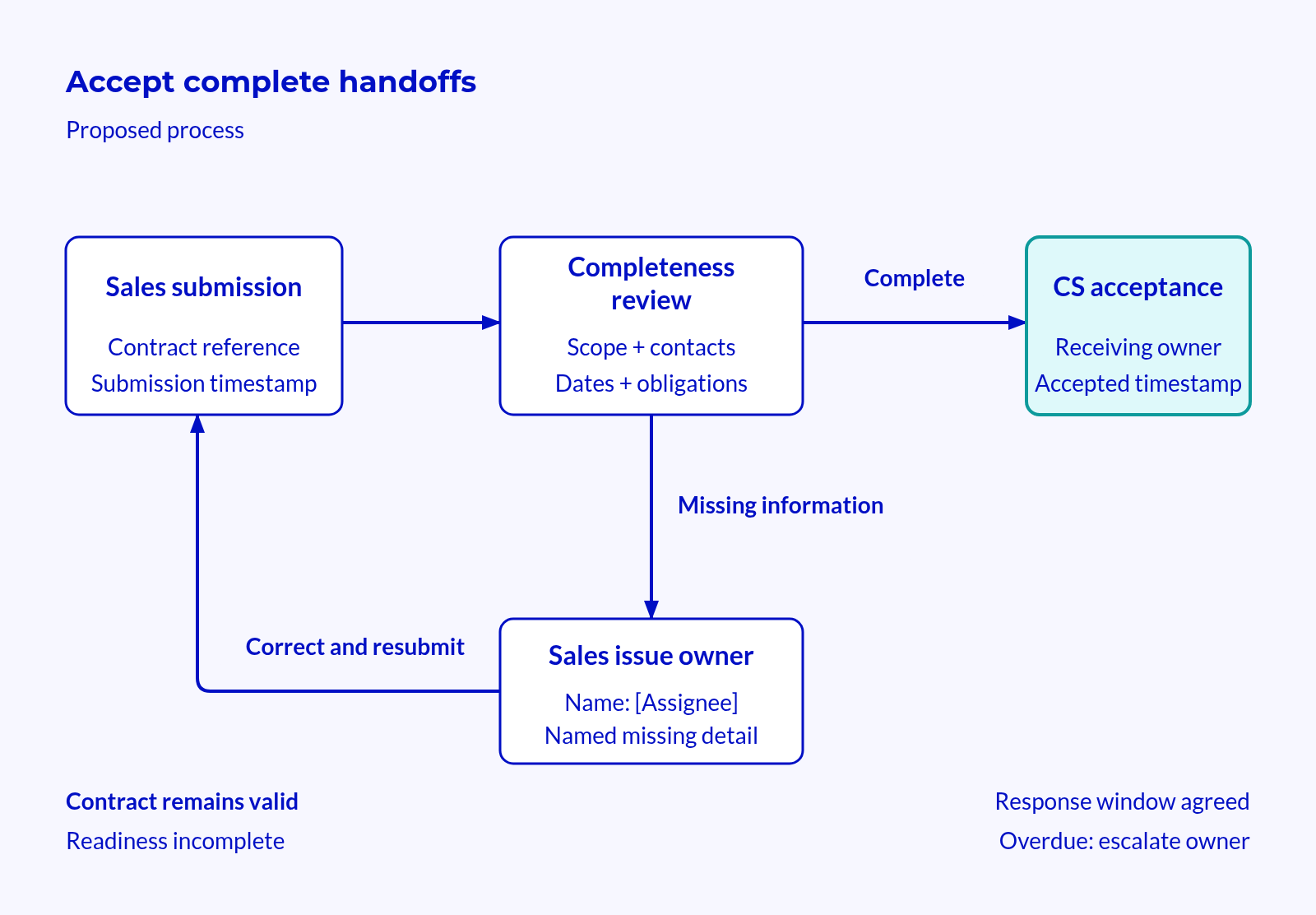
Sales submits the handoff with the contract reference, and the receiving owner accepts it or returns a named issue.
Acceptance evidence:
- Submitted state and submission timestamp.
- Named receiving owner.
- Accepted state and acceptance timestamp.
- Missing details and issue owner, where relevant.
- Agreed response window and route for overdue issues.
In a hypothetical handoff, the recurring fee and service dates are correct, but the person leading setup is missing. Keep the contract status valid while marking onboarding readiness incomplete. Return the missing-contact issue to its owner rather than treating the handoff as complete.
Measure time to acceptance from consistent timestamps that both teams use. Keep time spent waiting for sales details separate from time spent waiting for the receiving team’s decision.
💡 Tip
Record why a handoff returns, not just that it returned, so teams can spot gaps that recur across deals.
Workflows or automated tasks can support this process where the portal permits them. Check the relevant support before turning the proposed process into a live workflow.
Reconcile Contract Context with Finance Without Replacing the Ledger
Finance compares named measures at a shared cut-off and explains why the amounts differ. Contracted MRR does not need to equal invoices, payments, or recognised revenue because each answers a different question.
Assign an Owner to Each Discrepancy
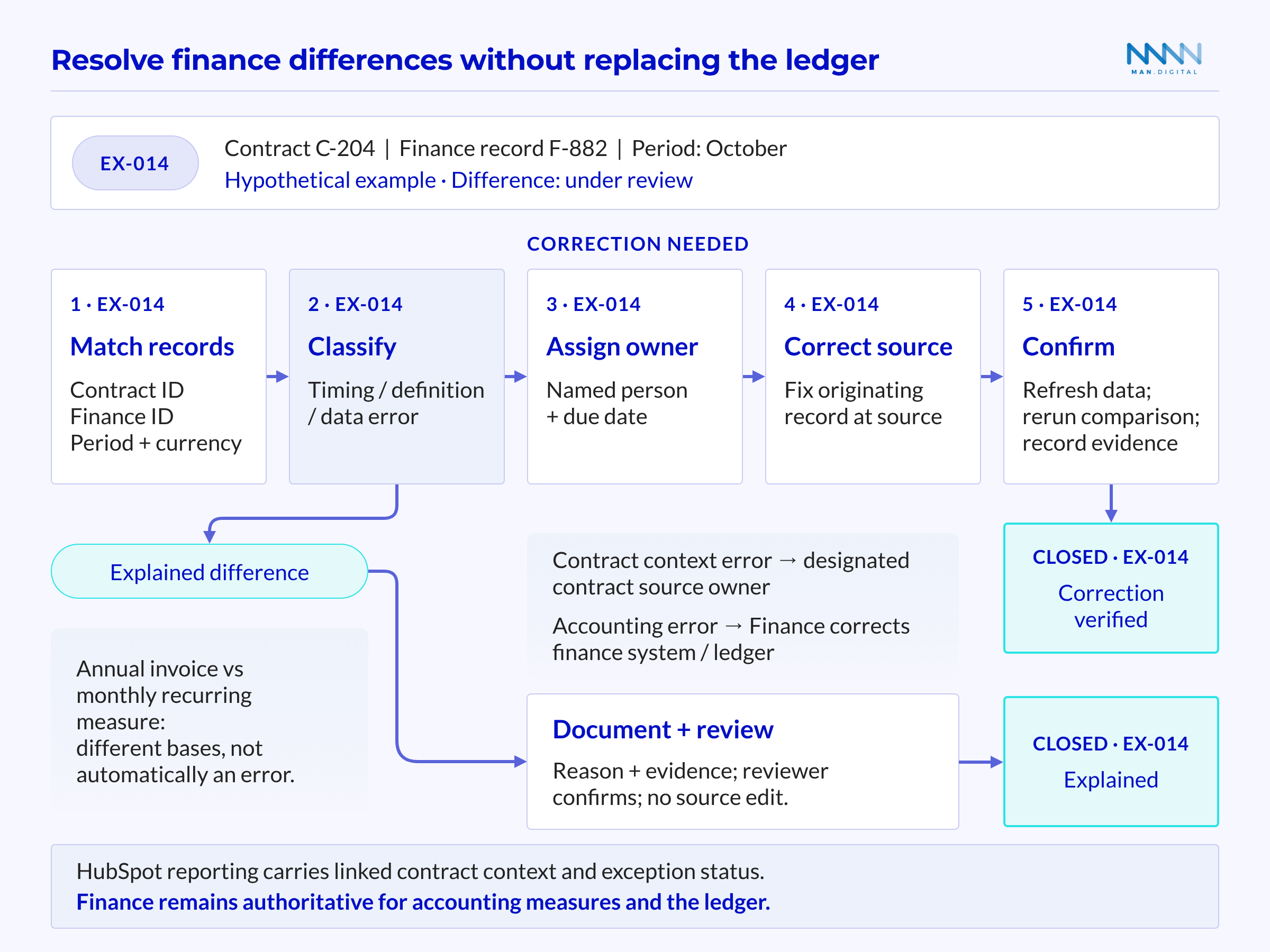
Match stable customer and contract IDs before comparing amounts across the systems. Then separate expected differences, such as billing timing, from errors in the source data.
An annual prepayment can create a billing difference without creating an error in contracted MRR.
Difference categories:
- Timing differences, including future starts and invoice dates.
- Billing scope, including one-off fees and tax.
- Credits that need an approved treatment.
- Currency effects under the agreed rate policy.
- Contract values that conflict with approved terms.
- Missing mappings or stale synced data.
Keep the basis for comparison visible beside each difference so reviewers know what they are comparing. A gap without an explanation belongs in a queue with an owner, not an edited spreadsheet total.
Hypothetical finance exception queue:
| Contract Reference | Reason | Owner | Next Action | State And Closure Evidence |
|---|---|---|---|---|
| PILOT-A | Annual invoice compared with monthly commitment | Finance analyst | Check billing schedule and service period | Explained with invoice references |
| PILOT-B | Recurring value conflicts with amendment | Commercial owner | Correct the value in the approved source | Open until approved terms and report agree |
| PILOT-C | Missing finance account reference | Finance operations | Check the stable mapping | Closed when the correct account links |
| PILOT-D | Setup fee included in invoice total | Finance analyst | Separate the one-off charge | Explained with invoice-line evidence |
| PILOT-E | Approved change missing downstream | Integration owner | Inspect and reprocess the failed transfer | Closed after the target shows the change |
Each correction needs a clear source of truth that governs the value. Finance controls financial postings and accounting treatment, while approved contract terms govern the relevant contract fields.
Do not edit both systems independently to force their totals to match, since that can hide the cause and create conflicting updates.
Before relying on a connector, review its supported mappings, sync direction, conflict rules, and failure handling.
Validate the Pilot and Keep the Revenue View Governed
A pilot tests whether the model explains real contract cases before the team moves more records. Include the cases the business handles rather than choosing only clean contracts that are easy to report.
Pilot cases:
- Annual prepayment and future service start.
- Mid-term expansion and effective cancellation.
- Customers with multiple contracts.
- Multiple recurring components or one-off charges.
Pilot acceptance:
- Each amount links to its agreement, component, period, and policy.
- Future commitments stay outside active MRR.
- Linked records do not multiply recurring value.
- Opening MRR plus movements equals closing MRR.
- Handoffs retain evidence of acceptance.
- Differences have recorded reasons or named owners.
Define the evidence needed to close an issue before the pilot starts. A corrected field is not enough if downstream reports still show the old value.
RevOps owns the model and report rules, while finance owns metric policy. Customer success owns handoff acceptance. Where a connection exists, its owner handles transfer failures.
Set a review schedule for open issues, source changes, and metric definitions. Each change needs approval, a check of its effects, and pilot tests the team can run again.
Assessment → Backbone → Run puts this work in order: find the gaps, build the model, then maintain it.
AI comes after the workflow can support reliable action, with clear owners and trusted source data.
Frequently Asked Questions
Teams can share contract terms while keeping their own measures and duties. The main choices are how to store contracts, retain past terms, and link records to finance.
Does HubSpot Reporting Require a Native Contracts Object?
No universal native Contracts object is assumed in this design. A shared contract reference can use supported records, a suitable custom object, or a linked model. The choice depends on the portal’s plan, record links, access rights, reporting needs, and history support.
Traceable terms and named owners matter more than the object label used to hold them.
Can a Shared Contract Record Replace Finance Reconciliation?
No, because contract commitments, invoices, cash, and recognised revenue answer different questions. A shared record supplies stable IDs, terms, dates, and owners that make comparisons clearer. Finance still controls accounting treatment and financial postings.
Expected differences need explanations, while data errors need owners, corrections in the approved source, and proof that downstream views show the fix.
Conclusion
Shared contract context makes HubSpot reporting easier to explain when each amount links to its terms, period, and source. The record shows whether a gap comes from billing timing, a changed fee, or missing data.
Today’s balance alone cannot explain past months or prove that customer success accepted a handoff. Stored amendments, acceptance timestamps, and evidence of resolved issues supply that detail without replacing finance’s controlled systems.
Key Takeaways
- Contracted MRR is distinct from bookings, invoices, cash, and recognised revenue.
- A shared contract record links terms, effective dates, owners, and finance records.
- Retained amendments and tested report grain protect recurring revenue totals.
- Customer success handoffs need evidence of acceptance, not just alerts.
- Data errors need corrections at the approved source; expected differences need recorded reasons.