
September 2, 2026
8 min read
Many B2B SaaS companies, however, face a different configuration problem.
HubSpot presents CPQ within a connected revenue platform rather than as an isolated quoting tool.
This model links configuration to customer data, approvals, contracts, billing, and renewals.
It shows why a correct quote depends on more than selecting the right product.
For manufacturers, a bad configuration can place the wrong motor inside a machine. For SaaS teams, every screen can look correct while the contract remains impossible to deliver. The right configurator must prevent the incompatibilities that put your revenue process at risk.
What a Product Configurator Actually Does
A product configurator turns a complex offer into a controlled set of choices. It guides users toward valid combinations and blocks conflicting selections. The resulting configuration becomes the basis for pricing, approval, and quoting.
It Converts Product Knowledge Into Rules
Many products depend on knowledge held by sales engineers, product managers, or experienced sellers. A configurator captures that knowledge as options, rules, dependencies, and limits.
For the wider category definition, start with what CPQ means. The configurator handles the first commercial task: determining what the customer can buy.
A useful configuration model controls several areas:
- Available products
- Which products appear for each market or customer type
- Which products require another product or service
- Which products cannot appear together
- Selectable options
- Sizes, materials, modules, plans, and service levels
- Required and optional components
- Default choices for common deals
- Compatibility rules
- Technical fit between physical parts
- Commercial fit between packages and contract terms
- Delivery limits based on region or service capacity
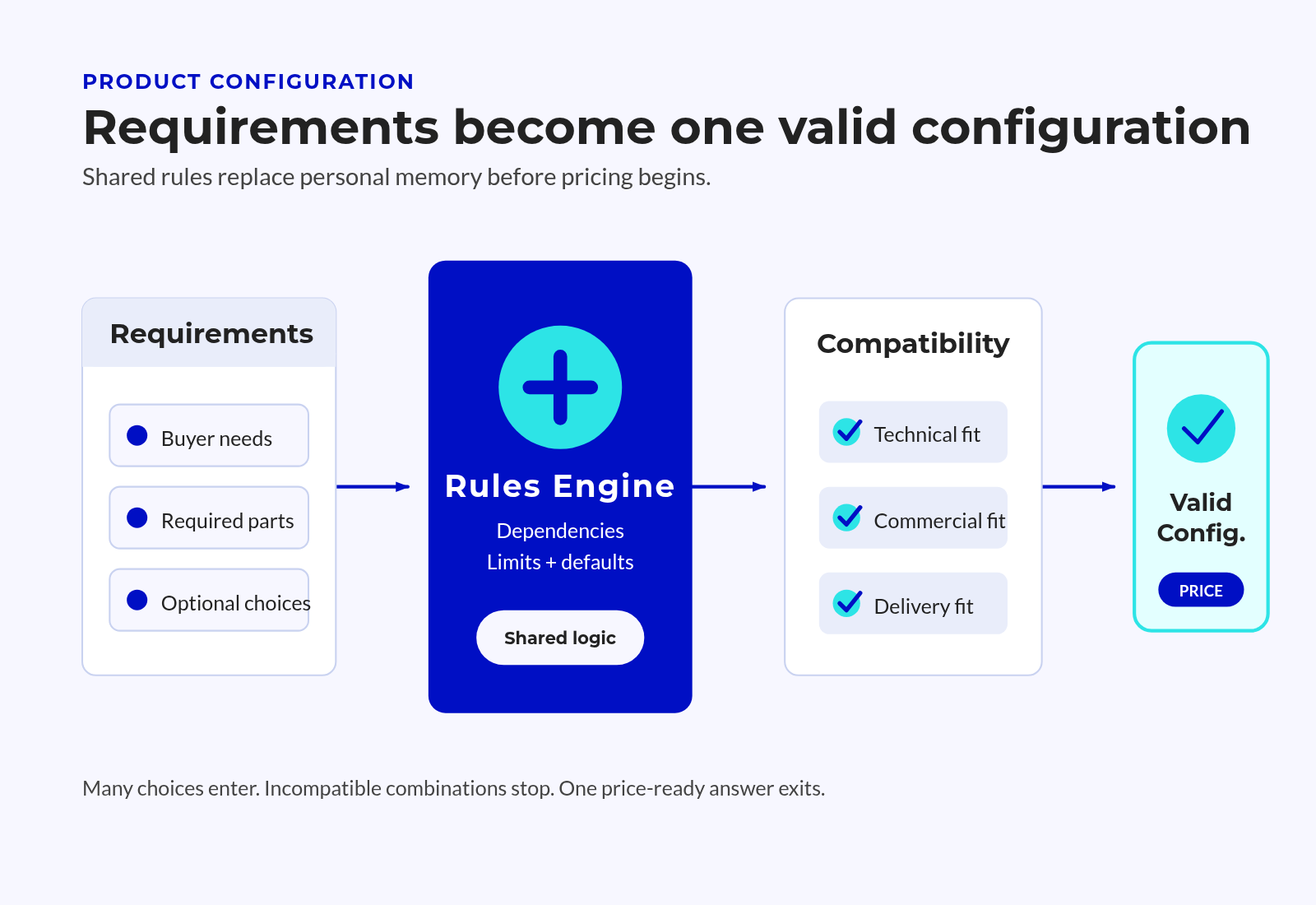
These rules replace personal memory with a shared system. The business no longer depends on a few people remembering every product exception.
It Produces a Valid Commercial Output
A configuration creates value only when downstream processes can use it. Its output can be a parts list, service bundle, subscription package, or structured set of quote lines.
Infor describes CPQ as a guided process connecting configuration, pricing, and proposal creation. That connection matters because a valid product can still carry the wrong price, approval path, or contract.
A complete output should tell downstream teams:
- What the customer selected
- Which options were included
- Which dependencies affected the selection
- What pricing logic applies
- Which approvals are required
- What operations must deliver
- What billing must charge
The output should also preserve the reason behind each decision. That context helps teams review exceptions without reconstructing the deal from emails and meeting notes.
💡 Insight
A configurator does more than accelerate a sale. It creates trusted data for finance, legal, delivery, and customer success.
The design of the article, in one line: separate physical configuration from commercial configuration, then choose the control layer that matches your risk.
Visual CPQ vs Rules-Based Configuration
Visual and rules-based configuration solve related problems, but they perform different jobs. One shows what the buyer is building. The other checks conditions that can remain invisible throughout the sale.
Visual Configuration Shows Physical Compatibility
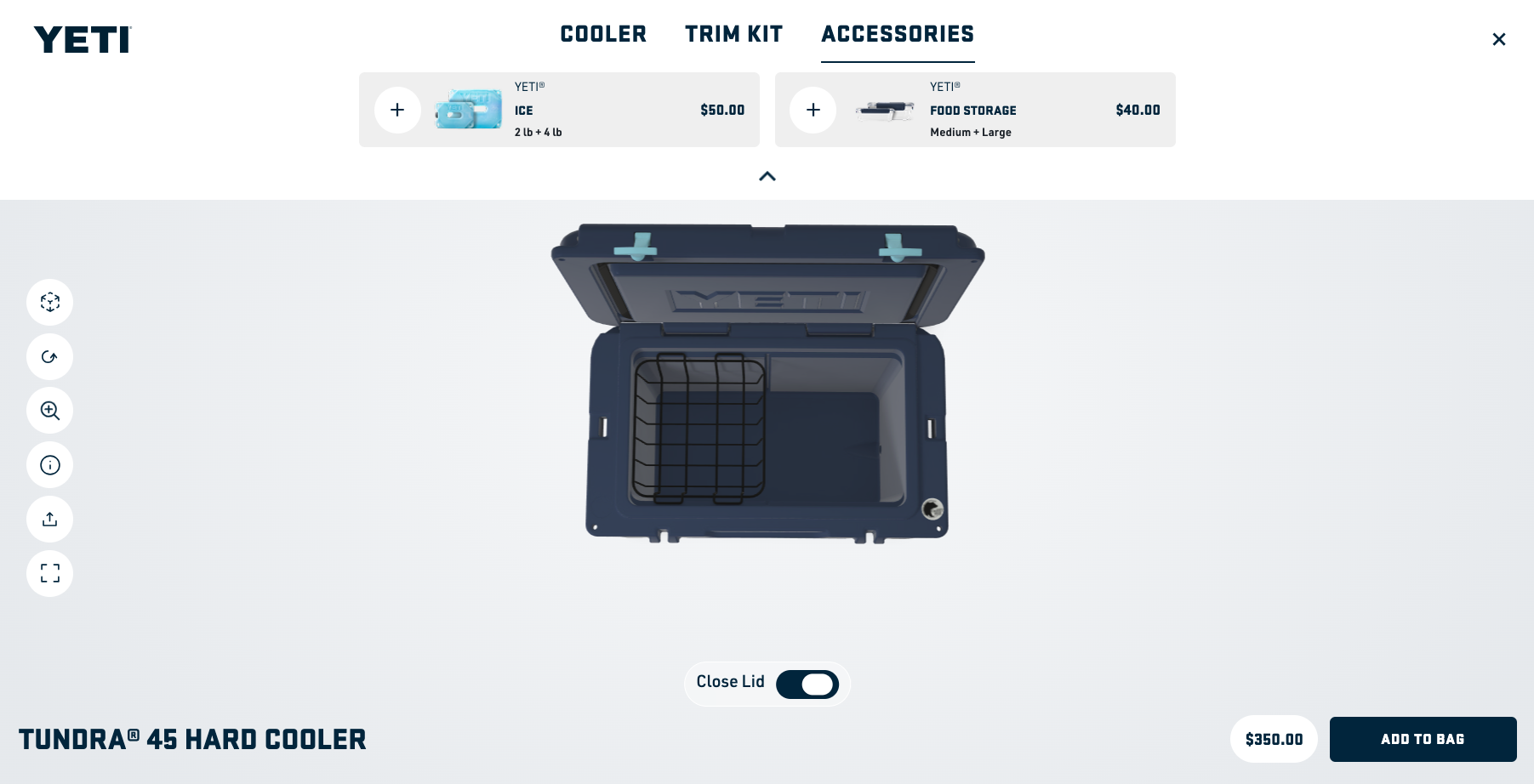
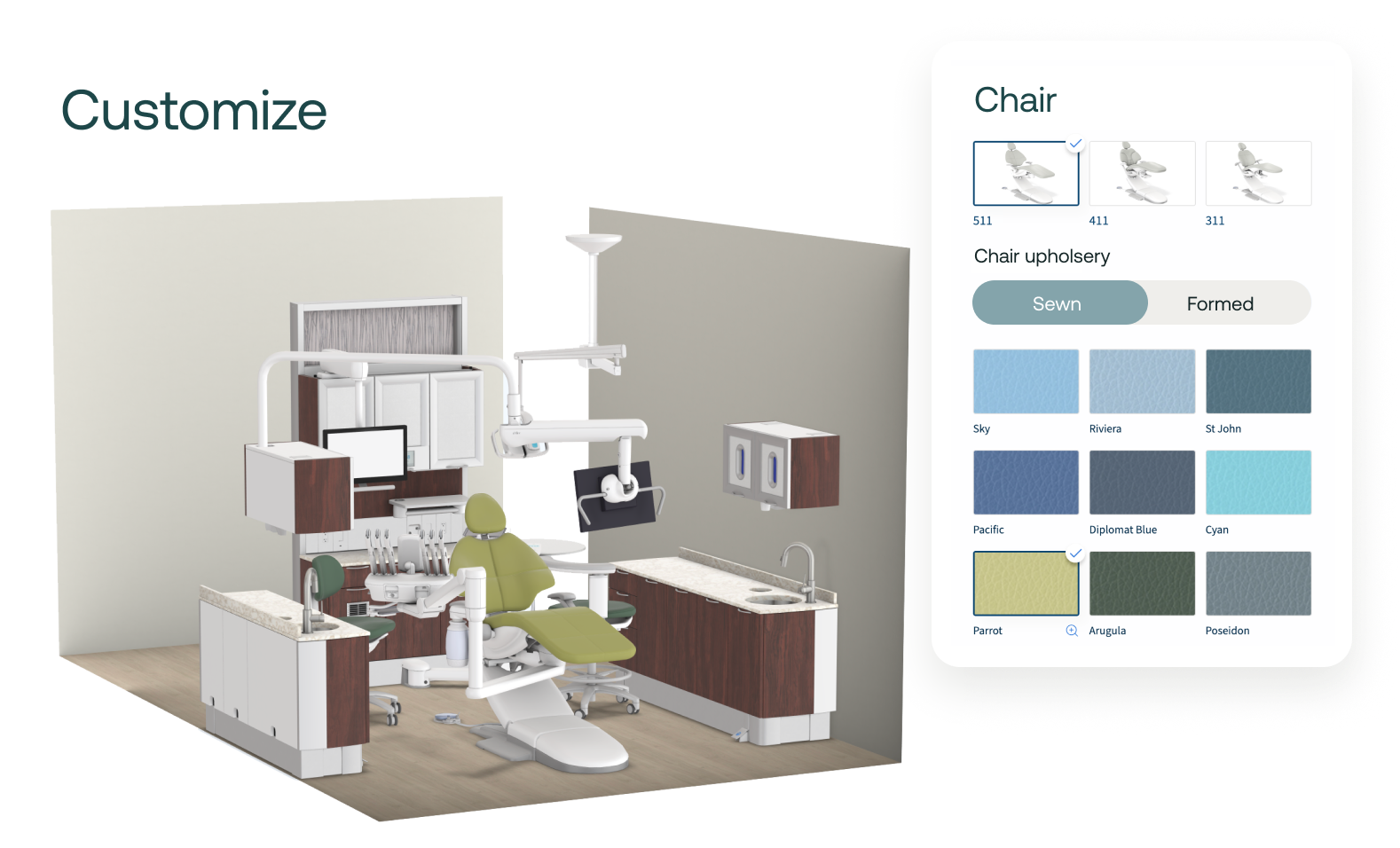
Visual CPQ displays the configured product while the user makes choices. The image changes when someone selects a different component, colour, layout, dimension, or accessory.
This approach works when appearance and physical fit shape the buying decision. Buyers can inspect the result before production begins, reducing uncertainty about what they will receive.
Cincom explains visual CPQ as a combination of guided selling and visual product representation. The visual layer may use images, drawings, or interactive models.
Visual configuration usually answers questions like these:
- Will this component fit the selected frame?
- Does this layout leave enough space?
- How will the chosen material look?
- Which accessory matches this model?
- What changes after the buyer selects another size?
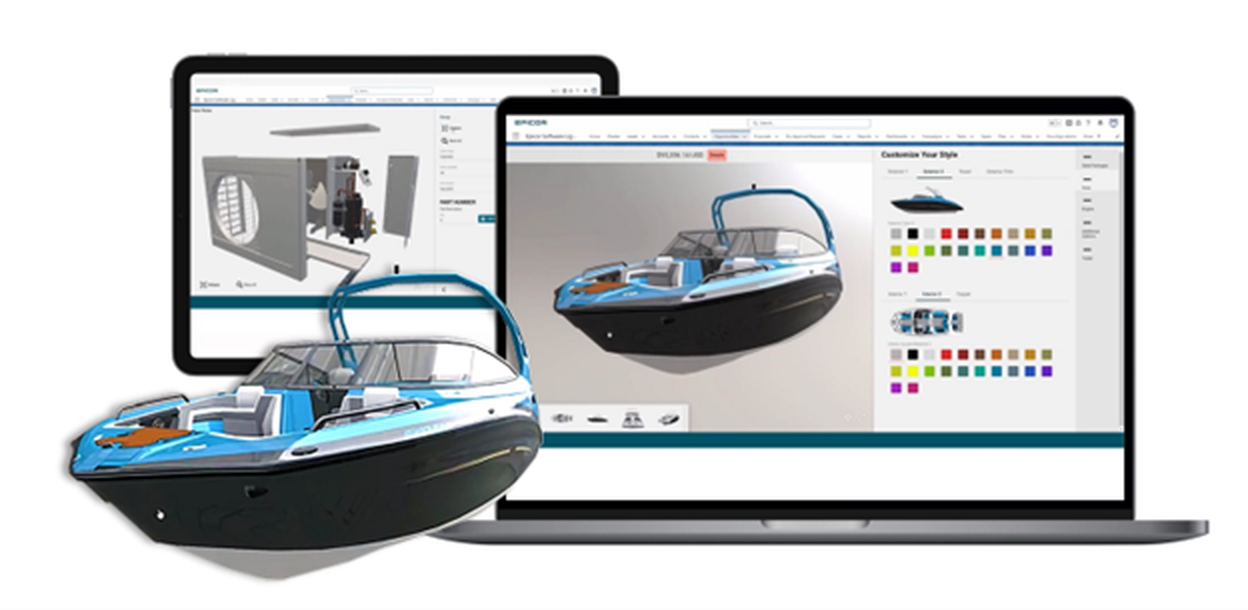
The picture is not decoration. It gives buyers and sellers visible evidence that the selected physical combination makes sense.
Rules-Based Configuration Checks Invisible Conditions
Rules-based configuration can work without a detailed product image. It checks relationships between products, customer data, prices, contracts, and delivery conditions.
| Decision Area | Visual Configuration | Rules-Based Configuration |
|---|---|---|
| Main problem | Physical fit and appearance | Commercial fit and policy |
| Typical inputs | Parts, dimensions, colours, layouts | Plans, terms, regions, usage, entitlements |
| User feedback | Updated product view | Warning, blocked choice, or approval |
| Common output | Valid product design | Valid commercial package |
| Main risk reduced | Product cannot be built | Contract cannot be delivered or billed |
What this means in practice: a configuration can look correct while violating a commercial rule. A discount can conflict with the contract term, but no product image will expose the error.
Rules-based controls can detect problems such as:
- A product that is unavailable in the buyer’s country
- A discount that conflicts with the contract length
- A service level that requires a support package
- An add-on that depends on another subscription
- A renewal term that conflicts with the billing schedule
- A service promise that exceeds delivery capacity
These controls can block the selection or request approval. They can also show the seller which condition caused the problem and what must change.
💡 Tip
Write each commercial rule as one plain sentence before building the automation. If RevOps cannot explain the rule clearly, the CRM cannot enforce it reliably.
Where Visual CPQ Came From, and Why It Still Matters
Visual configuration developed in industries where products contain many physical choices. Buyers needed a reliable way to combine parts without creating an impossible design. Complex physical products still create that need.
Complex Products Made Visual Guidance Necessary
Consider a machine with frames, motors, safety parts, and control units. Each selection determines which later options remain valid.
A product expert can understand these dependencies through years of experience. A new seller or buyer will not share that knowledge.
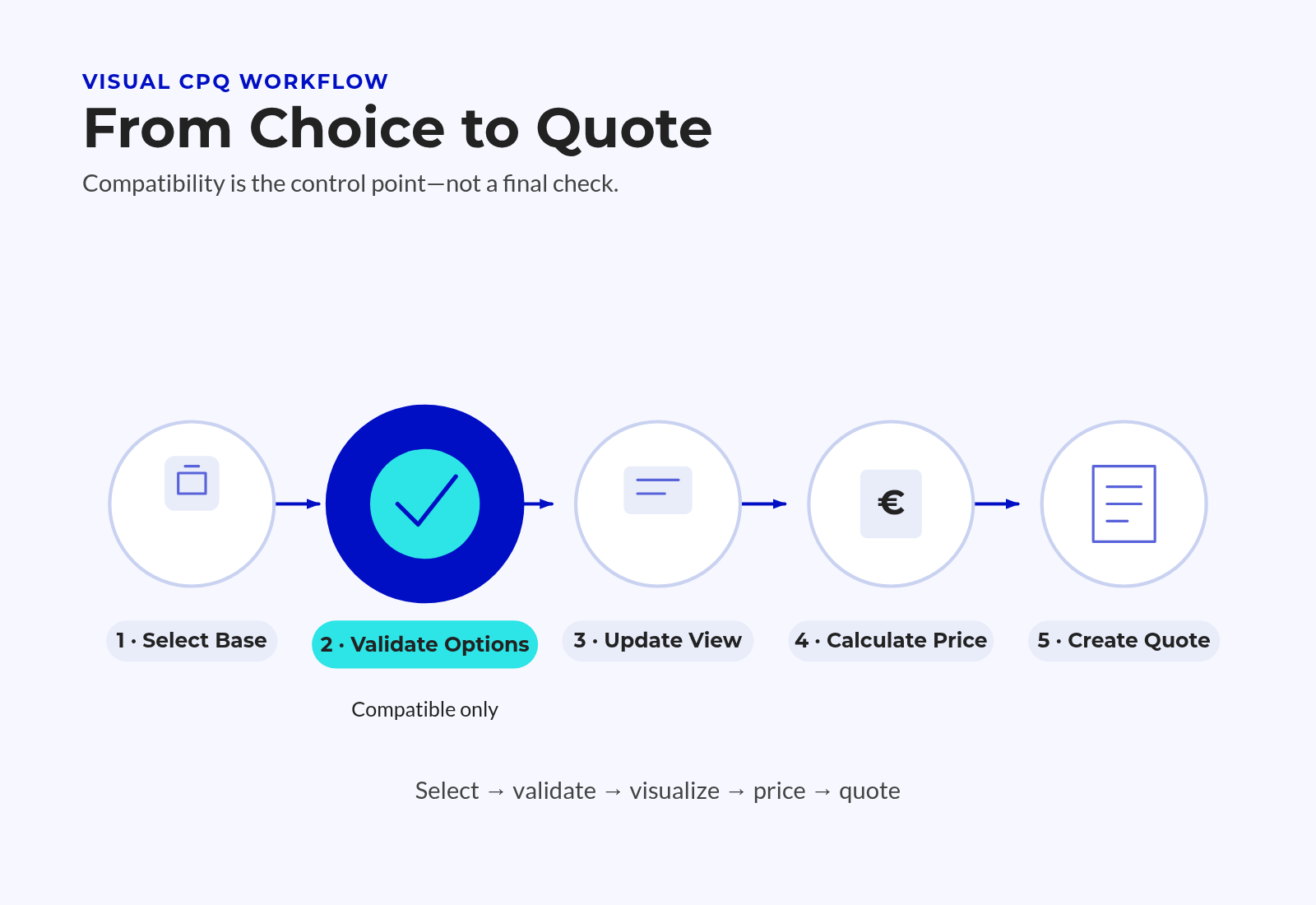
A visual configuration workflow follows a clear sequence:
- The user selects a base product.
- The system presents compatible options.
- Each choice changes the remaining options.
- The visual model reflects the current design.
- The valid configuration moves into pricing.
This workflow prevents sellers from promising products that engineering cannot build. It also helps buyers understand exactly what they will receive.
VividWorks describes visual configuration as a connected flow across selection, visualization, pricing, and quotation. This sequence keeps the product model tied to its commercial output.
The Visual Layer Still Supports Better Decisions
A visual interface remains useful when buyers care about shape, space, materials, or placement. It lets them compare choices without working through a dense technical catalogue.
Examples of how teams can use the visual layer include:
- Discovery
- The seller presents possible layouts during the conversation
- The buyer explains preferences using the model
- Configuration
- The system removes incompatible parts
- The visual changes after each selection
- Approval
- Stakeholders review the same design
- Fewer details remain open to interpretation
- Handoff
- Operations receives a structured configuration
- The final quote reflects the approved model

The image gives the buyer, seller, and delivery team a shared reference. Everyone reviews the same selected product instead of interpreting separate notes.
Visual CPQ matters most when seeing the product improves understanding. It matters less when the complexity lies in rights, dates, terms, and usage rules.
📝 Note
A polished product image cannot compensate for weak data. The visual layer must use the same rules and identifiers as pricing, quoting, and fulfilment.
When a B2B SaaS Company Does Not Need a Visual Configurator
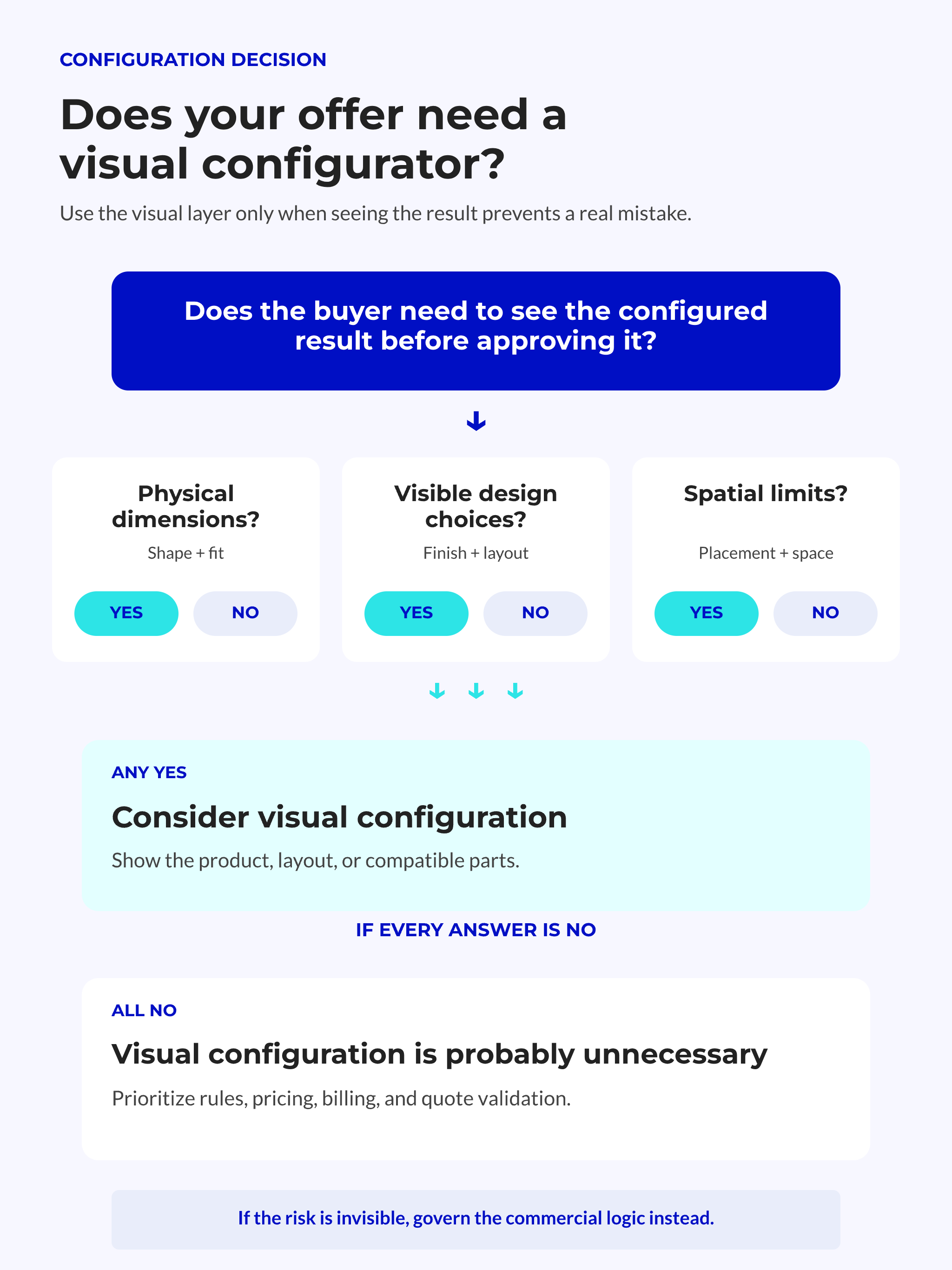
Most B2B SaaS offers do not contain parts that must fit within a physical space. They combine plans, licences, usage bands, services, and contract terms. A live rendering adds little value when nothing physical changes.
The Buyer Does Not Need a Product Model
A SaaS buyer must understand feature access, user limits, service scope, and billing terms. They rarely need to rotate an interactive model of their subscription.
A B2B SaaS company does not need a visual configurator when:
- Products have no physical dimensions
- Buyers cannot change a visible design
- Configuration depends mainly on contract terms
- The offer uses standard plans and add-ons
- Delivery teams need scope data rather than drawings
- Pricing changes through volume, usage, or commitment
- The final package is understood through text and tables
A visual layer can still help when SaaS includes:
- Designed customer portals
- Custom layouts or branded assets
- Physical equipment sold with software
- Connected devices with compatible parts
- Spatial plans that buyers must approve
The absence of a visual requirement does not remove configuration complexity. It changes where that complexity exists.
Commercial Errors Do Not Look Broken
This is the central configuration problem for SaaS revenue teams.
A seller can select a plan, add services, apply a discount, and create a professional quote. Every field can appear complete. Yet the package can still conflict with billing rules, company policy, legal terms, or delivery capacity.
Common invisible failures include:
- Contract mismatch
- Subscription and service terms use different dates
- Renewal notice terms conflict with the signed agreement
- Packaging mismatch
- An add-on appears without its required base plan
- A feature appears in a market where it is unavailable
- Pricing mismatch
- A discount exceeds policy without approval
- A usage tier does not match the quoted volume
- Delivery mismatch
- Services promise work outside the agreed scope
- The proposed start date ignores onboarding capacity
- Billing mismatch
- The billing schedule conflicts with the contract
- Usage charges lack the data needed for invoicing
These errors often surface after signature. Finance, legal, implementation, or customer success then discovers what the sales process failed to catch.
The quote looked valid because the interface displayed no warning. The commercial package was still wrong.
The Configuration Complexity SaaS Companies Actually Have
SaaS configuration is a revenue workflow problem. The system must connect the offer to customer context, pricing policy, approvals, billing, and delivery. Structured rules matter more than detailed product images.
SaaS Configuration Connects Commercial Dependencies
A SaaS package can appear simple because it contains only several quote lines. The real complexity sits in the relationships between those lines and the wider deal.
Configuration logic can need to evaluate:
- Customer segment
- Market and legal entity
- Product edition
- Number of users
- Expected usage
- Contract length
- Billing frequency
- Discount level
- Required onboarding
- Support commitments
- Renewal conditions
Each answer determines what the seller can offer next. The workflow should guide the seller, block invalid choices, and route valid exceptions for review.
Instruction: Map these dependencies before choosing software.
A practical mapping process includes four steps:
- List the commercial inputs
- Customer profile
- Products and add-ons
- Price and discount terms
- Service and contract conditions
- Define valid relationships
- Required combinations
- Blocked combinations
- Conditional options
- Market-specific limits
- Assign rule ownership
- Product owns packaging
- Finance owns price limits
- Legal owns contract terms
- Delivery owns service capacity
- Connect each exception to an action
- Block the quote
- Request approval
- Create a delivery review
- Return the deal for correction
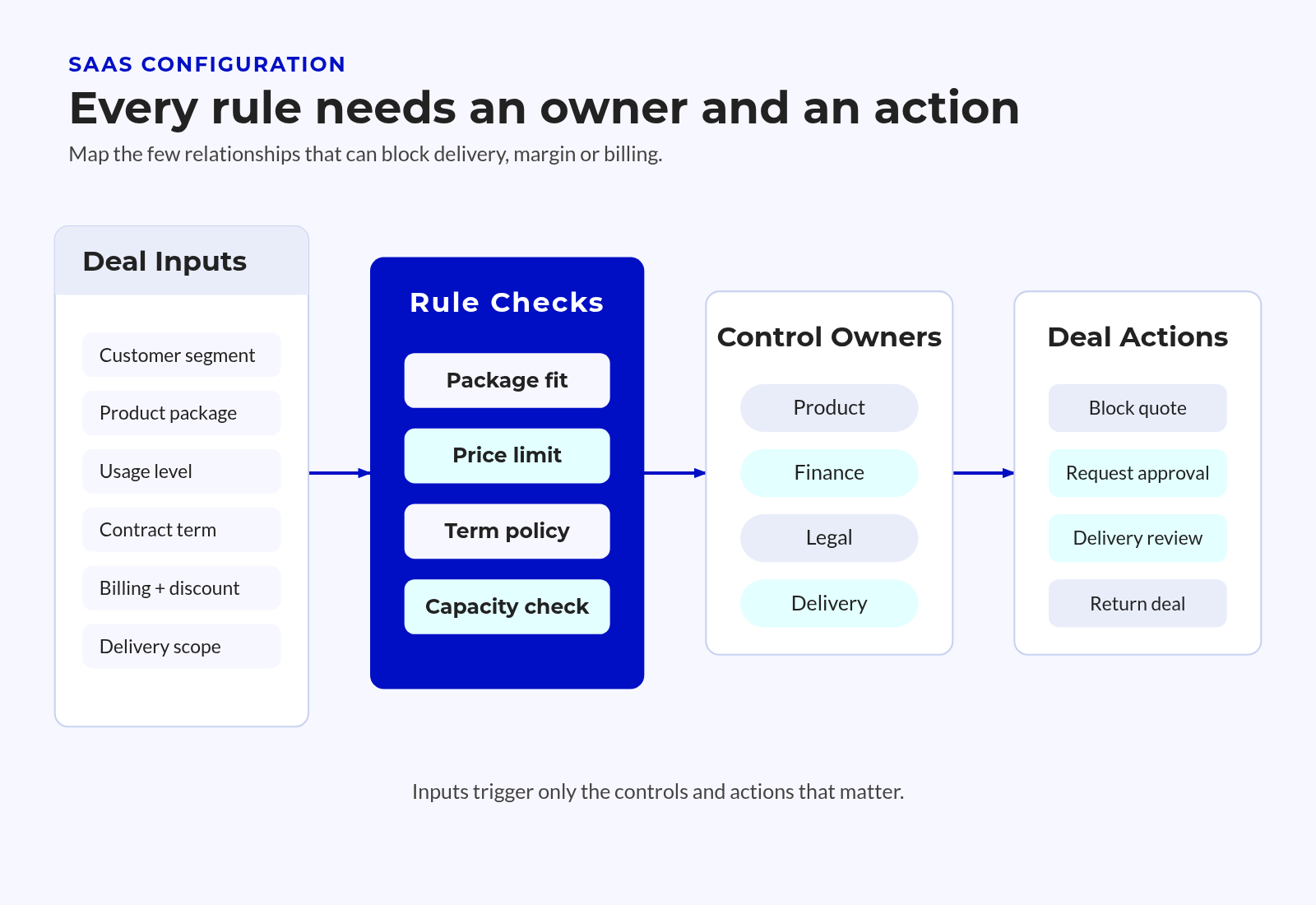
This map reveals which controls belong inside HubSpot. It also shows where specialist pricing, contract, billing, or configuration systems must contribute.
HubSpot Should Hold the Revenue Context
Configuration should not operate apart from the customer record. It needs account data, deal context, product details, approvals, and contract history.
That does not mean every rule must live in one platform. Each connected system needs a defined role and a reliable way to exchange data.
A practical ownership model can look like this:
- HubSpot owns customer and deal context
- Company, contact, opportunity, and pipeline data
- Seller activity and approval status
- The configuration layer owns selection logic
- Valid products and dependencies
- Required questions and blocked combinations
- Pricing controls own commercial calculations
- Price books, discounts, and approved exceptions
- Currency and market rules
- Billing owns invoicing events
- Billing frequency and payment schedules
- Usage records and invoice status
- Delivery owns fulfilment readiness
- Onboarding scope and start conditions
- Handoff data and service commitments
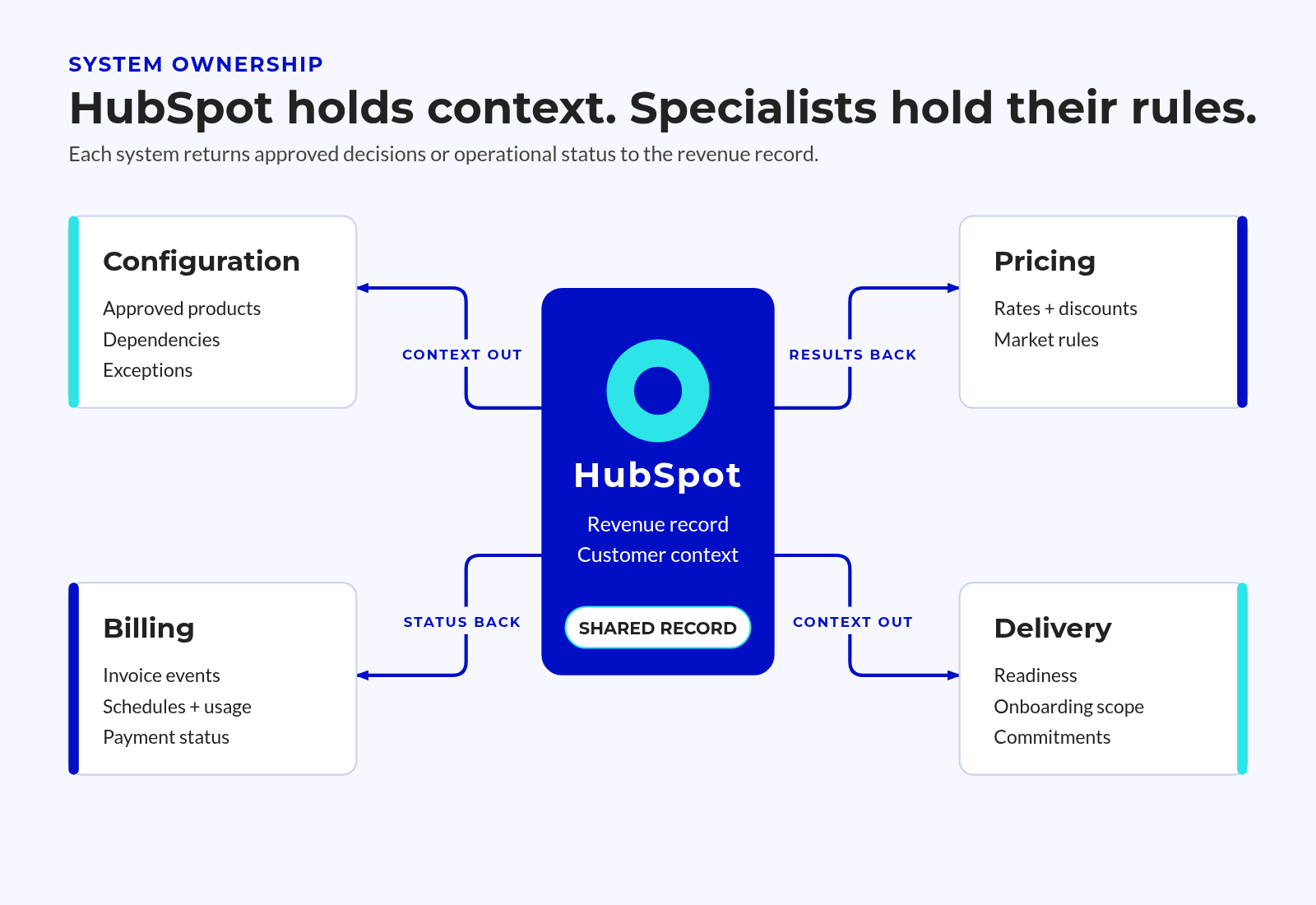
The configuration layer should receive the customer context required for each decision. It should return approved products, terms, exceptions, and rule results to the revenue record.
A connected process strengthens governance. RevOps can trace why a package was available, who approved an exception, and which terms reached the contract.
💡 Insight
The best SaaS configurator can look less impressive than an interactive product model. Its value appears in fewer corrections, cleaner approvals, and reliable handoffs.
Frequently Asked Questions
Senior buyers often ask whether their configuration problems justify another platform or a better revenue process. The answer depends on where incompatibility occurs and who must control it. These questions distinguish visual needs from commercial rule needs.
What is the Difference Between Visual CPQ and a Product Configurator?
A product configurator guides users toward a valid combination of products, components, or services. Visual CPQ adds an image or interactive model that changes with each choice. Every visual system needs configuration logic, but not every configurator needs visualization.
The right choice depends on whether seeing the result prevents physical errors or improves the buyer’s understanding.
Does a SaaS Company Need Visual CPQ?
Most SaaS companies do not need a visual product model because subscriptions have no physical shape or dimensions. They usually need rules controlling plans, add-ons, usage, discounts, terms, and services. A visual layer becomes useful when the offer includes layouts, physical equipment, designed assets, or another result that buyers must inspect.
Can HubSpot Manage Product Configuration Rules?
HubSpot can hold customer, deal, product, quote, and approval context. Its workflows can support many common commercial rules and route exceptions to the correct owner. Complex dependencies can require a dedicated configuration or pricing layer.
The design should keep HubSpot as the shared revenue record while each connected system controls its specialist logic.
How Should RevOps Choose the Right Configuration Approach?
Start by listing the errors that cause rework, margin loss, billing disputes, or delivery problems. Separate physical fit errors from commercial policy errors. Then map every rule to an owner, input, decision, and action.
This process reveals whether you need visualization, rules-based controls, workflow automation, or a combined approach.
For wider process context, review where configuration sits in the quote-to-cash lifecycle.
Conclusion
Visual CPQ solves a physical problem by showing whether selected parts, layouts, and finishes work together. Rules-based configuration controls invisible relationships across products, pricing, contracts, approvals, billing, and delivery.
The right model improves quoting without adding needless complexity. It raises deal quality, produces cleaner handoffs, strengthens governance, and helps teams build offers they can deliver.
Key Takeaways
- Product configurators turn expert knowledge into shared rules that guide valid selections.
- Visual configuration fits products where appearance, dimensions, or physical compatibility affect the buying decision.
- Most B2B SaaS companies need commercial controls rather than an interactive product model.
- HubSpot should preserve customer and deal context while connected systems manage specialist rules.
- A process-first design helps RevOps produce faster quotes and control downstream risk.
A governed quote-to-cash implementation in HubSpot connects configuration rules with approvals, contracts, billing, and delivery.