

August 2, 2026
8 min read
The value is simple: better revenue control while the function is still taking shape.
The timing matters because GTM teams face pressure from growth targets and tighter budgets.
Gartner found that marketing budgets flatlined at 7.7% of company revenue, which puts every operating choice under more scrutiny.
When budget gets tighter, leaders need cleaner systems before they add more tools or people.
The hard question is not whether external support can help. The hard question is whether your business needs judgment, ownership, or capacity. Once you name that need clearly, the right RevOps model becomes much easier to choose.
What Fractional RevOps Means
This section explains what the role owns, where it fits, and why it differs from admin support. It also sets the boundary between strategic design and daily execution.
The Role and Scope
A fractional RevOps leader helps align marketing, sales, and customer success around a shared operating model. That model usually covers lifecycle stages, lead routing, pipeline rules, attribution, reporting, and handoffs.
The work is part diagnosis and part operating design. It is not only about fixing fields in a CRM.
Common scope areas include:
- CRM audit and cleanup
- Lifecycle stage design
- Lead routing and handoff rules
- Pipeline governance
- Forecast process design
- Attribution and dashboard structure
- Sales and CS workflow improvement
- Tool selection and integration planning
A good fractional leader does not start with dashboards. They start with the operating problem behind the dashboard.
— Romeo Mann, Founder MAN Digital
Teams investing in revenue operations see more value when process comes before tooling.
What It is Not
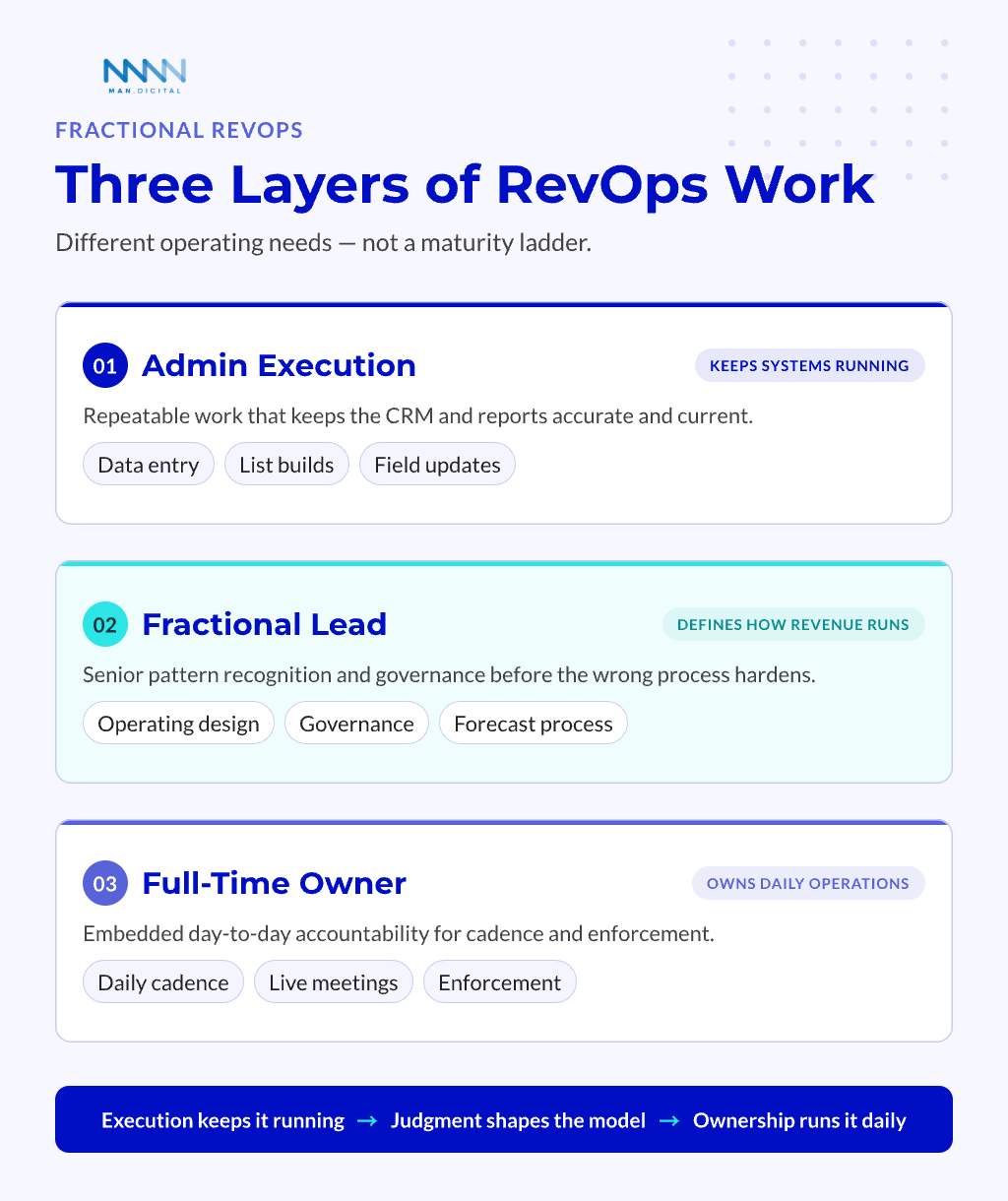
This model is not the same as hiring a virtual assistant, CRM admin, or tool consultant. Those roles can help, but they solve different problems. Admins keep systems running.
Senior RevOps leaders define how revenue work should run.
It is also not a magic fix for every backlog.
The model fits best when:
-
The problem crosses teams
- Marketing and sales use different lead definitions
- Reports do not match across functions
- Handoffs depend on personal judgment
-
The leadership team needs structure
- Forecast meetings lack clear inputs
- Pipeline reviews focus on stories, not evidence
- No one owns the operating cadence
-
The workload is real but uneven
- Some months need deep design
- Other months need light governance
- A full-time hire would sit underused
💡 Insight
The best use of fractional support is not extra hands. It is senior pattern recognition before the wrong process hardens.
For a deeper look, see our guide on the RevOps tools that support this work.
When Fractional RevOps Wins
The strongest fit appears when a company has grown past founder-led selling. Sales, marketing, and CS all need more structure, but the business can not have enough recurring work for a full-time RevOps role. This section shows the stage and workload signals that point toward external support.
Stage Signals in Europe
For European B2B SaaS and tech firms, the common fit zone is usually after the first GTM team forms. The company has several revenue functions, a growing CRM, and enough data to expose process gaps.
The pressure often shows up in simple ways.
Typical signals include:
- Sales leaders distrust forecast numbers
- Marketing questions lead quality feedback
- CS learns about risk too late
- CRM fields exist but teams use them differently
- Leaders cannot explain pipeline movement
- Regional teams follow different sales motions
This is where internal hiring can feel risky.
Public European research points to the same pattern. Many teams start with external senior support when the work is serious, but not yet daily.
Workload Signals That Matter
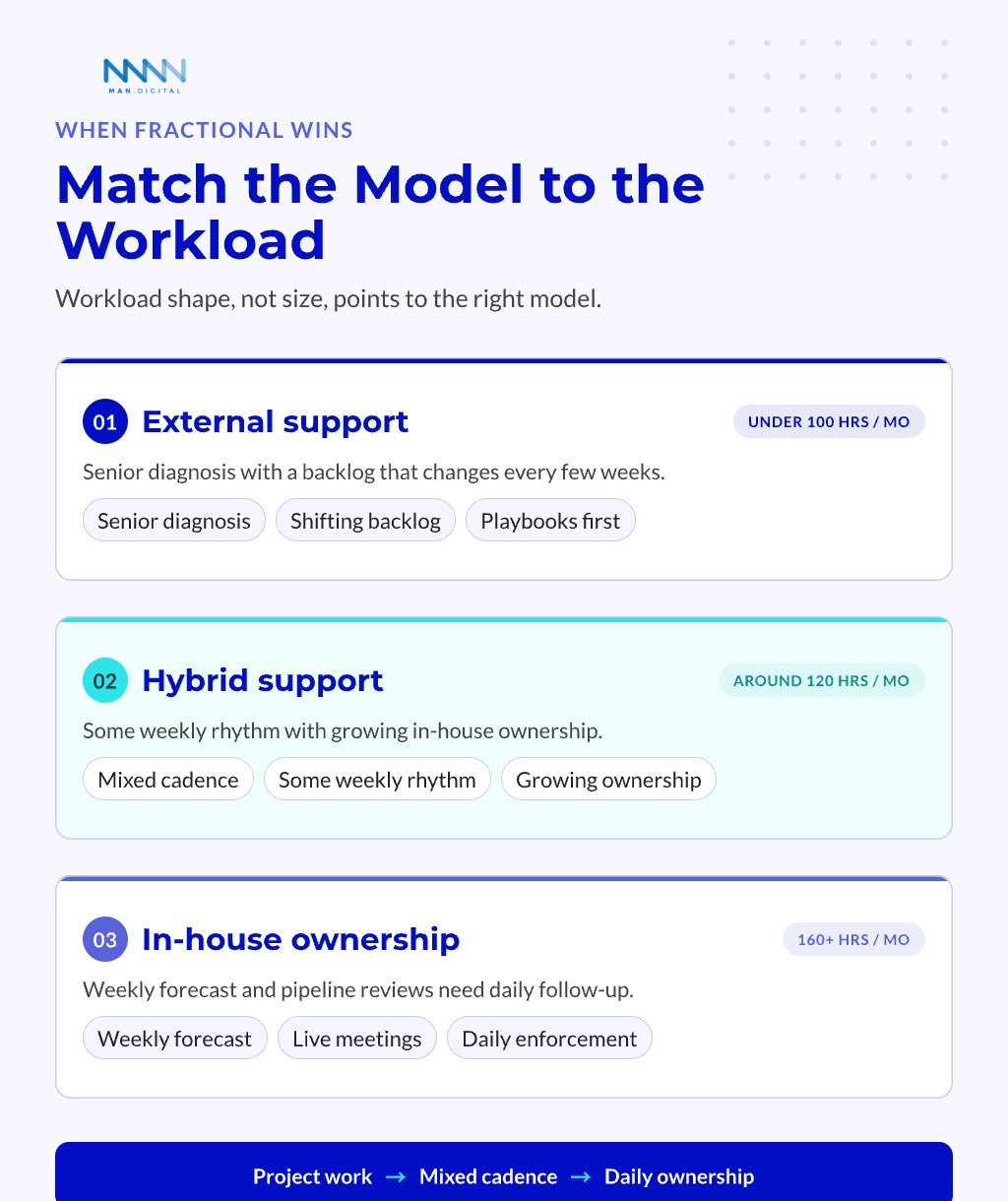
The clearest test is workload shape. If the need is project-shaped, external support usually makes sense. If the need becomes a daily rhythm, in-house ownership starts to win.
A simple planning rule helps.
Stay external while:
- RevOps work is under about 100 hours per month
- Leadership needs senior diagnosis
- The backlog changes every few weeks
- The company needs playbooks before headcount
Plan an in-house hire when:
- RevOps needs 120 to 160 hours each month
- Pipeline and forecast checks happen weekly
- Leaders need live meeting support
- Process enforcement needs daily follow-up
Use an agency or pod when:
- The roadmap is already clear
- The work needs several specialist skills
- Implementation speed matters more than diagnosis
- Data migration, integration, or automation dominates
💡 Tip
Separate the operating need from the task list. A long backlog does not always mean you need a full-time owner.
The Cost Model for Europe
Cost is not the only factor, but it changes the risk profile. Europe has wide labour cost variation, country rules, and local notice periods. This section compares the cost shape of fractional, pod, project, and in-house models.
Fractional Versus In-House Cost
Public pricing from the research set suggests a solo fractional RevOps leader often sits around €2.3k to €5.8k per month. Hourly pricing, where shown, often lands near €160 to €250 per hour.
Managed pods and RevOps agency retainers usually start higher. They often begin around €3.9k to €4.5k per month, then scale toward €12.5k or more. The difference is scope, not only seniority.
The operator research also shows that project-based work can range from quick audits to larger implementation builds in its pricing benchmark sheet. These bands help with planning, but they should not replace a scoped estimate.
| Model | Best Fit | Typical Cost Shape | Main Risk |
|---|---|---|---|
| Solo fractional leader | Senior diagnosis and governance | €2.3k to €5.8k monthly | Too little execution capacity |
| Managed pod | Defined implementation backlog | €3.9k to €12.5k+ monthly | Scope can spread |
| Full-time hire | Daily ownership and meetings | Salary plus employment load | Fixed cost too early |
| Project engagement | Audit or implementation sprint | €1.5k to €12k+ | Limited continuity |
The cost gap matters most before the operating model is stable. A fixed hire can be right later, but expensive early.
Hidden Costs and Tradeoffs
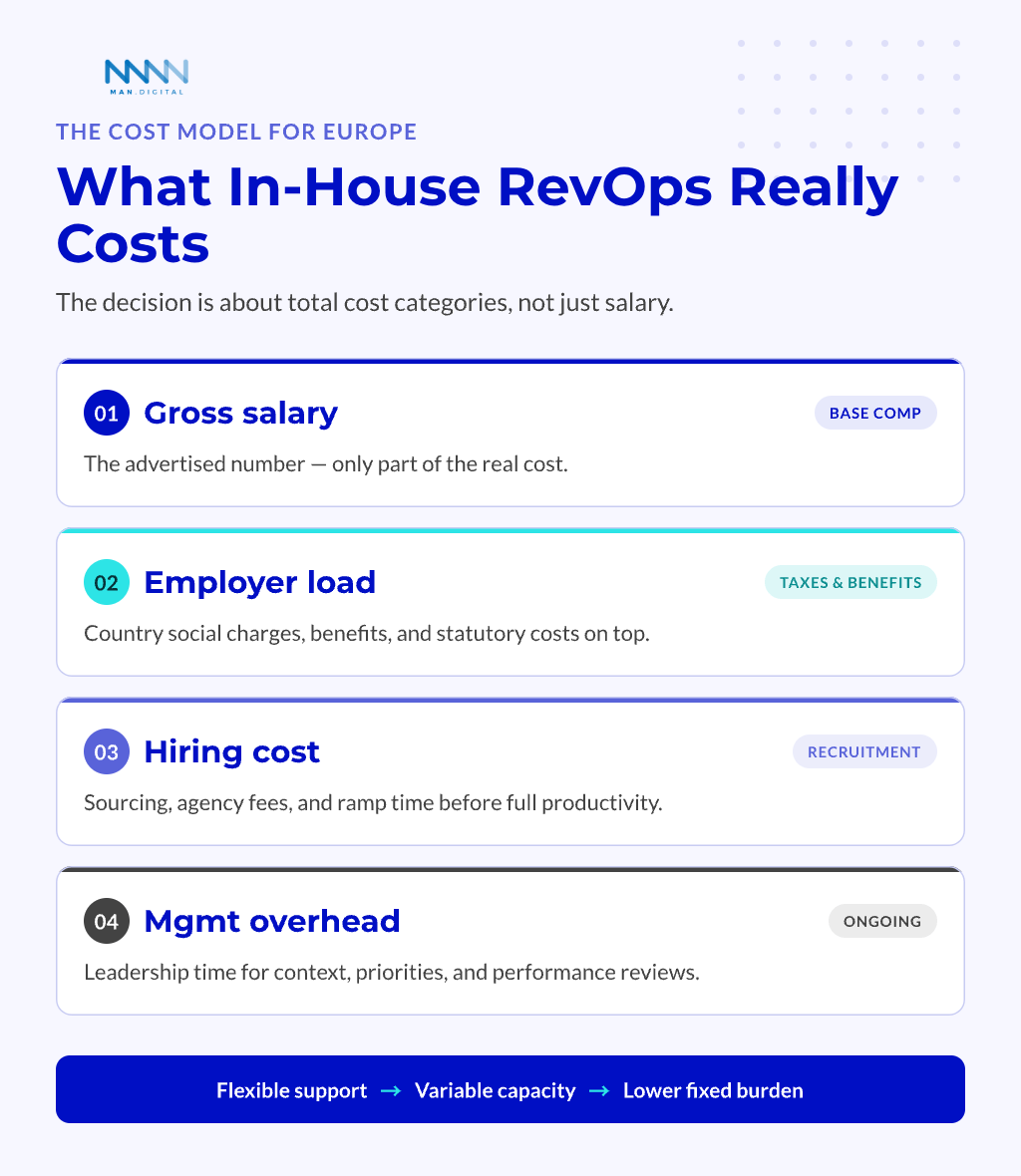
In-house RevOps also carries operational tradeoffs beyond salary. A new hire needs context, trust, clear priorities, and access to leadership decisions.
External support has tradeoffs too.
Fractional risks include:
-
Limited availability
- The person can support several clients
- Urgent requests need clear rules
-
Context gaps
- They need strong documentation
- Leadership must share real decision context
-
Scope drift
- Strategy can become admin work
- Projects can expand without clear priority
-
Dependency risk
- Knowledge must transfer inside the company
- Decisions need written playbooks
📊 Fact
A lower monthly cost does not make a model better. The right model is the one that matches the work shape, decision need, and operating risk.
Budget pressure makes RevOps design more important. Leaders need clean attribution, accepted lifecycle rules, and clear budget links.
A strong go-to-market framework gives those choices a wider operating context.
How to Choose the Right Model
The choice should not start with job titles. It should start with the business problem.
This section gives a practical decision model that separates senior judgment, recurring ownership, and execution capacity.
Judgment, Ownership, or Capacity
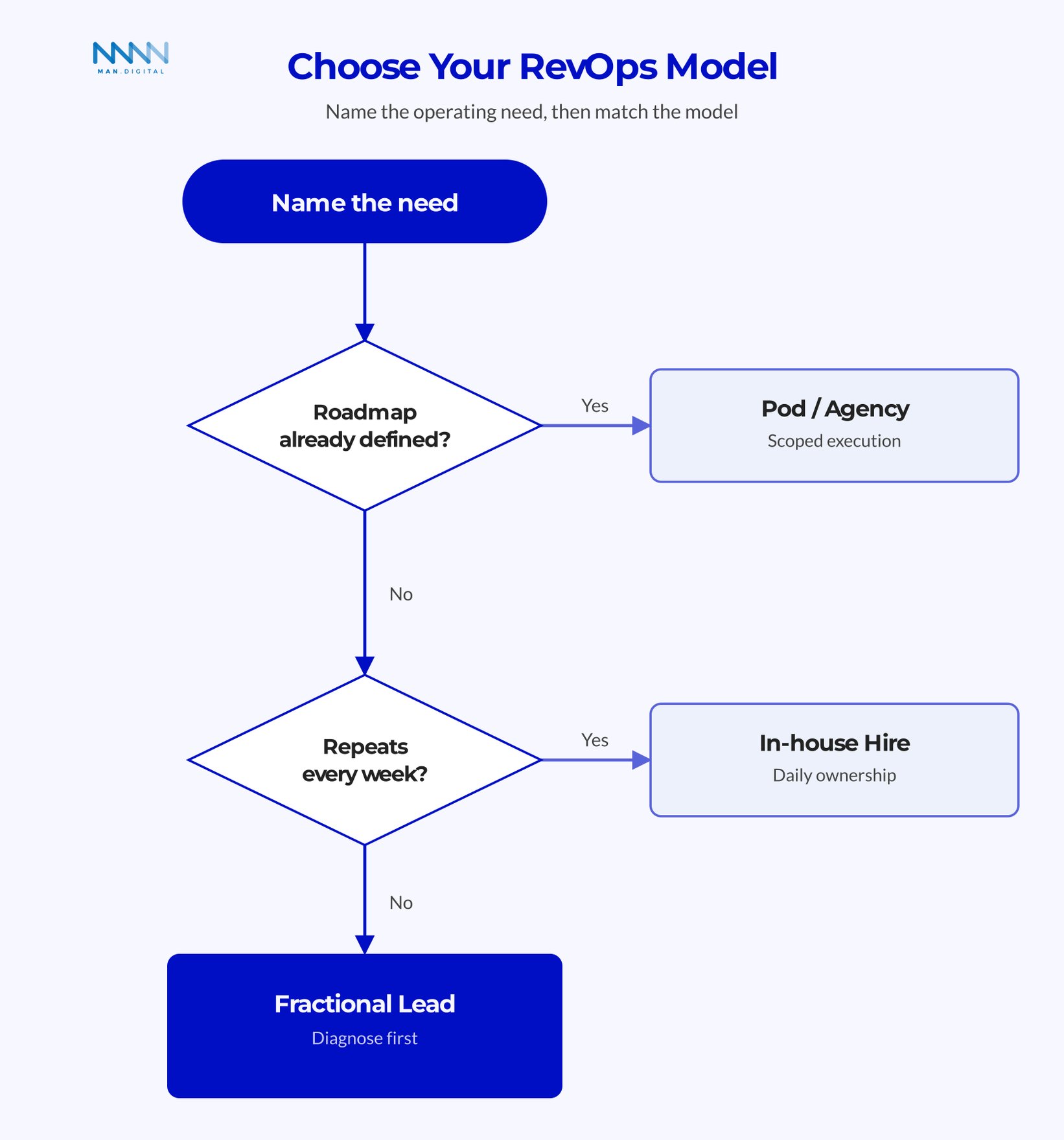
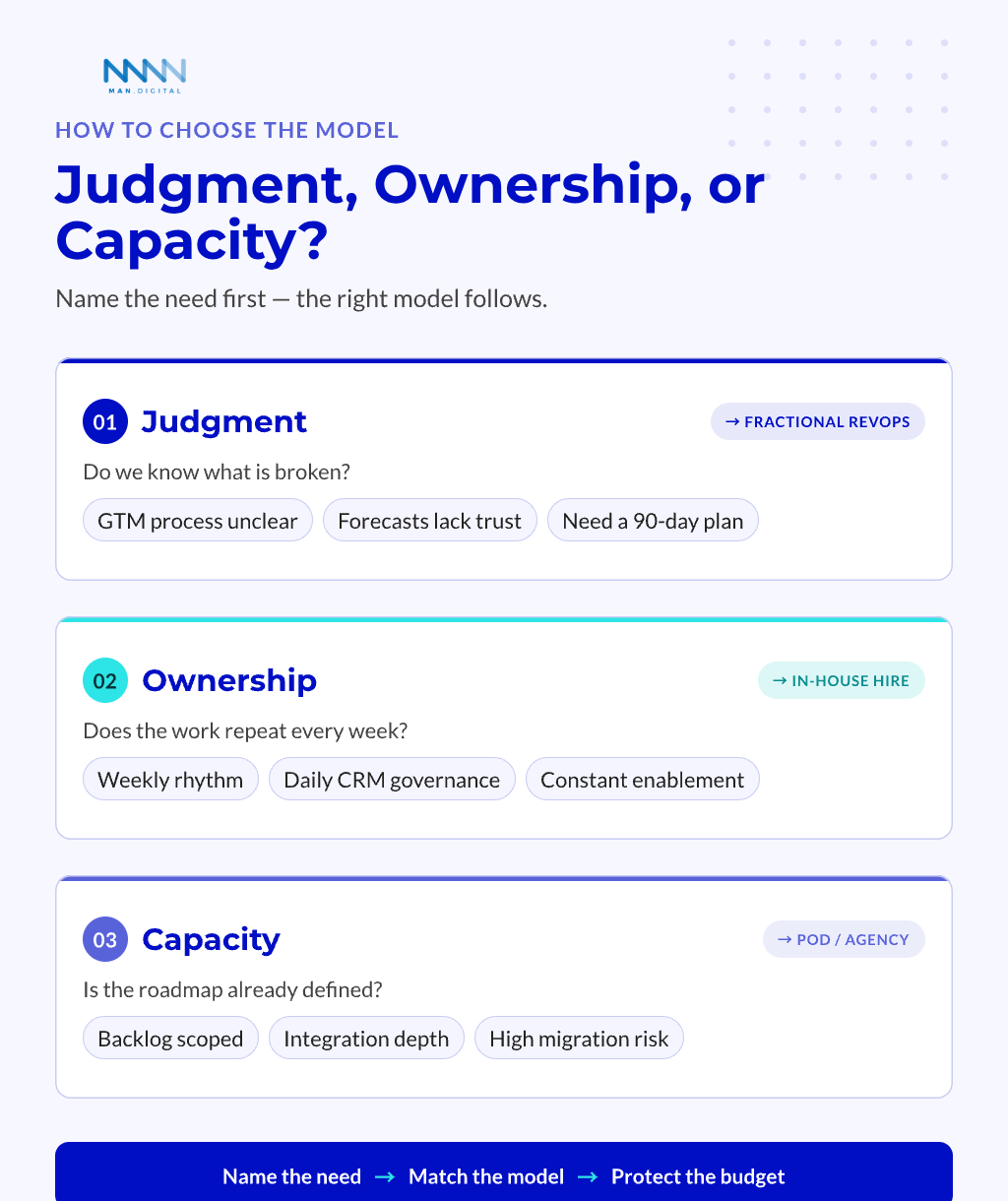
Use three questions before choosing a model.
Question one: Do we know what is broken?
If the answer is no, you need judgment. Fractional RevOps can diagnose the operating model, name the failure points, and sequence the work.
Question two: Does the work repeat every week?
If the answer is yes, you can need ownership. Weekly forecast meetings, pipeline hygiene, enablement checks, and routing reviews need someone close to daily operations.
Question three: Is the roadmap already defined?
If the answer is yes, you can need capacity. A managed pod or technical partner can move faster when the scope is clear.
This distinction protects the budget. It also keeps the company from blaming the wrong role for the wrong outcome.
The Decision Checklist
The right model should match stage, load, and risk. Use this checklist before signing a contract or opening a role.
Choose fractional support if:
- Your GTM process is unclear
- Leaders disagree on definitions
- Forecasts lack trust
- You need a 90-day operating plan
- The workload changes month by month
Choose in-house RevOps if:
- Weekly management rhythm depends on RevOps
- CRM governance needs daily enforcement
- The team needs constant enablement support
- Leadership decisions require deep context
- The workload is stable and full-time
Choose a pod or agency if:
- You need speed across many tasks
- The backlog is already scoped
- Integration work needs technical depth
- Migration risk is high
- You need several skills at once
Forecast quality is a good stress test. Forecast accuracy remains one of the most persistent challenges sales leaders report, and it usually traces back to weak inputs rather than effort. If your issue is bad inputs, fix the process before hiring more analysts.
A clean HubSpot data model also matters here. Poor object design can turn routing, reporting, and attribution into constant repair work.
This is why RevOps leaders should understand the HubSpot data model before changing automation.
How to Make Fractional RevOps Work
The model works best when it has a clear operating cadence. Without cadence, external support becomes a stream of calls, tasks, and loose advice. This section shows how to structure the first 90 days and keep accountability clear.
Build the First 90 Days
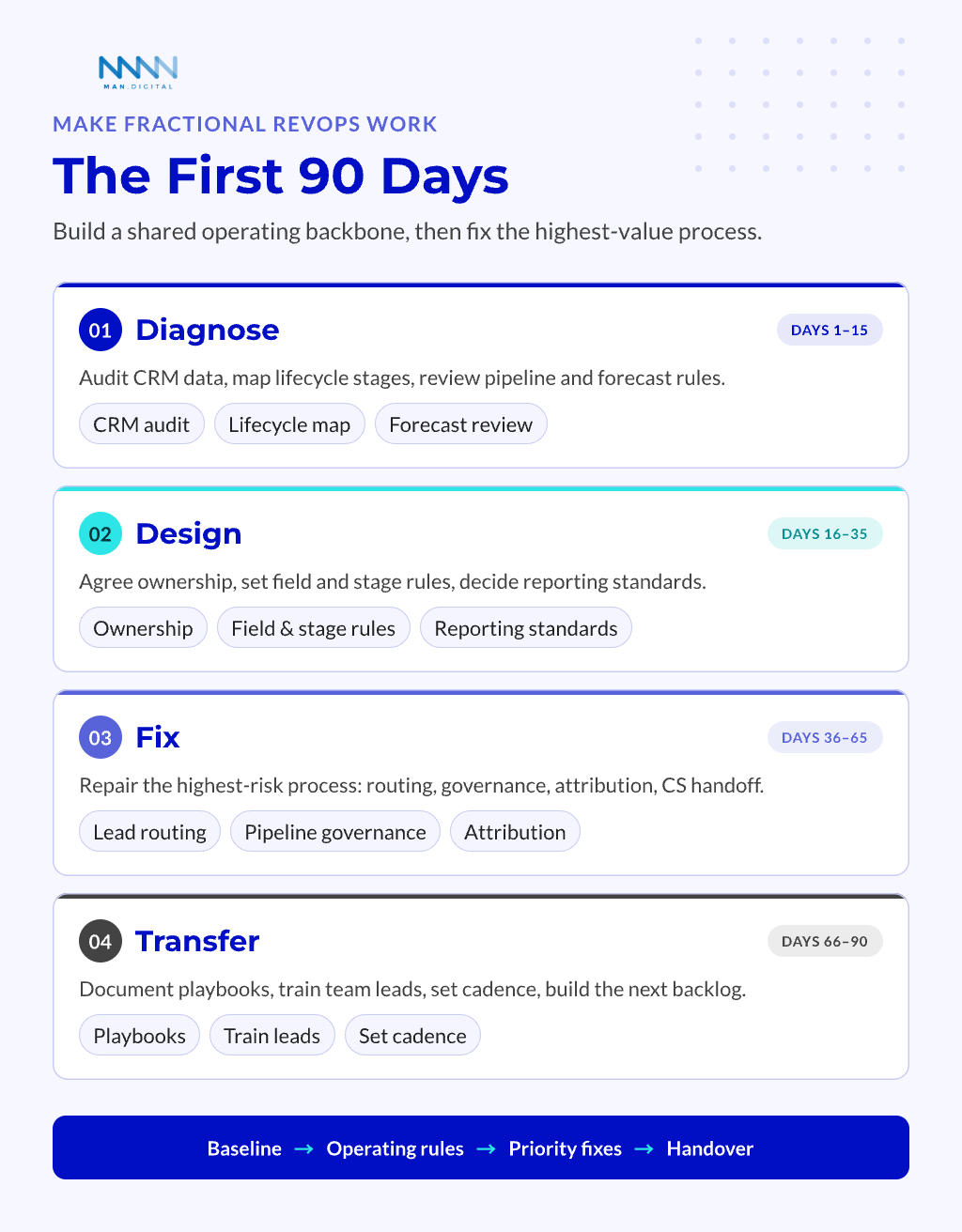
A strong first 90 days should produce a clear operating backbone. It should not try to fix every workflow at once. The goal is to create shared truth, then improve the highest-value process first.
A practical first 90-day plan:
-
Days 1 to 15: Diagnose the current state
- Audit CRM data quality
- Map lifecycle stages
- Review pipeline and forecast rules
-
Days 16 to 35: Define the operating model
- Agree on ownership
- Set field and stage rules
- Decide reporting standards
-
Days 36 to 65: Fix the highest-risk process
- Lead routing
- Pipeline governance
- Attribution reporting
- CS risk handoff
-
Days 66 to 90: Transfer control
- Document playbooks
- Train team leads
- Set meeting cadence
- Build the next backlog
This sequence keeps the work grounded. It also makes success easier to judge.
Set Cadence and Accountability
Cadence turns external advice into operating rhythm. The fractional leader should join the right meetings, own the right artifacts, and report progress in plain terms.
Useful operating artifacts include:
- RevOps backlog
- Data dictionary
- Lifecycle map
- Routing rules
- Forecast process notes
- Dashboard source map
- Weekly status update
📝 Note
The fractional leader should not become the only person who understands the system. Every major decision needs a written rule, owner, and review date.
HubSpot Operations Hub can support this work through data sync, automation, and programmable workflows. The platform matters less than the design, but the right operations layer helps teams turn rules into action through HubSpot operations tools.
Lead routing is a useful first test. If routing rules are unclear, every campaign creates sales friction. A practical lead routing model shows whether the operating rules are clear enough to automate.
Frequently Asked Questions
What is fractional RevOps?
A fractional RevOps leader helps align marketing, sales, and customer success around a shared operating model covering lifecycle stages, lead routing, pipeline rules, attribution, reporting, and handoffs. The work is part diagnosis and part operating design, not only fixing fields in a CRM.
When does fractional RevOps make more sense than a full-time hire?
It fits best after a company grows past founder-led selling and needs senior structure, while RevOps work stays under about 100 hours per month and the backlog changes every few weeks. Once the work becomes a weekly rhythm of forecast and pipeline reviews, in-house ownership starts to win.
How much does fractional RevOps cost in Europe?
Public pricing suggests a solo fractional RevOps leader often runs about €2.3k to €5.8k per month, or roughly €160 to €250 per hour. Managed pods and agency retainers usually start higher, from around €3.9k and scaling toward €12.5k or more depending on scope.
What is the difference between fractional RevOps and a CRM admin?
A CRM admin or virtual assistant keeps systems running and handles repeatable execution. A senior fractional RevOps leader defines how revenue work should run across teams, including lifecycle design, governance, and forecasting. They solve different problems: execution capacity versus senior operating judgment.
How do I choose between judgment, ownership, and capacity?
Ask three questions. If you do not know what is broken, you need judgment, which points to fractional RevOps. If the work repeats every week, you need ownership, which points to an in-house hire. If the roadmap is already defined, you need capacity, which points to a pod or technical partner.
What should the first 90 days of a fractional RevOps engagement deliver?
A clear operating backbone rather than a fix for every workflow. Days 1 to 15 diagnose the current state, days 16 to 35 define the operating model, days 36 to 65 fix the highest-risk process, and days 66 to 90 transfer control through playbooks, training, and a set meeting cadence.
Conclusion
Fractional RevOps helps growing B2B teams create cleaner revenue execution before they commit to a permanent function. It can turn scattered CRM work into a shared operating model, support better decisions, and improve trust across marketing, sales, and customer success.
The best model depends on the real need. External support fits senior judgment, in-house RevOps fits daily ownership, and a pod fits defined execution capacity. That clarity leads to stronger RevOps decisions and a more durable GTM engine.
Key Takeaways
- Fractional RevOps fits best when the company needs senior judgment, but not full-time daily ownership.
- In-house RevOps wins when governance, forecasting, and enablement become recurring management work.
- European hiring costs make early fixed headcount riskier, so flexible support can protect budget.
- The best engagements start with diagnosis, then move into one focused process fix.
- Success comes from cleaner decisions, stronger cadence, and better revenue trust across teams.